 listicle
Best Statement Pieces for Modern Living: 2026 Guide
Table of Contents
- What Makes a Statement Piece (and Why Modern Living Needs One)
- Best Statement Pieces for Modern Living: Quick Comparison
- How to Style Abstract Sculptures in Living Room Spaces
- Modern Resin Decor Ideas That Add Instant Drama
- Minimalist Statement Furniture: When Less Is More
- Sculptural Lighting: The Overhead Focal Point
- Balancing Bold Pieces with Neutral Decor and Proportion
- Small-Space Statement Styling: Big Impact, Compact Footprint
- Budget-Friendly and Sustainable Statement Design
- Conclusion: Choosing Pieces That Reflect Your Style
- Frequently Asked Questions
Last Updated: September 22, 2026
What Makes a Statement Piece (and Why Modern Living Needs One)
Statement pieces are single design elements that command attention and anchor a room's visual identity. It can be a sculpture, a light fixture, a chair, or a mirror, but it always does one job: it gives the eye somewhere to land.
That matters more than ever in modern living. Open floor plans and neutral finishes have made many homes feel calm but forgettable. A well-chosen piece fixes that without a full redesign. This guide from Your Decor Essentials walks through categories of statement pieces, how to style them, and how to avoid the mistakes that make bold decor look chaotic.
The 3-3-3 Rule for Statement Decor
The 3-3-3 rule keeps a room balanced: three textures, three heights, three neutral tones. A resin sculpture on a wood console beside a ceramic vase hits the texture count. Stacking low, mid, and tall objects covers height. Keeping walls, sofa, and rug in related neutrals gives the bold piece room to breathe.
Best Statement Pieces for Modern Living: Quick Comparison
Here is the short version. Each category below solves a different problem, so pick by room need rather than by trend.
| Piece Type | Best For | Style Fit | Effort to Style |
|---|---|---|---|
| Abstract sculpture | Console tables, shelves | Minimalist, bohemian | Low |
| Resin decor accents | Coffee tables, mantels | Contemporary, eclectic | Low |
| Sculptural furniture | Seating focal points | Mid-century modern, curated | Medium |
| Statement lighting | Dining and living ceilings | Warm minimalism | High |
| Oversized mirrors | Small or dark rooms | Any neutral palette | Medium |
How to Style Abstract Sculptures in Living Room Spaces
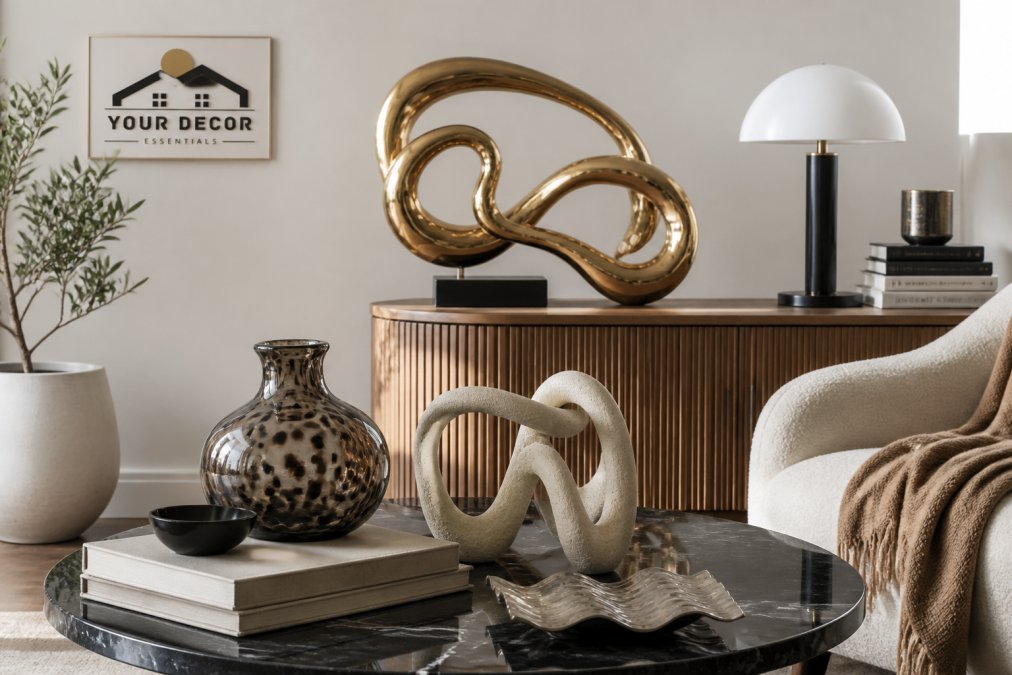
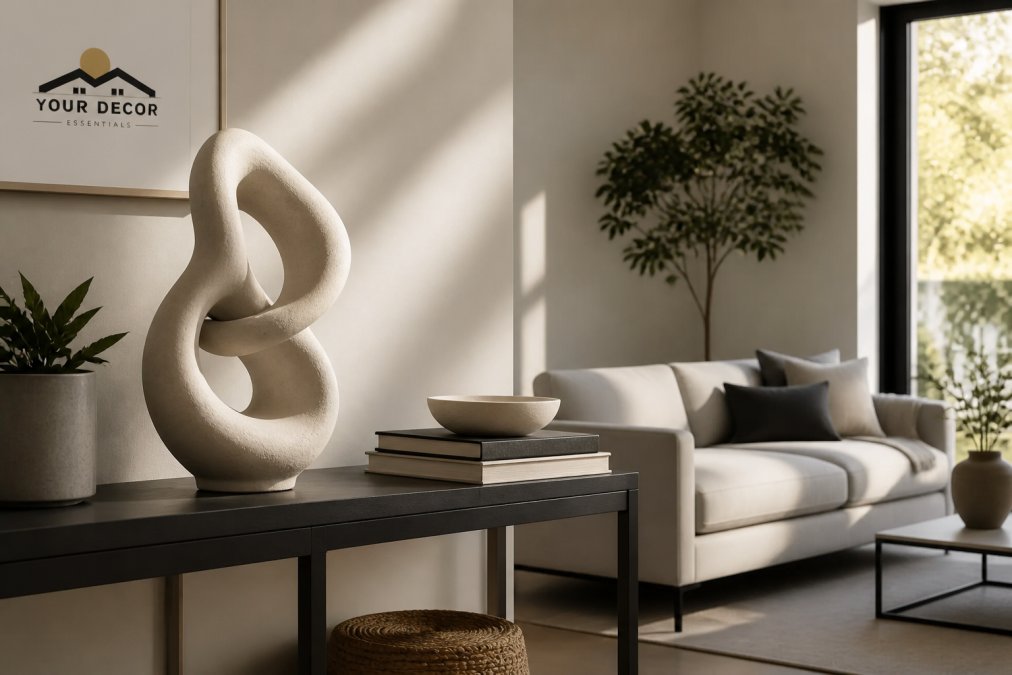
Knowing how to style abstract sculptures in living room spaces comes down to placement, height, and restraint. One piece placed with intent beats five pieces clustered together.
Start with a surface that gets seen daily: a console behind the sofa, a coffee table, or an open shelf at eye level. Give the sculpture clear space around it. Curved lines need negative space to read as deliberate rather than accidental.
Placement Rules for Maximum Impact
- Put the piece at roughly eye level when seated, not on the floor
- Leave at least one hand-width of empty space on each side
- Pair with one lower object, never a matching pair of the same height
- Avoid backlighting that flattens the silhouette
- Rotate seasonal pieces rather than adding more
Modern Resin Decor Ideas That Add Instant Drama
Modern resin decor ideas work because resin holds sharp curves and deep matte finishes that ceramic and stone often cannot. That flexibility lets a single accent carry a whole shelf.
Resin also handles color in ways that suit a neutral palette. A matte black or bone-white piece reads as sculptural rather than decorative. On a coffee table, an organic-shaped resin tray corrals remotes and candles while adding texture to a flat surface.
Minimalist Statement Furniture: When Less Is More
Minimalist statement furniture earns its name through form, not ornament. A sculptural wood chair with visible joinery and a clean silhouette does more for a room than a busy upholstered piece ever will. But the difference between a piece that reads as art and one that reads as filler comes down to three things: material honesty, joinery, and proportion.
Material honesty means the piece does not pretend to be something it is not. Solid white oak, black walnut, and ash are the workhorses of minimalist statement furniture because their grain patterns do the decorative work that carving or appliqué would do on a busier piece. Look for furniture where the joinery is visible and intentional, through-tenons, dovetails, and exposed dowels are not flaws; they are the design. A chair with a visible through-tenon at the arm joint tells you the maker trusted the wood to hold, not a hidden screw.
Joinery is also your best clue about longevity. Mortise-and-tenon and dovetail joints are repairable; stapled and glued particleboard is not. If you are buying a statement chair or console, ask what the primary joinery is. A solid-wood piece with traditional joinery can offer lasting quality.
Small-Space Statement Furniture
In an apartment or micro-living space, the statement piece has to earn its footprint by doing two jobs. A sculptural side table that also holds a lamp and a book is a statement. A bench that doubles as entryway storage is a statement. A chair that is only a chair is a luxury of square footage most small rooms cannot afford.
Vertical proportion matters more than width in a small room. A tall, narrow console or a slender floor lamp uses floor area the size of a dinner plate while still reading as a focal point. Wall-mounted shelving and floating consoles free the floor entirely, which makes the room feel larger even though the piece is bold.
Sustainable and Eco-Conscious Choices
Solid wood, natural stone, plaster, and well-made ceramic age better than trend-driven composites, so they stay in a room longer instead of being replaced. That longevity is the most practical form of sustainability in furniture.
- Shop vintage and estate sales for one-of-a-kind chairs, consoles, and mirrors
- Choose solid wood and natural materials over veneer where the budget allows
- Look for FSC-certified wood if you are buying new
- Refinish or reupholster a secondhand piece instead of buying new
- Avoid resin-heavy composites for large furniture; they are hard to repair and rarely recyclable
A common mistake is treating a sculptural chair as pure decor and hiding it in a corner. Put it where it gets used. A piece that is sat in looks intentional; a piece that is avoided looks like clutter.
Sculptural Lighting: The Overhead Focal Point
Sculptural lighting is the fastest way to change how a room feels after dark. A chandelier or pendant becomes the focal point the moment the sun goes down, so it should be chosen with the same care as any sculpture. But a fixture that looks right in a showroom can fail in a real room if the height, drop, and light output are wrong.
The Numbers That Matter
Ceiling height drives everything. In a room with an 8-foot ceiling, a pendant should hang so the bottom of the fixture sits about 30 to 36 inches above a dining table or kitchen island. In a room with a 9- or 10-foot ceiling, that distance can stretch to 36 to 40 inches. For open living areas where people walk under the fixture, keep the bottom of the pendant at least 7 feet off the floor.
Fixture drop is the distance from the ceiling to the bottom of the fixture. Most guides skip this, and it is the number one reason statement lighting ends up returned. Measure your ceiling height, subtract the recommended clearance, and subtract the fixture height. That number is your maximum drop. If the fixture's drop exceeds it, the piece will crowd the room no matter how beautiful it is.
Light output matters too. For a dining room, aim for about 30 to 40 lumens per square foot of floor area. For a living room used mostly in the evening, 10 to 20 lumens per square foot is usually enough. Color temperature should sit between 2700K and 3000K for a warm, residential feel; anything above 3500K reads as commercial or clinical. Dimming is non-negotiable for a statement fixture, a bold piece at full brightness every night becomes tiresome, while the same piece dimmed to 30 percent becomes atmosphere.
Shapes and Materials
Cloud-shaped and ring-style fixtures suit high ceilings and open plans. A cascading multi-tier pendant adds movement and shadow play to a plain dining area. Plaster and matte finishes keep the look soft; polished metal pushes it sharper. For a small room, a single sculptural flush-mount or a slim linear pendant reads as a statement without eating vertical space.
Sustainable Lighting Choices
LED fixtures with replaceable bulbs and drivers last far longer than sealed integrated units, and they can be repaired instead of replaced. Look for fixtures made from recycled metal, FSC-certified wood, or natural materials like linen and paper. Avoid fixtures with non-replaceable LED arrays; when the light fails, the whole piece becomes waste.
Check ceiling height and fixture drop before ordering. Most guides skip this, and it is the number one reason statement lighting ends up returned.
Balancing Bold Pieces with Neutral Decor and Proportion
Balance is about visual weight, not symmetry. A heavy, dark sculpture on one side of a console needs a lighter, taller object on the other to keep the arrangement from tipping.
Proportion follows the same logic. An oversized mirror or floor sculpture in a small room can work, but only if the surrounding furniture stays low and quiet. Scale the piece to the wall, not to the furniture. A large piece on a small wall crowds the room; the same piece on a full wall anchors it.
Small-Space Statement Styling: Big Impact, Compact Footprint
Small rooms can carry bold pieces, but the piece has to do more than one job. A sculptural side table, a mirror that bounces light into a dark corner, or a lamp that doubles as art all earn their footprint.
Vertical space is your friend. A tall, narrow sculpture uses floor area the size of a dinner plate while still reading as a statement. Wall-mounted pieces and floating shelves free up the floor entirely.
Keep the count low. One strong piece in a small room reads as designed; three read as crowded. Let the piece be the only loud thing in the space.
Budget-Friendly and Sustainable Statement Design
You do not need a designer budget to make a room feel curated. The trick is spending on one piece that carries the room and saving on everything around it.
Sustainable choices overlap heavily with good design here. Solid wood, natural stone, plaster, and well-made ceramic age better than trend-driven composites, so they stay in a room longer instead of being replaced.
- Shop vintage and estate sales for one-of-a-kind sculptures and mirrors
- Choose solid wood and natural materials over veneer where the budget allows
- Repaint or refinish a secondhand piece instead of buying new
- Group three small affordable accents into one arrangement rather than one expensive piece
For readers who want a curated starting point, Your Decor Essentials focuses on abstract sculptures, resin accents, and functional lighting, which covers the three categories that deliver the most visual change per dollar.
Conclusion: Choosing Pieces That Reflect Your Style
The hardest part of statement decor is not finding a bold piece. It is choosing one that still feels right over time. Buy for proportion, material, and how the piece makes you feel in the room, not for what is trending this season.
Your Decor Essentials curates abstract sculptures, resin accents, stylish furniture, and functional lighting designed to introduce visual interest and reflect a more distinctive, thoughtfully styled look. Each piece is chosen to help you build a personalized interior rather than a catalog copy.
Get started with Your Decor Essentials and find the piece that finally makes your space feel finished.
Frequently Asked Questions
What defines a statement piece in interior design?
A statement piece is any decor element that commands attention through scale, color, texture, or form. It acts as a focal point, anchoring a room's design and expressing personal style. Examples include oversized abstract sculptures, bold lighting fixtures, or sculptural furniture. The key is that it stands out while still complementing the surrounding decor.
How do you style abstract sculptures in a living room?
Place abstract sculptures on a console, coffee table, or shelf where they can be viewed from multiple angles. Use negative space around them to let their form breathe. Pair with neutral backgrounds to highlight their shape. For larger pieces, consider floor placement near a window or architectural feature. Group smaller sculptures in odd numbers for visual balance.
How many statement pieces should you have in one room?
A good rule is one to two statement pieces per room. Too many competing focal points create visual clutter. Choose one large piece, like a sculptural chandelier or a bold mirror, and one smaller accent, such as a resin sculpture. This balance keeps the space curated without overwhelming the eye.
What are the best materials for modern statement decor?
Resin, ceramic, plaster, and natural stone are popular for modern statement decor. Resin offers versatility in shape and color, while ceramic and plaster provide organic textures. Wood and metal are common in furniture. Each material brings a distinct aesthetic, so choose based on the mood you want to create.
Where should you place statement decor for maximum impact?
Place statement decor where it naturally draws the eye: entryways, above a sofa, or on a mantel. In living rooms, a sculptural light fixture or a large mirror can anchor the space. For smaller pieces, a console table or bookshelf works well. Ensure the piece is proportional to the wall or surface it occupies.