 listicle
Luxury Abstract Sculptures for Home Decor: 2026 Guide
Table of Contents
- Why Luxury Abstract Sculptures Define Modern Home Decor
- Quick Comparison: Top Luxury Abstract Sculptures for 2026
- How to Style Abstract Sculptures in Living Room Spaces
- Choosing a Modern Abstract Sculpture for Coffee Table Display
- Luxury Resin Accent Pieces: Materials That Matter
- Lighting Techniques for Sculptures: Making Form Visible
- Handcrafted vs. Mass-Produced: What You're Actually Paying For
- Investment and Value Assessment for Abstract Art
- Conclusion: Building a Curated Sculpture Collection
- Frequently Asked Questions
Last Updated: September 21, 2026
Why Luxury Abstract Sculptures Define Modern Home Decor
Walk through any well-designed home in 2026 and you'll notice something missing: matching sets. The rooms that feel intentional, the ones people photograph for design roundups, almost always feature one piece that refuses to blend in. That piece is usually a luxury abstract sculpture.
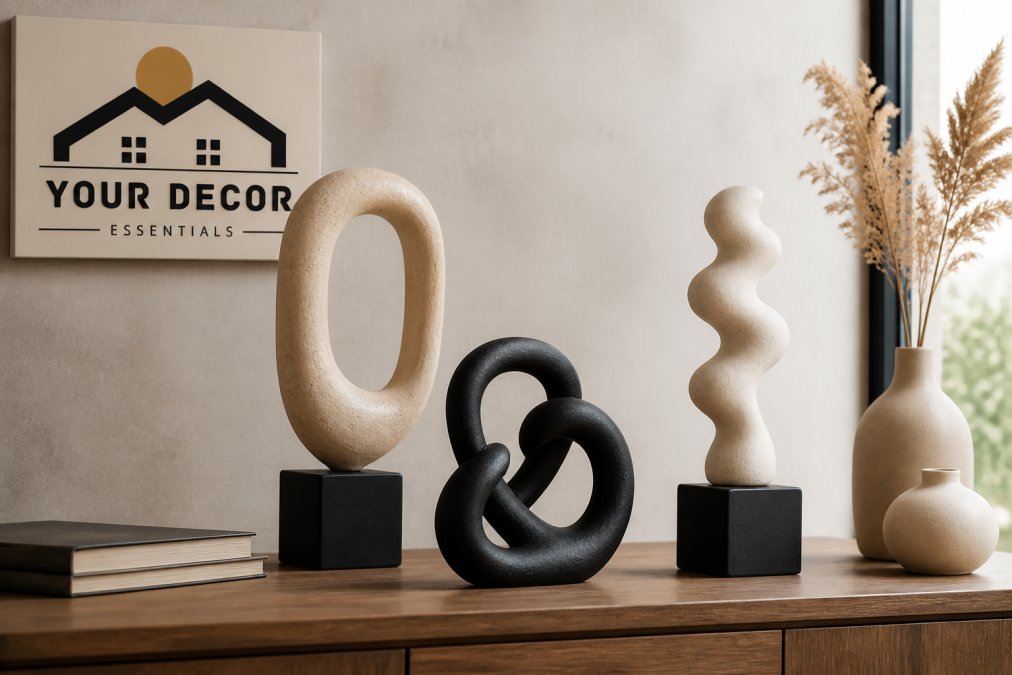
Luxury abstract sculptures for home decor are three-dimensional artworks defined by non-representational form, meaning they don't depict a person, animal, or object. Instead, they rely on fluid lines, geometric shapes, and textural contrast to create visual interest. This guide from Your Decor Essentials breaks down how to choose, style, and evaluate these pieces like a designer would.
Here's the tension most buyers don't see coming. A sculpture isn't furniture. You can't sit on it, store anything in it, or justify it by function alone. It earns its place through visual weight, spatial composition, and the way it anchors a room's mood. Get that right, and a single piece can do more for a space than a full furniture refresh.
Below, we'll cover the top pieces worth considering in 2026, how to style them room by room, and what separates a genuine investment from an expensive mistake.
Quick Comparison: Top Luxury Abstract Sculptures for 2026
The best luxury abstract sculptures balance material quality, scale, and finish. Here's how the leading options compare at a glance.
| Sculpture | Starting Price | Material | Best For |
|---|---|---|---|
| Your Decor Essentials Collection | Visit site for pricing | Resin, mixed media | Curated styling with guidance |
| Signature Design by Ashley Melinda | $55.60 | Metal | Affordable metallic accent |
| Artmellows 3D Custom | $450.00 | Resin composite | Personalized bespoke pieces |
| Aqua Handcrafted Art Glass | $102.97 | Handcrafted glass | Color and light play |
| Homary Floor Statues | $119.99 | Composite or metal | Large-scale statements |
| Amazon Resin Statues | $25.00 | Resin | Budget styling updates |
1. Your Decor Essentials Collection, Best Overall for Curated Styling
Our top pick is our own curated collection, and the reason is simple: most people buying abstract sculptures aren't designers. They need pieces that work together, not a random assortment of shapes that clash. Your Decor Essentials curated home decor
The collection centers on abstract sculptures and resin accents, alongside functional lighting that transforms how a room reads after dark. Instead of guessing whether a piece will match your existing furniture, you're choosing from a selection already vetted for visual cohesion. Our distinctive collection helps you create personalized interiors with thoughtful details, ensuring your home stands out with a sophisticated and artful touch.
2. Signature Design by Ashley Melinda Metal Sculpture
At $55.60, this 20-inch black and gold metal piece is the affordable entry point. The abstract geometric design suits a coffee table or bookshelf, and the dual-tone finish pairs with most neutral palettes. The limitation: fixed dimensions mean it won't fill a large console.
3. Artmellows 3D Custom Decor Sculptures
Starting at $450, Artmellows creates bespoke 3D-printed pieces from your own photographs. It's the most personalized option here, and the price reflects that. If you want something no one else owns, this delivers. If you want speed and simplicity, look elsewhere.
4. Aqua Handcrafted Art Glass Sculpture
Priced at $102.97, this handcrafted glass piece brings translucent color depth and organic form. It reflects light beautifully on a mantel. Glass is fragile, so placement matters more than with metal or resin.
5. Homary Modern Abstract Floor Statues
Starting at $119.99, these large-format statues fill empty corners and entryways. High visual impact, frequent sales. The tradeoff is floor space, which small apartments don't have to spare.
6. Amazon Modern Resin Abstract Art Statues
At $25 and up, these are the budget option. Lightweight resin, compact sizing, easy to clean. What most guides miss is that resin at this price often lacks the weight and finish of luxury pieces, so they read as accessories rather than art.
How to Style Abstract Sculptures in Living Room Spaces
Styling an abstract sculpture in a living room is not about finding a pretty spot. It is about applying three design principles that most product pages never explain: scale, balance, and negative space. Get these right and a single piece can anchor an entire room. Get them wrong and even an expensive sculpture looks like clutter.
Scale: The 1/3 Rule and Sightlines
A sculpture should relate to the furniture beneath it, not float in isolation. A common guideline among interior designers is that a tabletop sculpture should be roughly one-third the width of the surface it sits on. On a 60-inch console, that means a piece around 20 inches wide. On a 36-inch sideboard, aim for 12 inches.
Height matters too. For a coffee table, the sculpture should not rise above the eye level of a seated guest, generally under 16 inches, or it blocks conversation. For a console or mantel, the piece can rise higher because it is viewed from a distance.
Balance: Visual Weight, Not Just Size
Visual weight is how much attention a piece commands based on color, density, and contrast. A dark bronze or black metal sculpture carries more visual weight than a pale resin piece of the same dimensions. A glossy finish reflects light and feels lighter; a matte finish absorbs light and feels heavier.
Balance a heavy piece with lighter surrounding objects, a stack of pale books, a clear glass vase, a low ceramic bowl. If everything on the surface is dark and dense, the arrangement feels bottom-heavy. If everything is light and airy, the sculpture disappears.
Negative Space: Let the Piece Breathe
Negative space is the empty area around a sculpture. Most beginners crowd it. A useful rule: leave at least the sculpture's own width in empty space on either side. On a shelf, that may mean removing two books. On a console, it may mean choosing one supporting object instead of three.
Negative space also applies to the wall behind the piece. A sculpture against a busy patterned wallpaper or a gallery wall of framed art competes for attention. A solid wall, a subtle texture, or a single large artwork behind the sculpture gives it room to read as the focal point.
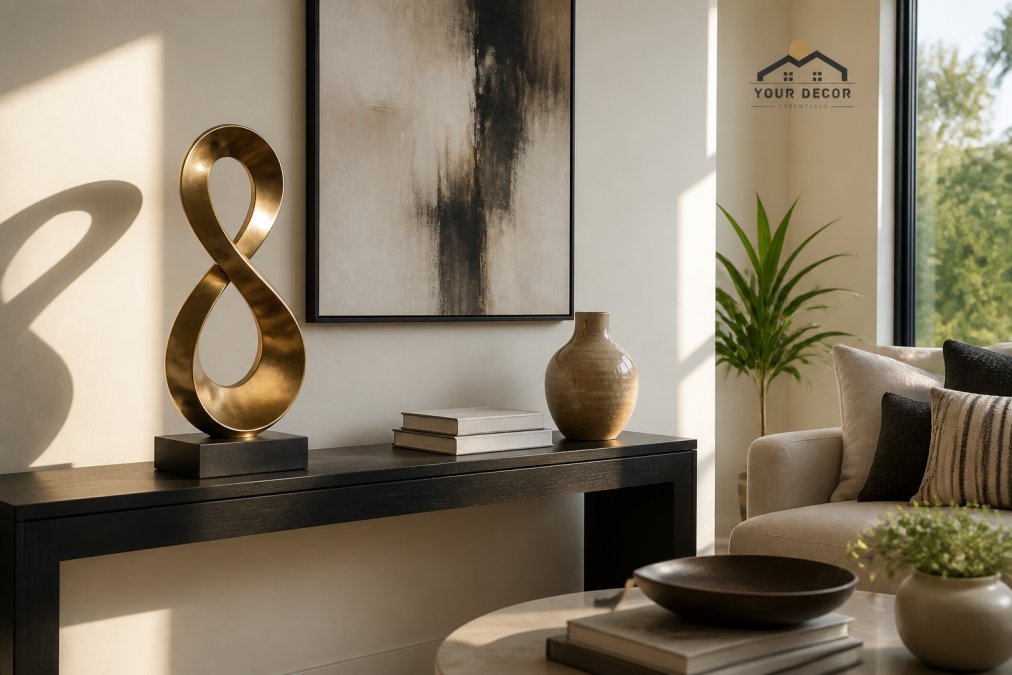
Placement: Interrupt the Straight Line
Rooms are full of straight lines, table edges, sofa backs, window frames. A sculpture's job is to interrupt at least one of them. Place a curved organic piece against a rectangular console to soften the geometry. Place an angular geometric piece against a round table to add tension.
The doorway test still applies: photograph the room from the doorway before you commit. What looks balanced up close can disappear from across the room, and the doorway view is what guests see first.
Choosing a Modern Abstract Sculpture for Coffee Table Display
A modern abstract sculpture for coffee table display should be roughly one-third the width of the table and no taller than the sightline when you're seated. Anything larger blocks conversation. Anything smaller gets lost.
Scale, Proportion, and Tabletop Placement
Consider these proportions before buying:
- Small tables (under 36 inches): pieces 8-10 inches tall
- Medium tables (36-48 inches): pieces 10-14 inches tall
- Large tables (over 48 inches): pieces 14-20 inches tall
- Round tables: a single centered piece beats a cluster
- Rectangular tables: offset placement with one supporting object
The Signature Design by Ashley Melinda, at 20 inches wide and 8 inches high, suits a large rectangular table. Pair it with a low tray to avoid a cluttered look.
Luxury Resin Accent Pieces: Materials That Matter
Luxury resin accent pieces earn their place through finish quality, not material prestige. Resin is a pourable composite that hardens into shape, and it can mimic stone, metal, or glass at a fraction of the weight. The difference between cheap and luxury resin comes down to surface finish and density.
A well-made resin piece has a matte finish or polished sheen without visible seams or bubbles. Cheaper resin feels hollow and light, which undermines the sculptural form. When comparing resin against bronze or stone, ask what you actually want: the heft of a natural material, or the design freedom and color range resin allows.
Lighting Techniques for Sculptures: Making Form Visible
Lighting determines whether a sculpture reads as a considered piece or a dark blob. The goal is directional light that creates shadow, because shadow is what reveals form. Flat overhead lighting erases the curves and angles that make abstract work compelling.
Three approaches work well:
- Picture lights or wall washers above a shelf or mantel, angled down
- Floor uplights beneath large standing pieces, casting shadow upward
- Adjacent table lamps positioned to the side, creating a raking light across the surface
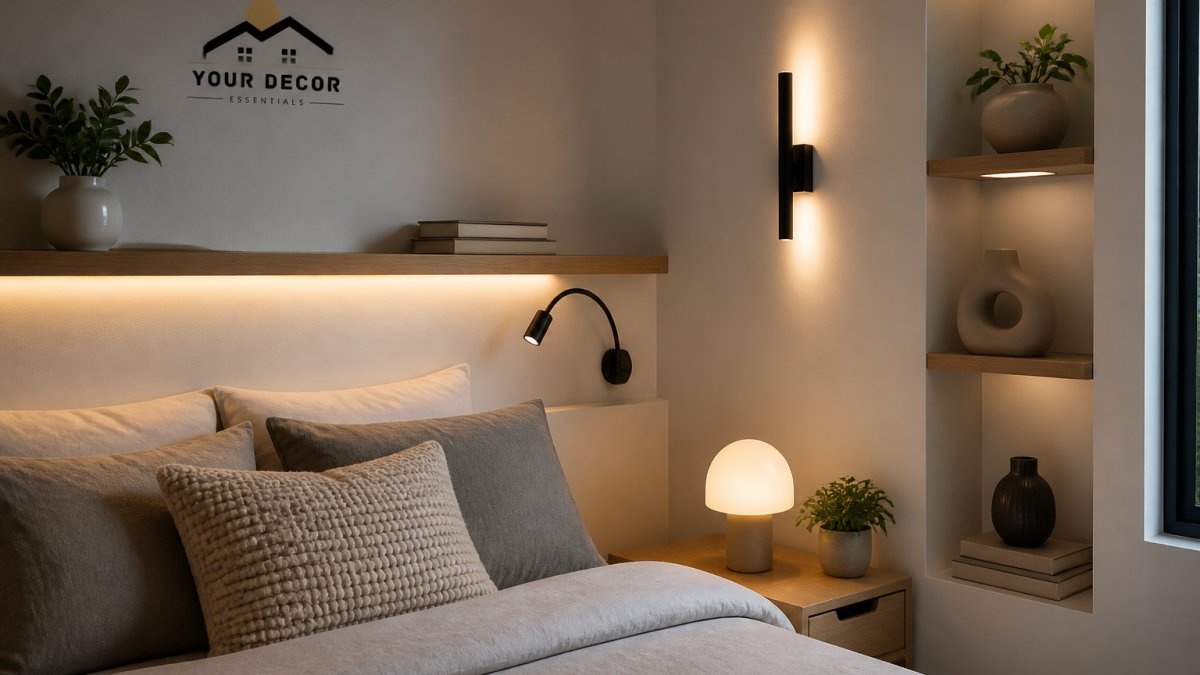
Functional lighting from Your Decor Essentials pairs with sculptural decor for exactly this reason. Our functional lighting helps transform rooms, making a piece lit well at night look twice as deliberate as the same piece under a ceiling fixture.
Handcrafted vs. Mass-Produced: What You're Actually Paying For
The premium on handcrafted work pays for three things: irregularity, finishing time, and material quality. A handcrafted glass piece like the Aqua sculpture, at $102.97, carries small variations that mass-produced copies can't replicate. Each one is slightly different.
Mass-produced pieces win on consistency and price. The Amazon resin statues at $25 deliver a uniform product every time. What they lack is the textural contrast and subtle imperfection that signal human hands.
Here's the honest tradeoff. If you want a piece that looks identical to thousands of others, mass-produced is fine and affordable. If you want something that reads as bespoke, handcrafted is worth the difference. There's no wrong answer, only a mismatch between what you want and what you buy.
Investment and Value Assessment for Abstract Art
Most abstract sculptures are decorative purchases, not financial investments. The resale market for contemporary decor is thin, and shipping costs often eat any gain. Buy a piece because you love looking at it, and treat any appreciation as a bonus. That said, if you want a piece that holds value better than average, here is a concrete framework.
Five Factors That Support Long-Term Value
1. Material durability. Bronze, stone, and stainless steel outlast resin, plaster, and glass. A bronze piece can be re-polished and re-patinated; a cracked resin piece usually cannot be repaired invisibly. If longevity matters, weight is a useful proxy, a heavy piece is more likely to be solid, not hollow.
2. Artist provenance. Documented makers hold value better than anonymous production. Look for a signature, a certificate of authenticity, or a named studio. An unsigned piece is not necessarily low quality, but it is harder to resell because buyers cannot verify origin.
3. Scale and uniqueness. One-of-a-kind pieces resist the depreciation that mass-market decor faces. A limited edition of 50 holds value better than an open-edition piece sold in thousands. Ask the seller whether the design is open edition, limited edition, or one-of-a-kind.
4. Condition. Original finish and no repairs matter. A sculpture that has been repainted, welded, or glued loses value even if it looks fine from a distance. Inspect seams, joints, and the base before buying.
5. Finish quality. On resin and composite pieces, look for visible seams, bubbles, or uneven sheen. A well-finished piece has consistent surface texture and no mold lines. These details separate a $200 piece from a $2,000 piece more reliably than the material label alone.
What Does Not Hold Value
Mass-produced resin statues, trend-driven colorways, and pieces without documentation rarely appreciate. They can still be excellent decor, just do not buy them expecting a return. The same applies to oversized pieces that are expensive to ship; the resale pool shrinks when buyers must arrange freight.
A Practical Buying Checklist
- Ask for the material composition, not just the marketing name.
- Request the edition size and whether a certificate is included.
- Confirm the return policy and who pays return shipping.
- Check the weight; a hollow piece is more fragile and less valuable.
- Photograph the piece and keep the receipt for insurance and resale.
For collectors, documented bronze and stone pieces sit closer to the investment end of the spectrum. For everyone else, value means how much you enjoy the piece over years of daily viewing. A sculpture you still notice after five years is a better investment than one you stopped seeing after five weeks.
Conclusion: Building a Curated Sculpture Collection
The hardest part of collecting abstract sculptures isn't finding pieces. It's resisting the urge to buy everything at once and ending up with a room that feels like a showroom instead of a home. Start with one piece that anchors a space, live with it for a few months, then add.
Your Decor Essentials makes that process easier with a curated selection of abstract sculptures, resin accents, and functional lighting designed to work together. You get pieces vetted for visual cohesion, so each addition builds on the last instead of clashing with it. Browse the collection and find the piece that makes your space feel finished.
Get started with Your Decor Essentials and build a collection that reflects your taste, one considered piece at a time.
Frequently Asked Questions
How do you style abstract sculptures in a living room?
Start with a focal point: place a large sculpture on a console, mantel, or side table where it anchors the room's visual weight. Group smaller pieces in odd numbers for balance. Use books or trays to ground them, and leave negative space around each piece so the sculptural form reads clearly. For a cohesive look, repeat one material (like brushed steel or resin) across two or three objects.
What materials are best for luxury home decor sculptures?
Bronze, marble, stainless steel, and high-grade resin are the most durable and visually rich options. Bronze offers weight and timeless patina; marble adds natural veining; brushed steel brings contemporary shine; resin allows complex fluid shapes at lighter weights. Each material suits different lighting and room styles, so match the finish to your existing palette and the amount of natural light the space receives.
How do I choose the right size sculpture for my coffee table?
A coffee table sculpture should be roughly one-third to one-half the width of the table and no taller than 18 inches so it doesn't block conversation. For a 48-inch table, aim for a piece 12 to 16 inches wide. If your table is glass or light-colored, a heavier visual weight works well; on dark wood, a lighter or reflective piece prevents the surface from feeling dense.
Are abstract sculptures considered good investments for home decor?
Limited-edition or artist-signed pieces from established makers can hold or grow in value, especially bronze and marble works. Mass-produced resin pieces are decorative rather than investment-grade. If resale matters to you, ask about edition size, materials, and provenance before buying. For most homeowners, the primary return is daily enjoyment and a more curated interior, not financial appreciation.