 How-to
Office Decor for Productivity: A Practical Selection Guide
Last Updated: November 12, 2026
Quick Summary
Choose office decor for productivity by first defining how you work, then picking pieces that stay out of your focus zone. Deep-focus workers need minimal visual noise, while call-heavy workers need a tidy, professional background. Set lighting and ergonomics first, then add one or two intentional accents.
- Match decor to your primary work mode before buying anything.
- Use muted neutral walls and one small saturated accent, under 10% of your visual field.
- Fix lighting and ergonomics before adding decorative pieces.
- Keep one or two statement pieces; too many objects compete for attention.
- Test each change for three to five days, one change at a time.
Table of Contents
- How Office Decor Affects Productivity in Practice
- Step 1: Define How You Actually Work
- Best Office Colors for Productivity and Focus
- Lighting and Ergonomics: The Foundation Before Decor
- Office Decoration Items That Earn Their Place on the Desk
- Office Decor Ideas to Increase Productivity Without Distraction
- Work Office Decorating Ideas on a Budget
- Small, Shared, and Hybrid Workspaces
- Testing Whether a Change Helps Your Work
- Choosing Your First Office Accents Next
- Frequently Asked Questions
Choosing office decor for productivity is less about filling a blank wall and more about removing the things that pull your attention away from work. This guide shows how to pick decor items that support focus instead of competing with it. Most people buy decor by feel, then wonder why their desk still feels cluttered. A better approach starts with how you actually work.
How Office Decor Affects Productivity in Practice
Office decor affects productivity mainly by shaping what your eyes land on while you work. A clean, calm setup gives your attention fewer things to sort through. A cluttered one does the opposite.
Think of decor as a background system, not a showcase. Every object in view either supports your next task or asks for a small piece of your focus. A sculpture on the shelf behind your monitor may look great, but if it draws your eye every time you look up, it is working against you.
Some practical signs your decor is helping:
- You can sit down and start work without moving things first
- Your eyes rest when you look away from the screen
- You rarely notice the objects around you while you focus
Some signs it is getting in the way:
- The desk surface holds more than a few items you did not choose on purpose
- Bright or busy pieces sit directly in your line of sight
- You feel the urge to tidy up every time you sit down
Step 1: Define How You Actually Work
Most decor advice assumes a single kind of worker. In reality, your work mode should drive your decor choices. A deep-focus writer needs different cues than a person who takes back-to-back calls or switches tasks every 15 minutes. This section gives you a simple decision framework to prioritize decor based on how you actually work.
Start by identifying your primary work mode from the list below. Pick the one that describes most of your week, then use the corresponding decor priorities.
Deep focus (long, uninterrupted analytical or creative work)
- Priority: minimize visual noise and glare.
- Decor moves: keep the desk surface nearly bare; place one low-contrast accent in peripheral vision; use a task lamp with warm, dimmable light; avoid busy wall art directly in front of you.
- Skip: multiple small objects, bright patterns, motion-based decor.
Collaborative or call-heavy (frequent video calls, shared documents, quick exchanges)
- Priority: look professional on camera and stay organized.
- Decor moves: choose a neutral background wall with one large, simple piece of art; keep a tidy tray for papers; use a plant that frames the frame without blocking your face; ensure lighting is frontal and even.
- Skip: cluttered shelves behind you, reflective surfaces that catch glare.
Task-switching (many short tasks, frequent interruptions)
- Priority: reduce friction and visual search time.
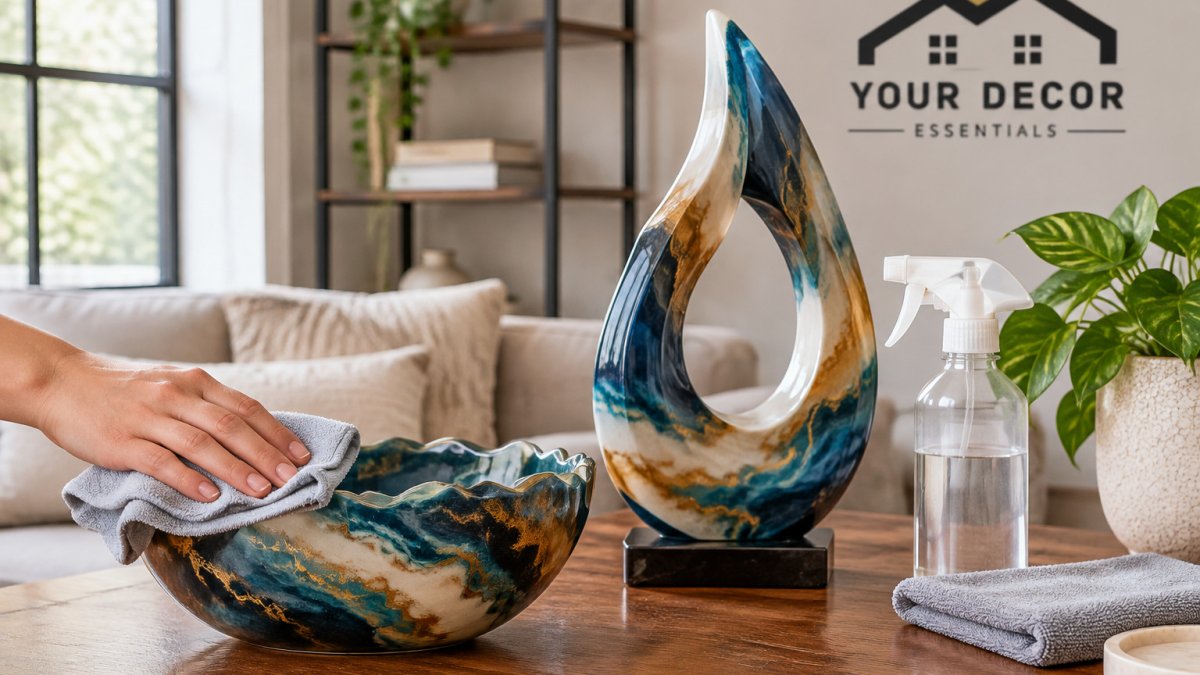
- Decor moves: use labeled containers and a single inbox tray; keep frequently used items within arm's reach; choose one energizing accent (e.g., a warm-toned resin piece) to signal start-of-task; avoid decorative items that require moving to access work tools.
- Skip: decorative bowls that collect random items, stacked papers.
Hybrid or shared (desk used by others or alternating locations)
- Priority: flexibility and quick reset.
- Decor moves: use a portable task lamp; keep personal items on a small tray that can be lifted away; choose a neutral base palette; add one portable plant or accent that can move with you.
- Skip: heavy wall art, permanent organizers that assume one user.
After picking your mode, write down your top two priorities. Then evaluate any decor purchase against those priorities. If a piece does not support your primary mode, it is likely to become clutter.
Watch out: Choosing decor based on aesthetics alone often leads to pieces that compete for attention. Use your work mode as a filter, not an afterthought.
A common pattern is that people buy decor for the space they wish they had, not the work they actually do. Matching decor to your real work mode reduces the chance you will need to redo the space later.
Best Office Colors for Productivity and Focus
Color affects productivity mainly through arousal and attention, not through magic. The mechanism is straightforward: saturated, high-contrast colors increase visual alertness, which can help short bursts of stimulation but may fatigue you over a long day. Muted, low-contrast colors reduce visual noise, which supports sustained focus. The effect is real but modest, and it varies by task and person.
Research on color and productivity is mixed. Many studies are small, short-term, or rely on self-reported mood rather than measured output. A common pattern in workplace studies is that cool tones (blues, greens) tend to support calm and sustained attention, while warm tones (reds, oranges) can increase arousal and speed on simple tasks but may impair performance on complex ones. Treat these as tendencies, not guarantees.
A practical color framework:
- Base (walls, large surfaces): Choose a low-saturation neutral such as warm off-white, soft gray, or muted sage. These reduce glare and visual competition.
- Accent (one or two small items): Use a single saturated color you enjoy, such as a deep blue resin piece or a terracotta planter. Keep it to less than 10% of your visual field.
- Task zone (desk surface): Keep the area directly around your keyboard and monitor neutral. Bright patterns or glossy finishes here create glare and pull your eye.
Watch out: Testing a color by painting a whole wall is expensive and hard to reverse. Start with a small accent item or a swatch taped to the wall for a week before committing.
To test whether a color helps you, run a simple one-week trial. Note your focus and comfort for three days with your current setup, then swap in one accent color and track for three to five days. Keep the change only if you notice a consistent difference. Avoid changing multiple colors at once, or you will not know which one mattered.
Choose one accent that fits your base palette, then build slowly.
Lighting and Ergonomics: The Foundation Before Decor
Lighting and ergonomics affect comfort far more than most decorative pieces. Get these right first, then add decor on top.
For lighting, aim for layers. Natural daylight is best during the day, so position your desk to reduce glare on the screen. Add a task lamp that you can angle onto your work surface. Ambient light from a ceiling fixture or floor lamp fills the room so your eyes do not strain against sharp contrast.
For ergonomics, check these basics:
- Your screen top sits at or slightly below eye level
- Your feet rest flat on the floor or a footrest
- Your elbows bend at roughly a right angle when typing
A desk that adjusts between sitting and standing gives you the option to change position during the day.
Office Decoration Items That Earn Their Place on the Desk
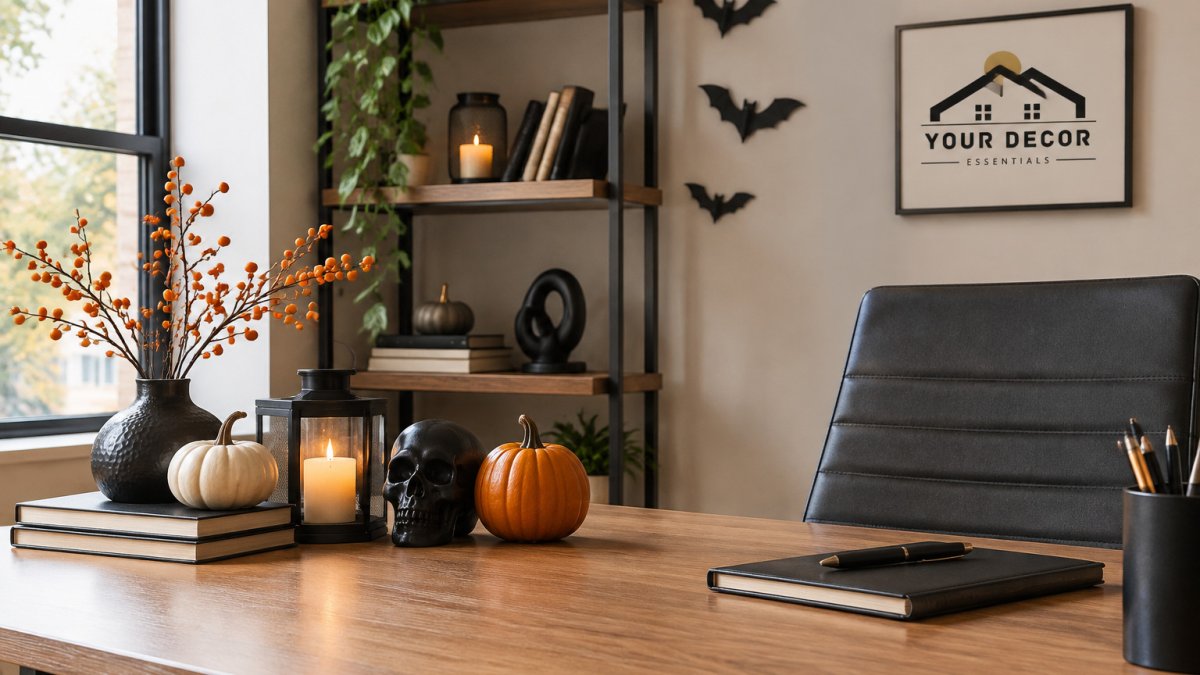
Every object on your desk should have a reason to be there. Use this simple test: if you would not miss it after a week, remove it.
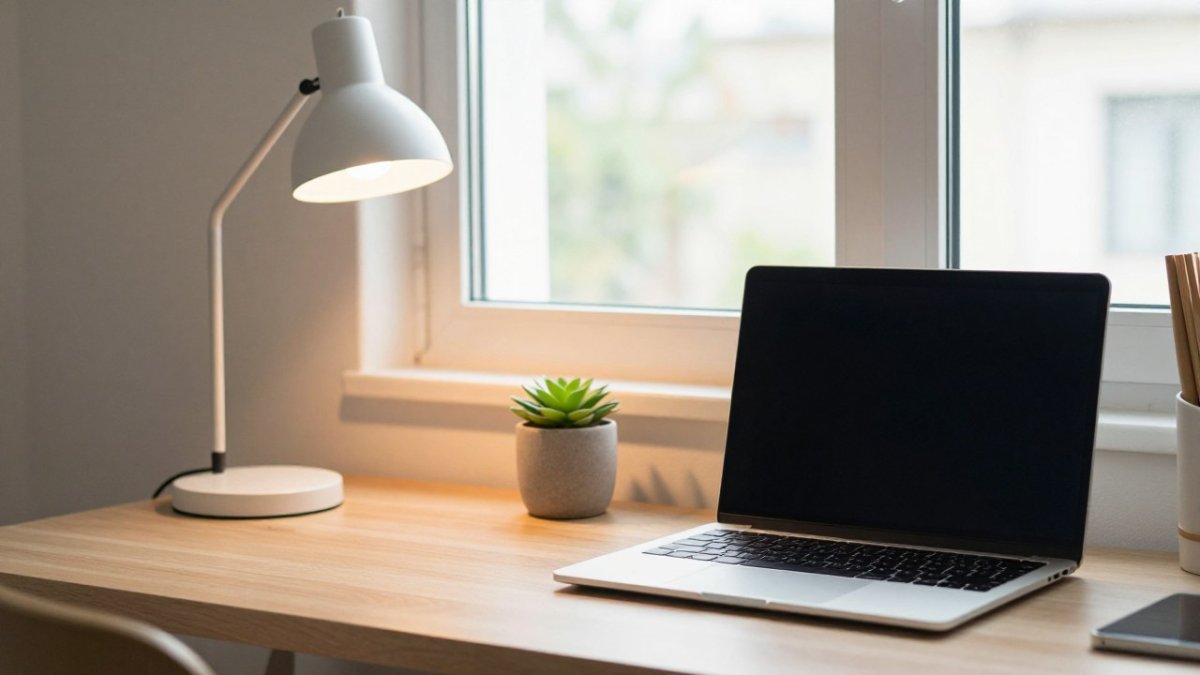
Items that often earn their place:
- A task lamp with adjustable direction and warm light
- A small plant placed where you can glance at it, not stare at it
- One sculptural or resin accent that suits your style and sits low
- A pen cup or tray that keeps small items contained
- A tidy tray for paper so loose documents stay out of view
Items that often cost more focus than they give:
- Multiple competing decorative objects
- Glossy or reflective surfaces that catch glare
- Items with bright patterns right behind your screen
Choose one or two statement pieces and keep the rest simple. A single well-placed sculpture often feels more intentional than a shelf full of small items.
The article's main decor items and their trade-offs are summarised below.
| Item | Why it earns a place | Watch for |
|---|---|---|
| Task lamp | Adjustable direction and warm light | Harsh overhead light instead |
| Small plant | Glanceable, not stare-worthy | Placement that invites staring |
| Sculptural or resin accent | One piece that suits your style | Sitting low, not in focus zone |
| Pen cup or tray | Keeps small items contained | Loose clutter on the desk |
| Tidy paper tray | Keeps loose documents out of view | Papers left in sight |
| Multiple competing objects | None, they compete for attention | Choose one or two statement pieces |
| Glossy or reflective surfaces | None, they catch glare | Glare on the screen |
Office Decor Ideas to Increase Productivity Without Distraction
Good office decor supports your work without asking for attention. Aim for pieces that sit in your peripheral vision rather than directly in your focus zone.
Some ideas that tend to work:
- Place a sculptural piece on a side shelf, not behind your monitor
- Hang one large piece of wall art on the wall you face when you look up
- Use a plant on a corner surface where it frames the room
- Add a textured throw or cushion to a chair you use for breaks
Some ideas that often distract:
- A busy gallery wall directly in front of your desk
- Multiple small objects arranged in rows
- Clocks or motion-based decor that pulls your eye
Rotate pieces every few months instead of filling every surface at once. A smaller set you change occasionally keeps the space feeling fresh without overwhelming you.
Work Office Decorating Ideas on a Budget
You do not need a big budget to build a productive workspace. The most useful changes often cost little.
Budget-friendly steps:
- Clear the desk completely, then add back only what you use daily
- Rearrange what you already own before buying anything new
- Add one plant, which is often affordable and easy to care for
- Replace harsh overhead light with a single warm lamp
When you do buy, spend on the items you touch or look at most: a good lamp, a comfortable chair, or one statement accent. Save on secondary items like small containers and organizers. Pricing depends on quantity, timing, and delivery, so check the website for current prices and a quote.
Small, Shared, and Hybrid Workspaces
Not everyone has a dedicated office. Many people work at a kitchen table, a corner of a bedroom, or a desk shared with others. Decor for these spaces needs to be flexible.
For small spaces:
- Choose a compact L-shaped or corner desk to use the room well
- Use wall-mounted shelves instead of floor furniture
- Pick one accent piece instead of many
For shared or hybrid spaces:
- Use a neutral base so the room works for different people
- Add personal items on a small tray or shelf that is easy to clear
- Use a portable task lamp that can move between uses
A foldable or convertible desk can help if you switch between work and other activities. Clear the workspace at the end of the day so the room feels ready for the next use.
Testing Whether a Change Helps Your Work
Decor changes are easy to make, but it is harder to know whether they help. A simple test can show you what is working.
Try this method:
- Note your focus level and comfort for three days before a change
- Make one change, such as moving a lamp or removing a cluttered shelf
- Keep notes for three to five days on how long you stay focused and how tired you feel
- Keep the change if it helps, or revert if it does not
Changing several things at once makes it hard to tell which one mattered. Make one change at a time. Keep a simple log on paper or in a notes app.
A common mistake is judging a change on the first day. New setups often feel different at first, so give each change a full week before you decide.
Choosing Your First Office Accents Next
Start small. Pick one functional item, such as a task lamp, and one accent piece you genuinely like. Live with them for a week, then decide what to add.
A simple order to follow:
- Fix lighting and seating comfort first
- Add one plant or natural element
- Add one statement accent in a color that fits your room
- Add organizers only when you notice clutter returning
If you want to explore options, browse the Your Decor Essentials collection. Start with one piece that fits how you work, then build from there.
Shop Your Decor Essentials for sculptural accents and task lighting that suit your workspace. Start with one piece you will actually use every day.
Frequently Asked Questions
How does office decor affect productivity?
Decor affects productivity mainly through comfort, visual clutter, and mood. A cluttered or poorly lit desk pulls attention away from the task, while a calm, organized space with good light makes it easier to start and stay on work. Decor that is personal but restrained tends to help more than decor that competes for attention. Test changes one at a time and notice whether you finish tasks more smoothly over a couple of weeks.
What colors are best for a productive office?
Many people find neutral tones with a single accent color easiest to focus in, such as soft whites, warm grays, or muted greens and blues. Bright reds and high-saturation patterns can increase arousal and distraction for some workers. Research on color and productivity is limited and mixed, so treat color as a comfort choice rather than a guaranteed performance boost. Choose a palette you find calm and that matches your lighting.
How can I decorate an office on a budget?
Start with what you already own: rearrange existing items, add one lamp or plant, and clear surfaces before buying anything. Secondhand frames, a single large print, or a few low-cost storage containers can change the feel of a room considerably. Prioritize lighting and a clear desk over decorative extras, since those affect daily comfort most. Spend in stages so you can judge what you actually use.
What should I put on my desk to improve productivity?
Keep only the items you use daily within reach: a notebook, a pen, your charger, and a water bottle. One small plant or a single personal object can add warmth without clutter. A desk lamp with adjustable brightness usually matters more than any ornament. Store reference items out of sight so the working surface stays clear for the task in front of you.