 blog
blog
West Elm vs DynamicHomeDecor Comparison Guide
Table of Contents
- West Elm vs DynamicHomeDecor Comparison: An Overview
- Best Unique Home Decor Online Shops: Where Do These Brands Fit?
- Design Aesthetics and Style Profiles
- Material Quality and Long-Term Durability
- How to Style Abstract Sculptures from Either Brand
- Curated Home Decor vs Mass Market: What's the Real Difference?
- Pricing and Value: What You Get for Your Money
- Sustainability and Ethical Manufacturing
- Which Brand Is Right for Your Home?
- Frequently Asked Questions
Last Updated: September 26, 2026
West Elm vs DynamicHomeDecor Comparison: An Overview
A west elm vs dynamichomedecor comparison comes down to one question: are you paying for a brand name, or for the piece itself? West Elm is a national retail chain with broad distribution. DynamicHomeDecor operates as a smaller online decor retailer. At Your Decor Essentials, we've watched shoppers wrestle with this exact decision, and the answer rarely lands where people expect.
Here's the short version. West Elm wins on showroom access and financing. DynamicHomeDecor wins on curation and the feeling that your living room won't look like your neighbor's. Neither is automatically the better buy, and neither is automatically the better value.
This guide breaks down design aesthetics, material quality, pricing structure, and sustainability so you can decide in about ten minutes instead of ten browser tabs.
Best Unique Home Decor Online Shops: Where Do These Brands Fit?
The best unique home decor online shops tend to fall into three buckets, and knowing which bucket a retailer sits in tells you most of what you need.
- Mass-market chains: high volume, wide catalog, heavy discounting, same pieces in thousands of homes
- Curated online retailers: smaller inventories, stronger point of view, pieces chosen rather than stocked
- Boutique studios: limited runs, artist-driven, often made to order
West Elm belongs firmly in the first bucket. DynamicHomeDecor sits between the first and second, leaning curated.
That distinction matters more than any single product review. A chain buys in bulk and spreads costs across thousands of units, which is why the prices look friendly. A curated retailer buys less, holds less, and prices each piece closer to what it actually costs to make and ship.
U.S. Small Business Administration retail industry guidance notes that smaller retailers typically compete on differentiation rather than price, which describes this split well.
Design Aesthetics and Style Profiles
West Elm built its reputation on a warm modern look: mid-century silhouettes, natural textures, muted palettes. DynamicHomeDecor leans more sculptural and contemporary, with a stronger emphasis on statement pieces. But the real difference isn't just the look, it's how each brand's aesthetic functions in a real room, and which one solves the problem you actually have.
West Elm's Modern Aesthetic
West Elm's look is consistent and safe. You can buy a sofa, a sideboard, and decorative pillows in one sitting and they will coordinate. That consistency is genuinely useful when you're furnishing a whole apartment from scratch.
The trade-off is predictability. Walk into three homes furnished from the same catalog and you'll spot the same media console in two of them. The style vocabulary is narrow: warm woods, brass accents, linen upholstery, and a mid-century silhouette that hasn't shifted much in a decade. If your space already has strong architectural character, exposed brick, ornate molding, a bold paint color, a uniform catalog can flatten it rather than complement it.
DynamicHomeDecor's Curated Contemporary Style
DynamicHomeDecor's catalog reads more like a gallery edit. Fewer pieces, more contrast, and a willingness to stock shapes that don't blend quietly into a room.
Contemporary style here means sculptural forms, resin and mixed materials, and lighting treated as decor rather than utility. If your space already has a strong point of view, this approach layers in more easily than a uniform catalog does. The risk is the opposite of West Elm's: a statement piece can overpower a room that lacks a clear focal point, and the narrower inventory means fewer safe fallbacks if a piece doesn't work in person.
Room-by-Room Style Fit
The aesthetic difference matters most when you apply it to specific rooms. Here's how each brand's strength plays out:
- Living room: West Elm wins for a full seating arrangement, sofa, coffee table, rug, and lighting that coordinate without effort. DynamicHomeDecor wins for a single sculptural accent, a resin side table, an abstract form on a console, that gives an otherwise neutral room a point of view.
- Bedroom: West Elm's muted palette and soft textiles create a calm, hotel-like feel. DynamicHomeDecor's stronger forms work better as a bedside lamp or a single art piece that anchors the room.
- Entryway or hallway: West Elm offers practical, low-risk pieces like console tables and mirrors. DynamicHomeDecor offers a taller sculptural form or a functional light fixture that doubles as decor.
- Home office: West Elm's mid-century desks and shelving coordinate with existing furniture. DynamicHomeDecor's statement lighting or a single bold object breaks up the monotony of a screen-heavy room.
The Style Test: Three Questions
Before you choose a direction, run your room through three questions:
- Does the room already have a strong focal point? If yes, you need accents that support it, not compete with it, DynamicHomeDecor's curated pieces tend to layer better. If no, a coordinated catalog like West Elm's can create the focal point for you.
- Are you furnishing more than one room at once? West Elm's consistency across categories reduces decision fatigue. DynamicHomeDecor's narrower catalog makes multi-room coordination harder.
- Do you want your home to look like a showroom or like a collection? West Elm delivers a polished, repeatable showroom look. DynamicHomeDecor delivers a collection that reflects a specific eye.
Neither answer is wrong. The mistake is buying a statement piece when you needed a foundation, or buying a coordinated set when you needed one object that makes the room yours.
Material Quality and Long-Term Durability
Material quality is where the two brands separate most clearly, and it's the factor buyers underweight most. A piece that costs less today but sags, chips, or fades in two years is the more expensive purchase. But most comparisons stop at "check the materials" without telling you what to check or how the two retailers actually differ. Here's the side-by-side technical breakdown that's missing from nearly every other comparison.
Textile Durability: Upholstery and Pillows
What to check: Look for a rub count (also called Martindale or Wyzenbeek) on the spec sheet. Residential upholstery generally starts around 15,000 double rubs; heavy-use pieces should exceed 30,000. Tight weave density matters as much as the number, a loose weave with a high rub count still snags.
West Elm: Publishes material content and often rub counts for upholstery. Performance fabrics (stain-resistant, easy-clean) are a growing part of the catalog. The trade-off is that some entry-level pieces use bonded leather or lower-density foam that compresses faster than higher-grade alternatives.
DynamicHomeDecor: As a smaller curated retailer, spec transparency varies by piece. Some listings include full material breakdowns; others describe the look more than the construction. The practical move is to ask directly for rub count, foam density, and frame material before buying, a curated retailer can often answer because it works with a smaller supplier base.
Wood and Composite Construction
What to check: Solid wood frames and dovetail joints outlast particleboard and cam-lock hardware every time. Ask whether the frame is kiln-dried hardwood, engineered wood, or MDF, and whether drawer joints are dovetailed or stapled.
West Elm: Uses a mix of solid wood, engineered wood, and veneers depending on the piece and price tier. Entry-level items lean on engineered wood; higher-tier pieces use solid frames. This is normal for mass-market furniture, but it means two pieces from the same collection can have very different bones.
DynamicHomeDecor: Smaller production runs often mean more consistent material choices within a collection, but less published standardization. The advantage is that a curated retailer can tell you exactly which factory and which material a specific piece uses, if you ask.
Resin and Sculptural Pieces
What to check: Resin quality is about finish and UV stability. Cheap resin yellows and scratches; well-finished resin holds its color and surface for years. Ask whether the piece is indoor-only or UV-treated for outdoor use.
West Elm: Resin appears mainly in decorative accessories and some lighting. Quality is generally consistent with the price tier.
DynamicHomeDecor: Resin and mixed materials are a core part of the sculptural aesthetic, so finish quality is more central to the brand's value proposition. This is where the curated approach can outperform, a retailer that stakes its identity on sculptural pieces has more incentive to get the finish right.
Long-Term Durability: What a One-Year Wear Test Actually Shows
Most reviews judge a piece in the first week. The real test is what happens after a year of daily use. Here's what tends to fail first, and how the two retailers compare:
- Sofa cushions: Lower-density foam sags within 12-18 months of daily seating. Higher-density foam (2.0 lb/ft³ or above) holds shape longer. West Elm's mid-tier and upper-tier sofas generally use better foam; entry-level pieces are the risk.
- Wood finishes: Veneer can lift at edges in humid rooms. Solid wood expands and contracts but survives. Both retailers sell pieces in both categories, check the spec, not the brand.
- Resin surfaces: Scratches show more on glossy finishes than matte ones. A matte or satin resin piece ages more gracefully.
- Hardware: Drawer glides and hinges are the most common failure point. Soft-close metal glides outlast plastic rollers by years.
The Warranty and Parts Question
Durability isn't just about materials, it's about what happens when something breaks. West Elm publishes warranty terms by category and sells replacement parts for many items. DynamicHomeDecor's warranty coverage varies by piece and is best confirmed directly. Before buying from either, ask three questions: What's the warranty term? Are replacement parts available? Who pays return shipping if the piece arrives damaged?
The Bottom Line on Durability
West Elm offers more published specs and a broader range of quality tiers, you can buy well or buy cheap, and the spec sheet tells you which. DynamicHomeDecor offers more consistency within its curated range and more direct access to material information if you ask. In both cases, the piece that lasts is the one whose frame, foam, and finish you verified before purchase, not the one with the better brand name.
How to Style Abstract Sculptures from Either Brand
Knowing how to style abstract sculptures is less about the sculpture and more about what sits around it. The piece needs breathing room and a light source that grazes it.
Start with scale. A sculpture should occupy roughly a third of the surface it sits on. Too small and it disappears; too large and it crowds the shelf.
Then build contrast. Pair a smooth resin form with a rough textile, a stack of books, or a matte ceramic. Contrast makes the sculpture read as intentional rather than accidental.
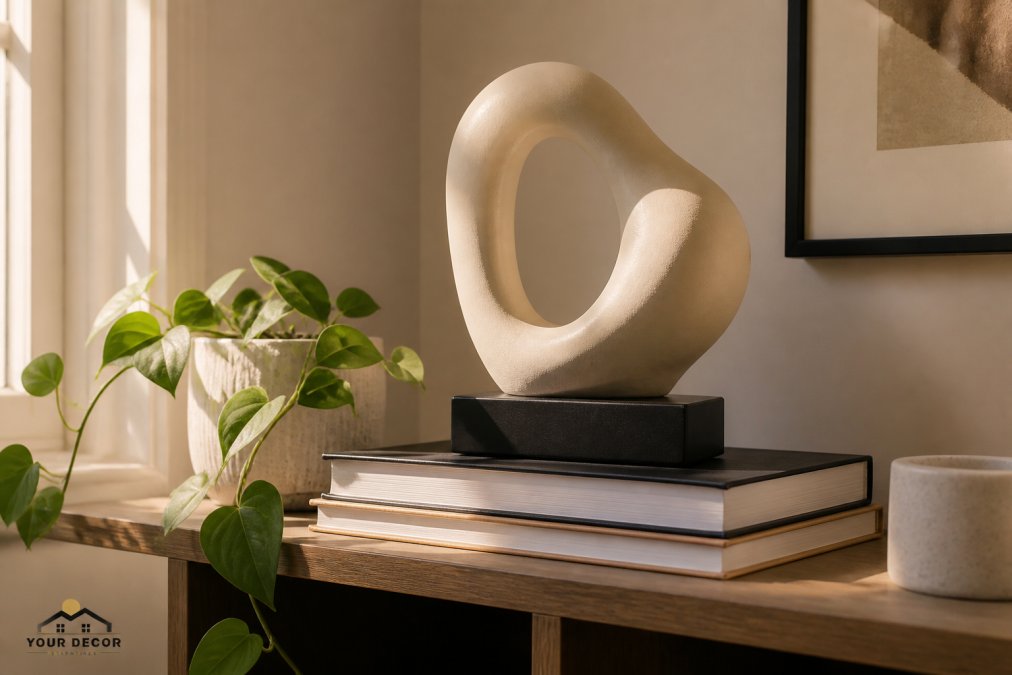
Three placements that work in almost any room:
- Console or sideboard: one large piece, offset to one side, never centered
- Bookshelf: one sculpture per shelf, mixed with books laid flat
- Entryway: a taller form paired with a shallow tray for keys
For functional lighting, treat the fixture as part of the composition. A sculptural lamp does double duty: it lights the sculpture and becomes one itself.
Curated Home Decor vs Mass Market: What's the Real Difference?
Curated home decor vs mass market comes down to inventory strategy. Mass-market retailers stock deep and wide so nothing sells out. Curated retailers stock narrow and rotate often, which is why pieces disappear.
That difference shows up in three places:
- Repeat exposure: mass-market pieces appear in thousands of homes; curated pieces circulate far less
- Design coherence: curated catalogs are edited by a buyer with a point of view; mass catalogs are assembled by category
- Availability risk: curated pieces may not restock, so hesitation has a real cost
There's a practical upside to mass market that gets dismissed too quickly. Returns are easy, replacement parts exist, and you can see the item in person. That's worth something.
The honest framing: mass market optimizes for convenience and price. Curation optimizes for distinctiveness. You're choosing which problem you'd rather have.
Pricing and Value: What You Get for Your Money
Pricing structure differs more than price level. West Elm runs frequent promotions, member discounts, and financing, which makes the sticker price a starting point rather than a final number. DynamicHomeDecor prices closer to a fixed model with less discounting.
That changes how you should compare them. A promotional price on a mass-market piece is real value if the construction holds up. A full-price curated piece is real value if it's the piece you actually wanted for five years.
Judge on price-to-value ratio, not price alone:
- What's the frame or core material?
- Is the finish warranted, and for how long?
- Does the retailer publish a warranty coverage term?
- What does shipping logistics cost, and who pays for damage?
Current pricing for Your Decor Essentials pieces is best confirmed directly on the site.
Sustainability and Ethical Manufacturing
Sustainability claims are where decor retail gets murky, and most comparisons skip this entirely. The useful question isn't whether a brand says "sustainable." It's whether the claim is specific.
Specific claims name a certification, a material source, or a measurable target. Vague claims use words like "eco-friendly" with nothing behind them.
Federal Trade Commission Green Guides sets the standard for how environmental marketing claims must be substantiated in the United States. If a brand's sustainability page wouldn't survive that standard, treat the claim as marketing.
What to look for from either brand:
- Sustainable sourcing statements that name the wood or fiber and its origin
- FSC-certified wood, which verifies chain of custody
- Low-VOC or water-based finishes on furniture
- Take-back or repair programs, which extend product life
Long-term durability is itself a sustainability argument. A sideboard that lasts fifteen years beats three that last five.
Which Brand Is Right for Your Home?
Pick West Elm if you're furnishing several rooms at once, want to see pieces in person, and value easy returns over distinctiveness. The catalog coordinates itself, and that's a real advantage when you're starting from an empty apartment.
Pick DynamicHomeDecor if you already have a direction and want accents that reinforce it rather than reset it. The narrower catalog means fewer compromises and a lower chance a guest owns the same piece.
Here's the decision in one table:
| Your Situation | Better Fit | Why |
|---|---|---|
| Furnishing a first apartment fast | West Elm | Coordinated catalog, easy returns |
| Adding statement accents | DynamicHomeDecor | Sculptural, less widely owned |
| Need to see it in person | West Elm | Showroom access |
| Want a specific design point of view | DynamicHomeDecor | Curated, edited inventory |
| Buying on promotion | West Elm | Frequent discounting |
| Buying one piece to last | Either | Judge on materials, not brand |
A third option exists for shoppers who want curation without the mass-market overlap: Your Decor Essentials stocks abstract sculptures, resin accents, and functional lighting selected for visual interest rather than volume.
Frequently Asked Questions
What are the primary differences between West Elm and boutique decor retailers?
West Elm operates as a large-scale retailer with a broad catalog, while boutique shops like DynamicHomeDecor focus on curated, limited-run pieces. The main differences come down to scale, exclusivity, and design intent. West Elm offers consistent availability and a recognizable modern aesthetic, but you may see the same items in many homes. Boutique retailers prioritize unique designs, often with abstract sculptures and resin accents, giving your space a more personalized feel.
Is West Elm furniture worth the money?
West Elm sits in the mid-to-upper range for mass-market furniture. Many shoppers find the design-forward looks and frequent sales make it a reasonable value, especially for sofas and lighting. However, if you prioritize one-of-a-kind pieces and material transparency, a curated shop may offer better long-term satisfaction. Consider your budget, how long you plan to keep the piece, and whether you want a look that feels widely replicated or distinctly yours.
How does the quality of resin and abstract decor compare between major brands and boutique shops?
Major brands typically produce resin decor in large batches with standardized molds, which keeps costs down but can lead to less detail. Boutique shops often use hand-finished techniques, resulting in richer textures and more variation between pieces. When comparing, look for solid weight, smooth edges, and UV-resistant finishes. Boutique resin accents tend to hold up better over time and offer a more artisanal appearance that stands out in a styled space.
What should I look for when choosing between mass-market and curated home decor?
Start by defining your goal: do you want to fill a space quickly with a cohesive look, or create a room that reflects your individual style? Mass-market options excel at speed and consistency, while curated decor offers uniqueness and often better material quality. Check return policies, assembly requirements, and whether the piece complements your existing furniture. If you entertain often or want a signature look, curated pieces usually deliver more visual impact.
Furnishing a home shouldn't feel like choosing between a catalog and a gamble. Your Decor Essentials curates abstract sculptures, resin accents, and functional lighting so each piece adds visual interest without repeating what's already in every other living room. Browse the collection to find accents that reflect your own style, and shop now to start building a space that looks like you chose it on purpose.