 how-to
Best Under Cabinet Lighting for Small Apartment Kitchens
Table of Contents
- Why Under Cabinet Lighting Transforms Small Apartment Kitchens
- Quick Comparison: Top Under Cabinet Lighting Picks for 2026
- Renter-Friendly Under Cabinet Lighting: No Drilling, No Damage
- LED Strip Lights for Kitchen Cabinets: Continuous, Even Illumination
- Under Cabinet Puck Lights: Focused Brightness for Small Spaces
- Under Cabinet Lighting Color Temperature: Warm White vs. Cool White
- How to Choose the Best Under Cabinet Lighting for Your Small Kitchen
- Installation Tips and Cable Management for Apartment Kitchens
- Frequently Asked Questions
Last Updated: October 15, 2026
Why Under Cabinet Lighting Transforms Small Apartment Kitchens
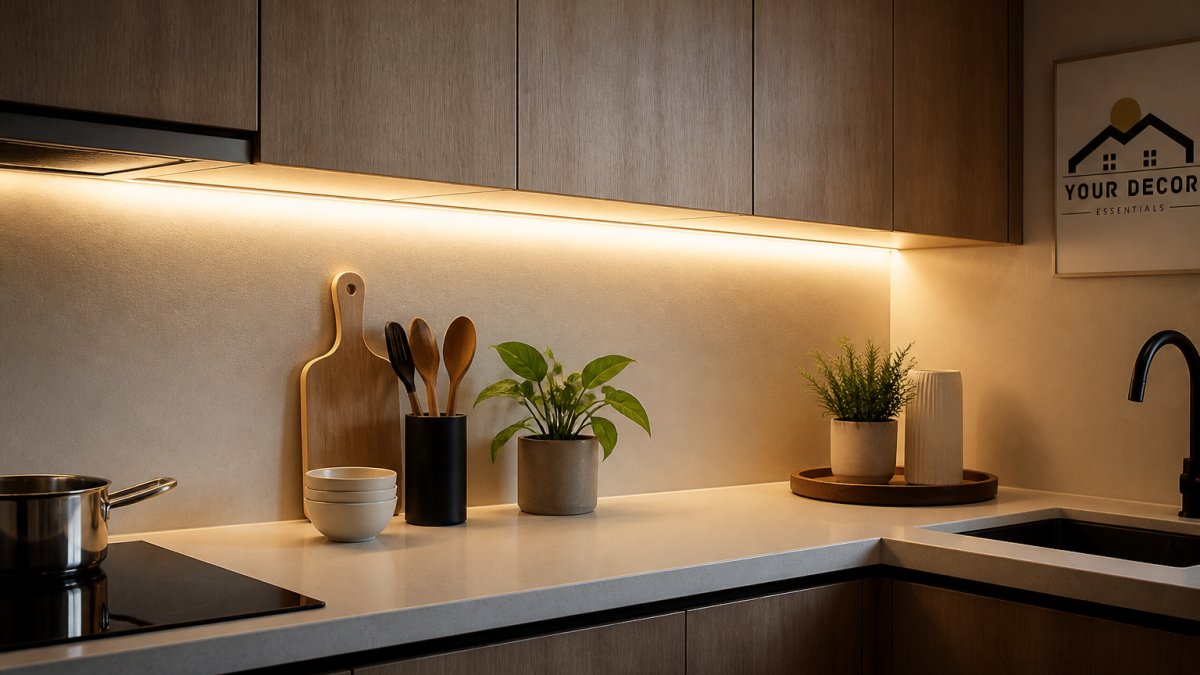
Under cabinet lighting is the single highest-impact upgrade you can make in a small apartment kitchen. It adds task lighting exactly where you chop, pour, and read recipes, and it turns a cramped countertop into a space that feels intentional rather than improvised.
The reason is simple. Overhead fixtures throw your body's shadow straight onto the counter. Under-cabinet fixtures sit between you and the work surface, so the light lands on the cutting board instead of behind your hands.
What most guides miss is that small kitchens punish bad lighting harder than large ones. A single hot spot or a harsh glare line is far more obvious in a compact galley. That is why the best under cabinet lighting for small apartment kitchens tends to be dimmable, low-profile, and easy to remove when you move out.
Quick Comparison: Top Under Cabinet Lighting Picks for 2026
The table below summarizes the main options worth considering, based on published roundups and the formats that suit apartment kitchens.
| Option | Format | Best For | Starting Price |
|---|---|---|---|
| Black+Decker LED Under Cabinet Lighting Kit | Kit | General-purpose small kitchens | $87 |
| GE Cync Reveal Smart LED Under Cabinet Light | Smart LED | App and voice control fans | $70 |
| Govee RGBIC LED Strip Lights | Strip | Continuous color-tunable light | Not stated |
| EShine LED Puck Lights | Puck | Focused pools of light | Not stated |
| Wobane under-cabinet lighting | Budget option | Tight budgets | Not stated |
| Your Decor Essentials functional lighting | Curated fixtures | Design-led small kitchens | See site for current pricing |
Black+Decker's kit was named best overall in The Spruce's under-cabinet lighting roundup, and GE's Cync Reveal took its best smart pick. Those two are the safest starting points if you want a known name and a clear price.
Renter-Friendly Under Cabinet Lighting: No Drilling, No Damage
Renter-friendly under cabinet lighting means you can install it, use it, and remove it without leaving a mark on the cabinet underside. That rules out screws, staples, and anything that needs a permanent hole.
Most renter-friendly setups rely on adhesive backing or mounting clips that grip the cabinet frame. The trade-off is real: adhesive holds well on smooth, clean surfaces and poorly on greasy or textured ones. Wipe the underside with a degreaser first, let it dry fully, then press the strip or clip into place and hold it for a slow count of thirty.
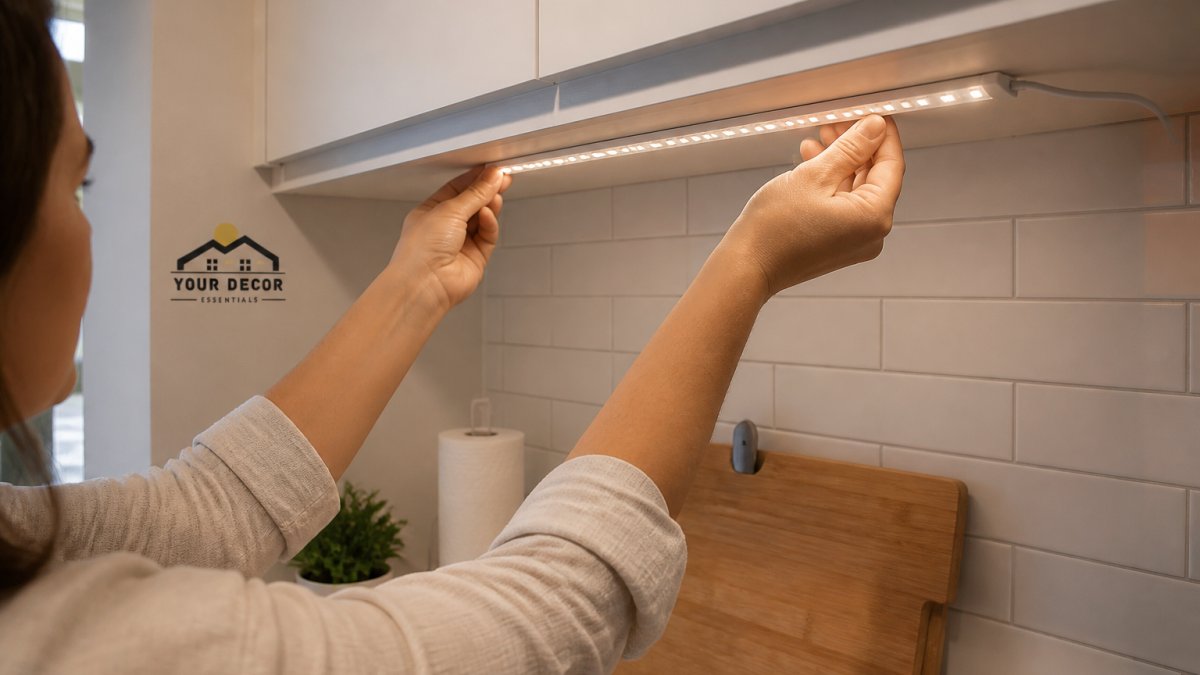
A common mistake is sticking the strip to the cabinet door instead of the cabinet bottom. Doors move, and the adhesive eventually gives. Mount to the fixed frame every time.
LED Strip Lights for Kitchen Cabinets: Continuous, Even Illumination
LED strip lights for kitchen cabinets are the best answer when you want an unbroken wash of light across the whole counter. Instead of pools and dark gaps, you get one continuous line from one end of the run to the other.
AQ Lighting Group's guide to under-cabinet lighting describes strip lights as a popular choice for even illumination and energy efficiency, and that matches what we hear from customers. A flexible strip bends around corners and follows the cabinet line, which matters in a small kitchen where the run is short and every inch counts.
The catch is brightness. A strip that looks bright in the store can read as dim once it is tucked under a cabinet. Look at lumen output, not wattage, and pick a dimmable strip so you can dial it back at night.
Under Cabinet Puck Lights: Focused Brightness for Small Spaces
Under cabinet puck lights are small, round fixtures that throw a focused circle of light. They suit apartment kitchens because you can place two or three exactly where you need them instead of lighting the entire run.
EShine's LED puck lights were listed as a premium traditional pick in NestAlpha's under-cabinet lighting comparison. The puck format is the right call when your counter has one real work zone, like a single prep area beside the sink.
Where pucks fall short is coverage. Three pucks over a long counter leave visible dark gaps between them. In a compact kitchen that is usually fine. In anything wider, a strip wins.
Under Cabinet Lighting Color Temperature: Warm White vs. Cool White
Under cabinet lighting color temperature decides whether your kitchen feels like a cozy room or a laboratory. Warm white, around 2700K to 3000K, flatters wood cabinets and makes the space feel lived-in. Cool white, around 4000K to 5000K, reads crisper and makes colors on the counter look truer. For most small apartment kitchens, we recommend warm white in the 3000K range. It matches the ambient lighting in the rest of an apartment far better than a stark cool white, and it is gentler on the eyes at night.
But in a compact kitchen, color temperature is not just about mood, it is about function. A single harsh cool-white strip under a low cabinet can bounce glare off a glossy backsplash and straight into your eyes, making the counter feel like an operating table. Warm white diffuses that glare and reduces the contrast between the lit counter and the dark room behind you, which matters when your kitchen doubles as a hallway or living space.
Here is how to choose without guessing:
- Match your overheads. If your ceiling fixture is warm white, your under-cabinet light should be within 500K of it. A 3000K strip under a 4000K overhead looks like a mistake, and in a small room that mismatch is the first thing guests notice.
- Consider tunable white. Some smart LED strips and bars let you shift from 2700K to 5000K with an app. That flexibility is useful in a studio apartment where the same room serves as kitchen, office, and lounge. You can go warm for dinner and cooler for detailed prep work.
- Test before you commit. Buy one fixture, hold it under your cabinet at night, and look at how it renders your countertop and backsplash. A color that looks good online can turn your granite green or your white subway tile yellow.
- Avoid mixing temperatures on the same run. If you use multiple fixtures, keep them all at the same Kelvin rating. Mixed temperatures create visible bands of different-colored light, which is especially obvious in a short cabinet run.
For renters, tunable white is a smart investment because it adapts to whatever apartment you move into next. A fixed 3000K strip is simpler and cheaper, but it locks you into one look. Either way, prioritize a high color rendering index (CRI) of 90 or above. A high CRI makes food look appetizing and wood cabinets look rich instead of muddy. Low-CRI lights are common in budget kits, so check the spec before you buy.
How to Choose the Best Under Cabinet Lighting for Your Small Kitchen
Choosing the best under cabinet lighting for a small kitchen comes down to five decisions. Work through them in order and the product picks itself.
- Pick the format. Strip for even coverage, puck for a single work zone, light bars for a middle ground.
- Pick the power source. Plug-in is simplest, battery-powered and rechargeable avoid cords, and hardwired is cleanest but needs an electrician.
- Pick the control. A basic switch is fine. A dimmer or motion sensor matters more in a small kitchen where you cook at odd hours.
- Check the brightness. Compare lumens across options, not watts. Brighter is not always better under a low cabinet.
- Confirm the installation method. Adhesive and clips for renters, screws only if you own the place.
Installation Tips and Cable Management for Apartment Kitchens
Cable management is where most apartment installs go wrong. You finish the lighting, then realize a cord is draped across the backsplash with nowhere to hide. In a small kitchen with one or two outlets, that mess is not just ugly, it is a tripping hazard and a constant reminder that you rent, not own.
The core challenge is power. Most apartments have a single counter outlet, often behind the stove or fridge. Plugging in three separate light fixtures means a daisy chain of cords and a power strip that never quite disappears. Here is how to solve it without an electrician.
Start by counting your outlets. If you have one usable outlet, plan for a single plug-in fixture that covers the whole run, or switch to battery-powered or rechargeable lights. If you have two, you can split the load, but you will still need to route cords invisibly.
Route cords along the back edge of the counter. Tuck them behind appliances, along the caulk line where the backsplash meets the counter, or under the lip of the upper cabinets. Adhesive cable clips in the same finish as your cabinets make the cord disappear. Avoid running cords across the front of the counter or dangling over the sink.
Group plug-in fixtures onto one power strip with a switch. Mount the strip out of sight, inside a cabinet, on the side of the fridge, or under the sink, so you can turn everything on with one flick. This also makes it easy to unplug everything when you move out.
For battery-powered and rechargeable lights, choose models you can reach without a step stool. In a small kitchen, you do not want to climb on the counter to swap batteries. Look for lights with magnetic mounts or removable pucks that click out for charging.
Leave a small service loop at each fixture. A few extra inches of cord let you adjust the light later without redoing the whole run.
Renter-friendly removal matters as much as installation. Adhesive mounts should come off with a hair dryer and dental floss, not a paint scraper. Test a small area first. If you used screws, fill the holes with spackle and touch up with matching paint, but in most apartments, you will want to avoid screws entirely.
A lighting kit with pre-linked sections saves the most time, since you are not joining pieces by hand. If your kitchen has only one usable outlet, battery-powered or rechargeable lights remove the cord problem entirely. And if you are handy, low-voltage hardwired options exist, but they require a junction box and typically a landlord's permission.
For a compact galley, consider a single LED strip that runs the entire length of your upper cabinets. One cord, one plug, and no gaps. That is the simplest cable management plan of all.
Frequently Asked Questions
What is the best type of lighting for kitchen under cabinets?
LED strip lights and puck lights are the two most popular choices. LED strip lights provide continuous, even illumination along the entire counter, while puck lights offer focused brightness in specific spots. For small apartment kitchens, strip lights often work better because they reduce shadows and create a seamless look. Consider your counter layout and whether you need broad or targeted light.
What kind of renter-friendly under cabinet lighting is available?
Renter-friendly options include adhesive-backed LED strips, wireless puck lights with mounting clips, and plug-in light bars. These require no drilling and can be removed without damaging cabinets. Look for lights with strong adhesive backing or removable clips. Battery-powered and rechargeable models also avoid the need for new outlets.
Are LED strip lights or puck lights better under kitchen cabinets?
It depends on your needs. LED strip lights provide even, continuous light and are great for task lighting across a long counter. Puck lights are better for focused brightness in specific areas, like over a sink or stove. In small apartment kitchens, strip lights often reduce glare and shadow better, but puck lights can be more flexible for tight corners.
What color temperature is best for under-cabinet kitchen lighting?
Warm white (2700K-3000K) creates a cozy, inviting feel and is ideal for living spaces. Cool white (4000K-5000K) provides brighter, more focused light for tasks like chopping. For small apartment kitchens, a neutral white around 3500K balances both. Many LED lights offer dimmable or adjustable color temperature settings to suit different times of day.