 how-to
Choosing Right Lighting for Living Room: 2026 Guide
Table of Contents
- What You'll Need Before You Shop
- Layering Living Room Lighting: The Three-Tier Method
- Best Color Temperature for Living Room Zones
- How to Choose Light Fixture Size Without Guessing
- Living Room Lighting Layout Ideas for Every Room Shape
- Bulb Types, Lumens, and Dimmer Switches
- Smart Lighting Integration and Video Call Setups
- Lighting for Small vs. Large Living Rooms
- Budget-Friendly Lighting Hacks That Still Look Expensive
- Common Mistakes to Avoid
- Frequently Asked Questions
Last Updated: September 10, 2026
What You'll Need Before You Shop
Choosing right lighting for living room spaces starts with three numbers: the room's square footage, its ceiling height, and the primary activities that happen there. Grab a tape measure, note whether you have dimmer switches or standard toggles, and check the color temperature of any bulbs you already own. This guide walks through the full process, from layering strategy to fixture sizing, so you can buy with confidence instead of guessing.
Here's the uncomfortable truth: most people buy a light fixture the way they buy a throw pillow. They see something they like, check the price, and take it home. Then it either glares, feels dim, or makes the whole room look flat.
Lighting is the one design element that changes how every other object in the room reads. Get it right and your furniture, art, and finishes look intentional. Get it wrong and even expensive pieces look tired.
Below, we'll show you exactly how to plan a living room lighting scheme from scratch, including the sizing formulas most retailers never mention.
Layering Living Room Lighting: The Three-Tier Method
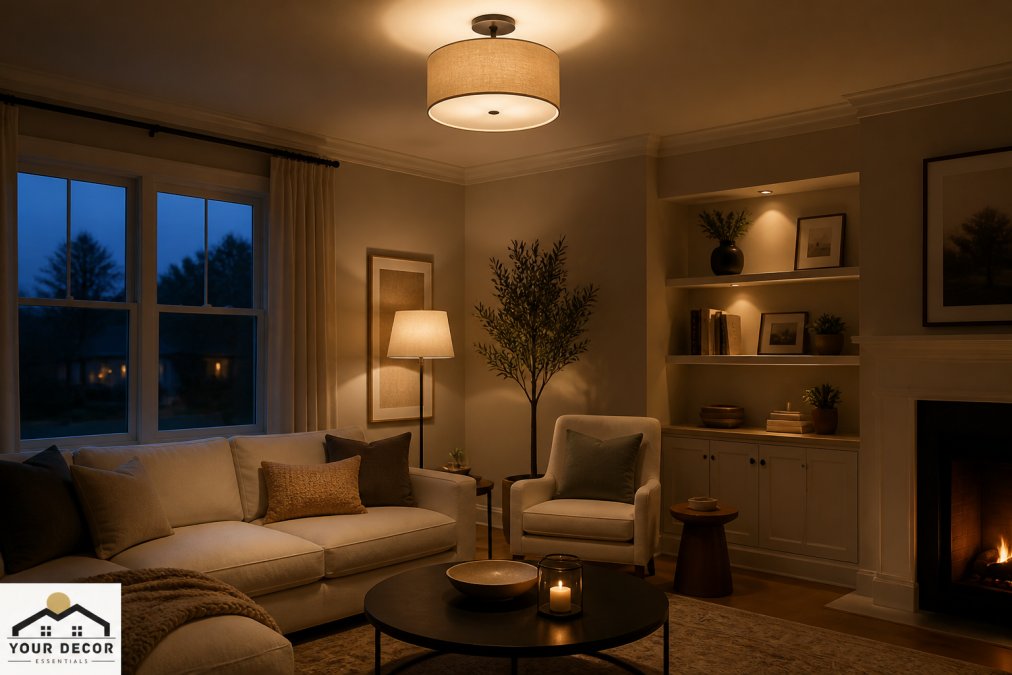
Layering living room lighting means combining three distinct light types, ambient, task, and accent, so no single fixture carries the whole room. A layered scheme gives you control: bright for cleaning, soft for conversation, focused for reading. It's the difference between a room that feels like a showroom and one that feels like home.
Ambient Lighting: The Base Layer
Ambient lighting is the general illumination that makes a room usable. Ceiling fixtures, recessed downlighting, and flush mount or semi-flush mount fixtures typically fill this role. It should be even and diffuse, never the star of the show. Think of ambient light as the foundation, it supports everything else but shouldn't call attention to itself.
Task Lighting: Where You Actually Read and Work
Task lighting is directional light for specific activities: reading, knitting, working on a laptop, or doing a puzzle. Floor lamps, table lamps, and swing-arm wall sconces handle this best because you can aim them. Position task light opposite your dominant hand so your own shadow doesn't fall across the page.
Accent Lighting: The Layer That Makes It Look Designed
Accent lighting creates drama. It highlights artwork, architectural features, shelves, or a textured wall. Track lighting, picture lights, and small adjustable spots work here. The rule is simple: accent light should be roughly three times brighter than the ambient light around it, which is what creates that satisfying pop.
Best Color Temperature for Living Room Zones
The best color temperature for living room lighting is 2700K to 3000K for most seating areas, with cooler options reserved for workspaces. Color temperature, measured in kelvins, determines whether light reads as warm white, neutral, or cool white. Mixing temperatures in one sightline is the fastest way to make a room feel disjointed.
Kelvin Ranges and What They Look Like in Practice
- 2200K-2400K: Candle-like amber, best for accent and mood lighting
- 2700K: Classic warm white, flattering on skin and wood tones
- 3000K: Soft white, slightly crisper, good for task areas
- 3500K-4000K: Cool white, best for kitchens, offices, and video calls
- 5000K+: Daylight, rarely appropriate in a living room
How to Choose Light Fixture Size Without Guessing
How to choose light fixture size comes down to two formulas based on room dimensions. For a ceiling fixture, add the room's length and width in feet, then convert that total to inches. A 12-foot by 14-foot room needs a fixture roughly 26 inches wide. For hanging fixtures, the bottom edge should sit 30 to 36 inches above a dining or coffee table surface.
The Spacing and Height Formulas
- Ceiling fixture width: Room length + room width (in feet) = fixture width in inches
- Recessed light spacing: Divide ceiling height by two to get spacing distance in feet
- Pendant height: 30-36 inches above table surface
- Chandelier height: 3 inches per foot of ceiling height
- Wall sconce height: 60-66 inches from floor to center
These spacing requirements keep light even and prevent the dark pockets that make rooms feel smaller.
Living Room Lighting Layout Ideas for Every Room Shape
Living room lighting layout ideas shift depending on whether you're working with a long narrow space, a square open plan, or an awkward L-shape. The goal stays the same: even coverage with no dead zones and no hot spots. Start by mapping where people actually sit, walk, and work, then place light accordingly.
Long Narrow Rooms
Run fixtures in two parallel rows rather than one center line. For a 10-foot-wide room, keep each row about 3 feet from the long walls, leaving a 4-foot central walkway. Space recessed lights every 4 to 6 feet along each row. This prevents the tunnel effect that a single center line creates.
Square Open-Plan Spaces
Define each zone with its own light source so the eye reads separate areas. A common pattern is to use a dimmable ceiling fixture over the seating area, a pendant over a dining table, and a floor lamp near a reading chair. Keep ambient light levels within 20 percent of each other across zones to avoid a patchwork look.
L-Shaped Rooms
L-shaped rooms benefit from a corner anchor, a floor lamp or tall plant with a spotlight, to visually square off the space. Place the anchor in the inner corner where the two legs meet. Then add a second light source along the longer wall to balance the visual weight.
Zone Mapping in Practice
Walk the room and mark where people sit, walk, and work. Use painter's tape to outline furniture footprints. Then place light sources so that each zone has at least one dedicated fixture. A common mistake is to light the center of the room and leave the edges dark; instead, aim for overlapping pools of light that blend at the edges.
Small vs. Large Room Adjustments
Small living rooms need fewer, brighter, more flexible sources. Large rooms need more fixtures at lower output to avoid a cavernous feel. In a small space, one well-placed floor lamp and a dimmable ceiling fixture often outperform a grid of recessed lights, which can make a compact room feel like an office. Large living rooms are the opposite problem. A single ceiling fixture leaves corners dark and makes the room feel unfinished. Use multiple ambient sources, plus accent lighting on the far walls, to pull the eye around the space and make it feel intentional rather than empty.
| Room Size | Ambient Strategy | Task + Accent | Watch Out For |
|---|---|---|---|
| Under 150 sq ft | One dimmable ceiling fixture | One floor lamp, one accent | Too many fixtures crowd the room |
| 150-300 sq ft | Two ambient sources | Two task, two accent | Single source leaves corners dark |
| Over 300 sq ft | Three or more ambient | Three task, three accent | Uneven coverage reads as unfinished |
Bulb Types, Lumens, and Dimmer Switches
Wattage tells you energy use; lumens tell you brightness. For a living room, aim for roughly 10 to 20 lumens per square foot of ambient light, then add task and accent sources on top. LED bulbs now dominate the market because they run cool, last for years, and come in adjustable color temperatures.
Dimmer switches are the single highest-impact upgrade you can make. They let one fixture serve multiple moods, from bright for cleaning to low for evening conversation. Look for dimmers rated for LED loads, older dimmers designed for incandescent bulbs often cause flickering or buzzing with modern LEDs.
Smart Lighting Integration and Video Call Setups
Smart lighting integration lets you control color temperature, brightness, and schedules from a phone or voice assistant. This matters more than it used to because the same living room now doubles as an office, a studio, and a lounge. Smart bulbs and smart switches both work; bulbs are easier to retrofit, switches are better if you want to keep your existing fixtures.
Smart Bulbs vs. Smart Switches
Smart bulbs screw into existing sockets and connect via Wi-Fi, Bluetooth, or Zigbee. They are the fastest retrofit but require the switch to stay on. Smart switches replace your wall switch and control any bulb, but they need neutral wiring in the box. For renters, smart bulbs are the clear choice. For homeowners who want to keep fixture choices open, smart switches are more flexible long-term.
Protocols and Compatibility
Wi-Fi bulbs are simplest but can clog your network if you add many. Zigbee and Z-Wave require a hub but are more reliable for larger setups. Matter is the newer standard that aims to unify all of these; look for the Matter logo if you want future-proof compatibility. Most major brands now support Matter, so you can mix and match.
Circadian Rhythm Lighting
Circadian lighting adjusts color temperature throughout the day: cooler (4000K-5000K) in the morning to promote alertness, warmer (2700K) in the evening to support melatonin production. Some smart bulbs and hubs offer automated circadian schedules. This is a unique angle most traditional guides miss, and it directly addresses the living room's dual role as workspace and relaxation space.
Video Call and Content Creation Setup
For video calls and content creation, position a soft light source in front of you at roughly 4000K, never behind. A ring light or a diffused floor lamp at eye level eliminates the under-eye shadows that overhead lighting creates. Skip overhead-only setups for calls; they flatten faces and cast shadows downward. For a more professional look, use a key light at 45 degrees to one side and a fill light at lower intensity on the opposite side. A common pattern is to place a smart bulb in a floor lamp and set it to 4000K at 80 percent brightness for calls, then switch to 2700K at 30 percent for evening relaxation.
Practical Integration Tips
- Group lights by zone in your smart home app so you can control layers independently.
- Set scenes for "Movie," "Reading," and "Work" to switch moods with one tap.
- Use voice assistants to adjust brightness without getting up.
- Schedule lights to turn on at sunset for security and convenience.
Lighting for Small vs. Large Living Rooms
Small living rooms need fewer, brighter, more flexible sources. Large rooms need more fixtures at lower output to avoid a cavernous feel. In a small space, one well-placed floor lamp and a dimmable ceiling fixture often outperform a grid of recessed lights, which can make a compact room feel like an office.
Large living rooms are the opposite problem. A single ceiling fixture leaves corners dark and makes the room feel unfinished. Use multiple ambient sources, plus accent lighting on the far walls, to pull the eye around the space and make it feel intentional rather than empty.
| Room Size | Ambient Strategy | Task + Accent | Watch Out For |
|---|---|---|---|
| Under 150 sq ft | One dimmable ceiling fixture | One floor lamp, one accent | Too many fixtures crowd the room |
| 150-300 sq ft | Two ambient sources | Two task, two accent | Single source leaves corners dark |
| Over 300 sq ft | Three or more ambient | Three task, three accent | Uneven coverage reads as unfinished |
Budget-Friendly Lighting Hacks That Still Look Expensive
Budget-friendly lighting hacks come down to placement and warmth, not price. A well-placed floor lamp with a warm white bulb does more for a room than a costly fixture in the wrong spot. Start with what you have, then upgrade one layer at a time.
- Swap cool white bulbs for 2700K warm white, the single cheapest upgrade
- Add a dimmer switch to your main fixture
- Use a floor lamp to create a reading corner instead of adding ceiling lights
- Point an uplight at a textured wall to add depth without new fixtures
- Group three small table lamps instead of buying one large statement piece
- Add a picture light over existing artwork to make it read as intentional
Common Mistakes to Avoid
The biggest lighting mistake is treating it as an afterthought, buying fixtures for looks alone and hoping the light works out. A common mistake is placing a single ceiling fixture in the center of a large room and calling it done. That layout leaves corners dark, casts shadows under furniture, and makes the room feel smaller than it is.
Another frequent error is mixing color temperatures across a single sightline. A warm table lamp beside a cool overhead light creates a color clash that no amount of styling fixes. Match your kelvins, or at least keep them within 500K of each other in the same view.
Finally, don't skip the dimmer. Even a basic dimmer switch turns one fixture into three usable moods, and it's one of the least expensive changes you can make. For homeowners furnishing a first space, it's often the difference between a room that feels finished and one that feels like a rental.
If you'd rather not source every layer separately, ENERGY STAR's lighting guidance explains how to read bulb labels for lumens and color temperature before you buy. For broader design context, the American Lighting Association publishes consumer resources on fixture selection and placement.
Frequently Asked Questions
What is the 5'7" lighting rule?
The 5'7" rule states that the bottom of a hanging pendant or chandelier should sit about 5 feet 7 inches from the floor in a living room with standard 8-9 foot ceilings. This keeps the fixture high enough to walk under comfortably while low enough to feel connected to the seating area. If your ceiling is taller, raise the fixture proportionally, roughly 3 inches for every additional foot of ceiling height.
Is daylight or soft white better for a living room?
Soft white (around 2700K to 3000K) is the better default for living rooms. It creates the warm, relaxed atmosphere most people want in a space for conversation and unwinding. Daylight bulbs (5000K to 6500K) read as harsh and clinical in a living room setting. Save daylight for garages, workshops, or task areas. If you want a slightly crisper feel for reading, 3500K is a reasonable middle ground.
How do I know what size light fixture fits my living room?
Add your room's length and width in feet, then use that total as the diameter in inches. A 12-foot by 16-foot living room calls for a fixture roughly 28 inches wide. For hanging fixtures, the bottom should hang 30 to 36 inches above a coffee table. For flush mounts in low-ceiling rooms, keep the fixture under 12 inches tall so it doesn't crowd the space.
Should living room lighting be warm or cool?
Warm white light in the 2700K to 3000K range works best for most living rooms. It flatters skin tones, makes wood and fabric look richer, and supports the relaxed mood the room is built for. Cool white (4000K and above) tends to feel like an office or hospital. If you need brighter light for hobbies or reading, increase lumens at the same warm color temperature rather than switching to a cooler bulb.
Getting the layers, color temperature, and fixture sizing right takes an afternoon of planning, but it changes how your entire living room reads. Your Decor Essentials curates functional lighting alongside abstract sculptures and resin accents, so you can build a layered scheme and the artful details that finish it in one place. Our collection is built for homeowners who want pieces that feel personal, not mass-produced. Shop Now and start with the layer your room is missing.