 how-to
How to Size Abstract Sculpture for a Console Table
Table of Contents
- Start With the Console, Not the Sculpture
- What Size Art Over a Console Table Teaches You About Scale
- The Console-to-Sculpture Sizing Formula
- Sculpture Dimensions and Proportions: Reading the Specs Correctly
- Clearance Gaps and Negative Space Around Your Abstract Sculpture
- Height, Sightlines, and Viewing Distance
- How to Balance Decor on a Console Table With Other Objects
- Console Table Decor Ideas That Showcase Your Sculpture
- Stability, Weight, and Material Considerations
- Conclusion
- Frequently Asked Questions
Last Updated: October 8, 2026
Start With the Console, Not the Sculpture
Most people fall for the sculpture first. They see a piece they love, bring it home, and then discover it swallows the console table whole. This is almost always avoidable.
The trick to how to choose the right size abstract sculpture for a console table is simple: measure the furniture before you ever measure the art. The console is the stage. The sculpture is the performer. If the stage is too small, no performer looks good.
So grab a tape measure and write down three numbers.
Measuring Width, Depth, and Height
Width is the full length of the console from end to end. Depth is how far it sticks out from the wall. Height is the distance from the floor to the top surface.
Write all three down. You will use them in every decision that follows.
A few notes on each:
- Width sets the maximum footprint your sculpture can occupy
- Depth tells you how much tabletop you have to work with
- Height affects sightlines and how the piece reads from across the room
Skip this step and you are guessing. Measure once and the rest gets easy.
What Size Art Over a Console Table Teaches You About Scale
The rule for art over a console table is the same rule that governs sculpture on top of it. Both live in the same visual zone, so both follow the same logic.
That rule is proportion. The piece should relate to the furniture, not float above it or crush it.
Here is the standard guidance designers use:
- A piece should span roughly two-thirds to three-fourths of the console's width
- It should not exceed the console's depth
- It should leave breathing room on both sides
This is where what size art over console table guidance becomes useful even if you are shopping for sculpture. The math is nearly identical.
interior design principles from the American Society of Interior Designers back up what most stylists already know: scale and proportion are the first things the eye reads in a room. Get them wrong and nothing else fixes it.
The Console-to-Sculpture Sizing Formula
Here is the formula we recommend. It takes about two minutes to run, and it works for any console size.
- Measure the console width. Call it W.
- Multiply W by 0.66. This is your minimum sculpture width.
- Multiply W by 0.75. This is your maximum sculpture width.
- Measure the console depth. Call it D.
- Your sculpture depth should be no more than D minus 4 inches for clearance.
- For height, aim for a sculpture that reaches between one-half and two-thirds of the wall height above the console.
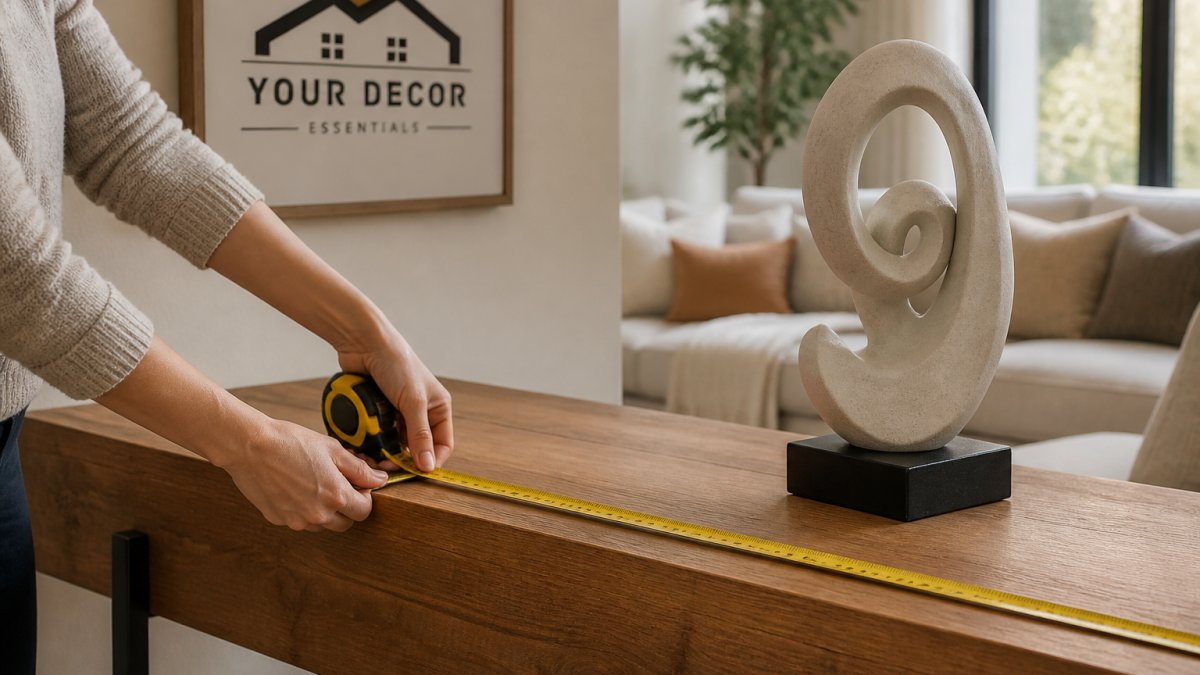
A 60-inch console, for example, wants a sculpture between 40 and 45 inches wide at the base. A 48-inch console wants something between 32 and 36 inches. That is the footprint. Height is a separate conversation, and we will get to it.
Worked Examples for Three Common Console Types
Most consoles fall into one of three size categories. Here is how the formula plays out for each.
Narrow entryway console (36 inches wide, 12 inches deep). Minimum sculpture width: 24 inches. Maximum: 27 inches. Maximum depth: 8 inches. If you also place a lamp and a tray, subtract roughly 12 inches of width for those items, leaving a sculpture footprint of 12 to 15 inches. In that case, choose a tall, narrow piece rather than a wide one.
Standard living-room console (60 inches wide, 16 inches deep). Minimum sculpture width: 40 inches. Maximum: 45 inches. Maximum depth: 12 inches. This size can handle a statement sculpture plus a book stack and a small accent. If you want a lamp on one side, keep the sculpture to the left or right third rather than centered.
Large sideboard or buffet (72 inches wide, 18 inches deep). Minimum sculpture width: 48 inches. Maximum: 54 inches. Maximum depth: 14 inches. A sideboard this wide can support two smaller sculptures instead of one large piece. A common pattern is a tall piece on one end and a low, wide piece on the other, with a tray in the middle.
Accounting for Usable Tabletop Space
A sculpture does not get the whole console. Lamps, books, trays, and decorative objects all compete for the same surface. Before you finalize the sculpture size, measure the area you plan to leave open.
A simple method: place painter's tape on the console to mark where each object will sit. The remaining uncovered area is your usable tabletop space. Size the sculpture to fit inside that zone, not the full console width.
A Quick Calculator You Can Run in Your Head
If you do not want to do the math, use this shortcut. For a console with no other objects, the sculpture base should be about two-thirds the console width. For a console with one lamp, reduce that to one-half. For a console with a lamp and a tray, reduce it to one-third. These are rough numbers, but they keep you in the right range before you pull out the tape measure.
Sculpture Dimensions and Proportions: Reading the Specs Correctly
Product listings give you three numbers: width, depth, and height. Most shoppers read only the height. That is a mistake.
Width and depth describe the footprint. Height describes the presence. You need all three to judge whether a piece will work.
Here is what to look for on any listing:
- Base width: how much surface the piece actually occupies
- Base depth: how far it reaches forward from the wall
- Overall height: where the top of the piece lands
- Weight: how much the console has to support
If a listing only gives height, ask for the rest. A tall, narrow piece and a short, wide piece can share the same height and look nothing alike on a console.
Why Footprint Matters More Than Height Alone
A sculpture with a wide base eats tabletop. A sculpture with a narrow base leaves room for other objects. Two pieces at the same height can require completely different amounts of space.
Think of it like a plant. A tall fern in a narrow pot takes up almost no surface. A low, spreading succulent takes up a lot. Sculpture works the same way.
Clearance Gaps and Negative Space Around Your Abstract Sculpture
Negative space is the empty area around your abstract sculpture. It is not wasted space. It is what makes the piece readable.
Aim for these gaps:
- At least 6 inches between the sculpture and the wall behind it
- At least 4 inches between the sculpture and the front edge of the console
- At least 6 inches of clear space on each side
These gaps do three things. They protect the piece from knocks. They let light move around it. And they give the eye a place to rest.
Tighten those gaps and the console starts to feel cluttered even if you only own three objects. Open them up and a single sculpture can carry the whole surface.
Height, Sightlines, and Viewing Distance
Where you stand when you look at the console determines how tall the sculpture should be. This is the sightline rule, and most shoppers never think about it.
Stand at the spot where you will most often view the console. That might be the entryway door, the sofa across the room, or the hallway leading in. Now look at the console.
The top of the sculpture should land just below or at your eye level. If it sits much lower, it disappears. If it towers over you, it dominates.
Viewing distance matters too. A sculpture viewed from 10 feet away reads differently than one viewed from 3 feet. For a console in an entryway, most people see it up close. For a console behind a sofa, the view is longer. Size up for the longer view.
How to Balance Decor on a Console Table With Other Objects
A sculpture rarely lives alone on a console. It shares the surface with lamps, books, trays, and small accents. How to balance decor on a console table comes down to visual weight.
Visual weight is how heavy an object feels to the eye, regardless of its actual mass. A dark, dense piece feels heavier than a light, airy one of the same size.
Use these rules to balance the arrangement:
- Pair a heavy sculpture with lighter objects nearby
- Offset a tall piece with a lower stack of books or a tray
- Keep the tallest object off-center for a more natural look
- Group small items in odd numbers, usually three
- Leave one clear zone of empty surface
The sculpture should be the focal point, not one of five competing objects. Everything else supports it.
Console Table Decor Ideas That Showcase Your Sculpture
A few arrangements work again and again. Here are console table decor ideas we see styled well most often.
The minimalist entryway. One abstract sculpture, one low bowl, one tall vase. Lots of open space. Works in narrow hallways where clutter would feel tight.
The layered living room console. A sculpture on one side, a stack of art books on the other, a lamp behind. The eye moves across the surface instead of stopping in one place.
The mantel-style arrangement. A long, low sculpture centered, flanked by two matching candle holders. Symmetrical and calm.
The asymmetric display. A tall sculpture on the left third, a small cluster of objects on the right, empty space in the middle. Modern and relaxed.
Pick the one that matches the room's mood. A formal living room usually wants symmetry. A casual entryway can handle asymmetry.
Stability, Weight, and Material Considerations
A sculpture that tips is a sculpture that breaks. Stability is not a small detail, and it is where most online guides stop short. Here is what actually matters.
Weight and Console Capacity
Every console has a weight limit, even if it is not printed on the label. A solid marble sculpture can weigh 40 to 80 pounds. A resin piece of the same size might weigh 8 to 15 pounds. Before you buy, check the console's construction. A console with thin legs and a hollow core may flex under a heavy piece. A solid wood console with a sturdy frame can handle more.
A simple test: press down firmly on the center of the console with your hand. If it flexes or creaks, keep the sculpture under 20 pounds. If it feels solid, you have more room.
Base Shape and Tipping Risk
A tapered base on a smooth surface is a tipping risk. A flat base with a felt pad on a solid console is stable. The wider the base relative to the sculpture's height, the more stable it will be. As a rule, the base width should be at least one-third of the sculpture's total height. A 24-inch-tall sculpture should have a base at least 8 inches wide.
Top-heavy pieces, where the visual mass sits high, are more likely to tip if bumped. If you love a piece that feels top-heavy, add a small museum putty pad under the base. It costs almost nothing and stops the piece from sliding when someone brushes past.
Surface Protection
Metal and stone bases can scratch wood, glass, or lacquer. Felt pads or rubber grippers protect the surface and add friction. Check whether the sculpture comes with pads. If not, buy a pack of self-adhesive felt pads and apply them to the bottom of the base. For heavy pieces, use a thin rubber mat cut to the base size instead of felt, which can compress over time.
Material Trade-Offs
Resin pieces are usually lighter than stone or metal, which makes them easier to place but also easier to knock over. Heavier materials stay put but require a sturdier console. Ceramic and plaster can be brittle; a fall from console height will likely break them. Metal and resin tend to survive a short fall. If the console is in a high-traffic entryway, choose a material that can take a bump.
A Stability Checklist Before You Buy
- Total weight of the sculpture
- Weight capacity of your console
- Whether the base is flat or tapered
- Whether the piece has a felt pad or grip on the bottom
- Whether it sits on a narrow or wide footprint
- Whether the material is brittle or resilient
Run through this list once, and you will avoid the most common mistake: bringing home a beautiful piece that will not stay put.
Conclusion
Sizing a sculpture for a console table comes down to a few numbers and a little patience. Measure the console first. Run the two-thirds to three-fourths formula. Check the footprint, the clearance, and the sightline. Then style around the piece instead of crowding it.
At Your Decor Essentials, we carry a curated selection of unique home decor, specializing in abstract sculptures and captivating resin accents. Our distinctive collection helps you create personalized interiors with thoughtful details, ensuring your home stands out with a sophisticated and artful touch. Every item is picked to feel personal, not mass-produced.
Ready to find the piece that fits your console? Shop Now and bring home a sculpture that finally looks right in the space.
Frequently Asked Questions
What size abstract sculpture should I put on a console table?
A good starting point is a sculpture that takes up about one-third of the console's total width. For a 60-inch console, look for a piece roughly 18 to 22 inches wide. Height should reach at least 12 to 18 inches so the sculpture reads as a focal point rather than a small accessory. Leave at least 6 inches of open tabletop on either side for breathing room.
How tall should a sculpture be on a console table?
Aim for a sculpture that sits between 12 and 24 inches tall for most standard consoles (30 to 34 inches high). If the console sits against a wall with art above it, keep the sculpture's top at least 6 inches below the bottom of the frame. For an entryway console, a taller piece in the 18 to 24 inch range creates a stronger sightline as you walk in.
How much space should I leave around a sculpture on a console table?
Leave a clearance gap of at least 4 to 6 inches on each side of the sculpture and 6 to 8 inches from the front edge of the console. This negative space keeps the piece from feeling crowded and makes it easier to dust. If you're pairing the sculpture with a lamp or vase, double the gap on that side so the two objects don't compete.
How do I list sculpture dimensions when shopping online?
Sculpture dimensions are typically listed as width x depth x height, in that order. Width is the side-to-side measurement, depth is front-to-back, and height is top-to-bottom. Always check whether the listed height includes a base or pedestal. If you're comparing a piece to your console, measure the sculpture's footprint (width x depth) against your usable tabletop space, not just the overall height.