 ultimate-guide
Decorating Tips for New Homeowners 2026
Table of Contents
- What Every New Homeowner Needs to Know Before Decorating
- Modern Home Decor Trends 2026
- Essential Furniture for New Homeowners
- How to Style a New House on a Budget
- Incorporating Abstract Sculptures in Home Design
- Strategic Paint and Color Palettes for New Homes
- Maximizing Small Spaces with Vertical Optimization
- Mixing Investment Pieces with Affordable Finds
- Sustainable and Eco-Conscious Sourcing
- Smart Home Integration Aesthetics
- Psychology of Space and Mental Well-Being
- Maintenance and Longevity of Trends
- Frequently Asked Questions
Last Updated: September 16, 2026
What Every New Homeowner Needs to Know Before Decorating
Decorating tips for new homeowners 2026 start with one uncomfortable truth: most people buy furniture before they understand how they actually live in a room. At Your Decor Essentials, we've watched that mistake play out in thousands of first homes, and it almost always costs more to fix than to avoid. The fix isn't a bigger budget. It's a plan built around proportion, patience, and a few rules of thumb that designers use quietly and rarely explain.
Before you order anything, measure your rooms and map your daily routines. Where do you drop your keys? Where does light actually land at 4pm? Which wall do you never look at? Those answers determine layout far more than any trend list.
Here's what most guides get wrong: they treat decorating as a shopping problem. It's a sequencing problem. Get the order right and a modest budget looks intentional. Get it wrong and even expensive pieces feel random.
The 3-5-7 Rule and Other Design Shortcuts
The 3-5-7 rule is a styling guideline that groups objects in odd numbers, typically three, five, or seven, to create visual balance on shelves, mantels, and console tables. Odd numbers force the eye to move rather than settle, which reads as more dynamic than symmetrical pairs.
A few more shortcuts worth knowing:
- 60-30-10 for color: 60% dominant tone, 30% secondary, 10% accent
- Rug sizing: at least the front legs of every seat should sit on the rug
- Hanging art: center at eye level, roughly 57 to 60 inches from the floor
- Lighting layers: ambient, task, and accent, never just one
The American Society of Interior Designers resource library publishes guidance on space planning that reinforces these fundamentals, and they haven't changed much because human proportion hasn't changed.
Modern Home Decor Trends 2026
Modern home decor trends 2026 favor sculptural silhouettes, tactile finishes, and reflective surfaces over the flat, high-contrast minimalism that dominated the early 2020s. The shift is toward rooms that feel collected rather than purchased, with texture doing the work that pattern used to do.
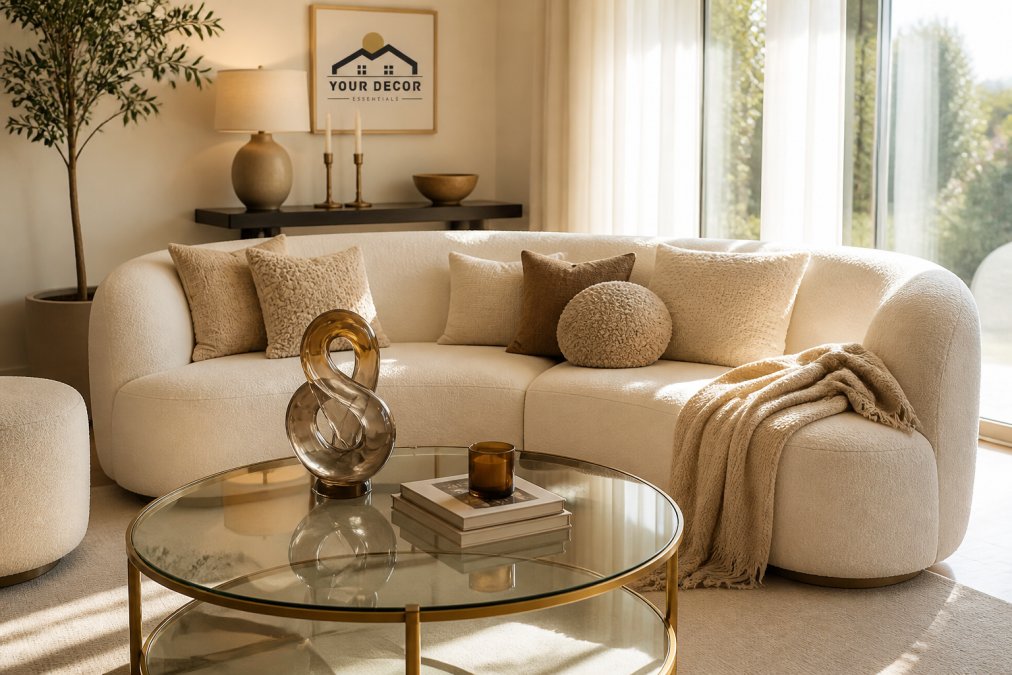
What's driving it? People spent years in rooms that photographed well and lived poorly. Soft edges, natural materials, and pieces you want to touch are the correction.
But here's the part most trend coverage skips: a trend you can't live with for five years is a cost, not a style. New homeowners carry a mortgage, not a staging budget. So the useful question isn't "what's hot in 2026", it's "which of these trends will still look right when the next cycle arrives?"
The Durability Test: Structural Trends vs. Seasonal Trends
A practical way to sort 2026 trends is to ask whether the trend lives in the structure of a piece or in its surface.
Structural trends change the shape, proportion, or material of an object. They tend to age well because they respond to how bodies and rooms actually work:
- Curved and organic silhouettes (rounded chair backs, pedestal tables, soft-edged sofas)
- Natural and tactile materials (boucle, raw linen, unlacquered brass, matte ceramic, solid wood)
- Layered lighting (ambient, task, and accent rather than a single overhead source)
- Warm metals (brass, bronze, aged gold) instead of cool chrome
- Reflective surfaces used to bounce light into rooms with few windows
Seasonal trends live in the surface layer, a specific color, a specific pattern, a specific finish that only reads correctly for a season or two. These are the ones that make a room feel dated fastest, and they're the ones to buy in the smallest possible dose.
A simple rule: if the trend changes the shape of a thing, it's probably durable. If it changes only the color of a thing, it's probably fleeting.
Sculptural Silhouettes and Tactile Finishes
Sculptural silhouettes describe furniture and decor with curved, organic, or asymmetrical forms that read as objects rather than boxes. A rounded chair back, a pedestal table with a tapered base, a vase that leans slightly off-axis. These shapes soften open-concept living spaces that otherwise feel like hallways.
Tactile finishes are the companion trend: boucle, raw linen, unlacquered brass, matte ceramic, and hand-finished resin. The point is contrast. A room where everything is smooth and cool feels like a lobby. Add one rough, one soft, and one reflective surface and it feels inhabited.
Both of these pass the durability test. A curved sofa is still a curved sofa in 2031. A boucle chair doesn't stop being comfortable when the color cycle moves on.
Reflective Palettes and Warm Metallics
Reflective color palettes use lighter, glossier surfaces to bounce light into rooms with limited windows. Warm metallics, meaning brass, bronze, and aged gold rather than chrome, pair naturally with these palettes because they add depth without reading cold.
For new homeowners, the practical version is simple: paint the largest surfaces in a soft neutral, then introduce reflection through a mirror, a glass-topped table, or a glazed ceramic piece. You get the light benefit without committing to a full renovation.
Which 2026 Trends to Buy Small
Some 2026 trends are worth trying, just not at full scale. Buy these in the smallest dose that satisfies you:
- A specific trending color (a pillow, a vase, a small sculpture) rather than a painted wall
- A trending pattern (a throw, a set of napkins) rather than upholstery
- A trending finish (a lamp, a tray) rather than a large furniture surface
- A trending shape (one accent chair) rather than a full seating set
The logic is the same one that governs any first-home purchase: the bigger the surface area, the longer you'll have to live with the decision. Trend-proof the large surfaces; experiment on the small ones.
Essential Furniture for New Homeowners
Essential furniture for new homeowners comes down to five anchors: a sofa, a bed frame, a dining table, a storage piece, and a rug. Everything else is optional and can be added over time without the room looking unfinished.
The mistake is buying all five at once from one catalog. You end up with a room that matches but doesn't reflect anyone.
| Room | Anchor Pieces | Add Later | Skip For Now |
|---|---|---|---|
| Living room | Sofa, rug, coffee table | Side tables, art, lighting | Full media wall |
| Bedroom | Bed frame, mattress, nightstands | Bench, art, lamps | Matching dresser set |
| Dining | Table, four chairs | Sideboard, pendant light | Full china cabinet |
| Entryway | Bench or console, hooks | Mirror, tray, runner | Built-in shelving |
How to Style a New House on a Budget
Styling a new house on a budget works best when you spend where the eye rests and save where it doesn't. High-touch, high-visibility surfaces justify more money. Back-of-house storage and utility pieces rarely do.
The Sequencing Method: What to Buy in What Order
A workable order for a first home, based on how rooms reveal themselves over time:
- Month 1, Measure and map. Before buying anything, measure each room and note where light lands, where traffic flows, and which walls you actually look at. This costs nothing and prevents most expensive mistakes.
- Month 1-2, Anchors only. Buy the sofa, the bed frame, and the dining table. These set the proportions every other piece has to live with. Live with them for a few weeks before adding anything else.
- Month 2-4, Rugs and lighting. These two categories change how everything else reads more than any other purchase. A rug defines the seating zone; layered lighting defines the mood. Both are worth prioritizing over decor.
- Month 4-6, Storage and utility. Add the pieces that solve a daily problem (entryway hooks, a console, a storage ottoman). Function first, style second.
- Month 6+, Art, accents, and the affordable layer. This is where personality lives, and it's the layer you'll edit most often. Add it last so it responds to the room rather than fighting it.
Where to Splurge and Where to Save
Splurge on anything your body touches daily and anything that carries weight: the sofa frame, the mattress, the dining table surface. Save on lighting shades, throw pillows, vases, and small decor, because those are the pieces you'll want to change as your taste settles.
The Affordable Layer Needs Editing More Than the Expensive One
One insider note: a single well-chosen abstract piece does more for a room than five inexpensive accessories. It gives the eye a focal point, and focal points are what make a space feel designed rather than filled.
Budget Allocation by Category
A workable allocation for a first home, expressed as relative shares rather than dollar amounts (since pricing varies by market and by piece):
- Anchors (sofa, bed, dining table): the largest share, because these set the room's proportions
- Rugs and lighting: the second-largest share, because they change how everything else reads
- Art and decor accents: a modest share, added gradually
- Textiles: the smallest share, and the easiest to swap seasonally
Incorporating Abstract Sculptures in Home Design
Incorporating abstract sculptures in home design gives a room a focal point that isn't a screen or a piece of furniture. An abstract form asks the eye to interpret rather than recognize, which is why it holds attention longer than a literal object like a figurine or a framed quote.
Placement matters more than size. Three reliable spots:
- Console or entryway table: a mid-size piece anchors the arrival zone
- Bookshelf or built-in niche: a smaller sculpture breaks up rows of spines
- Coffee table or side table: a low, wide form adds weight without blocking sightlines
Strategic Paint and Color Palettes for New Homes
Strategic paint choices do more for a new home than any furniture purchase, because paint sets the background every other decision sits against. Start with the rooms you use most and the walls you see longest.
A practical sequence:
- Choose a whole-home neutral for hallways and connecting spaces
- Pick one accent wall per main room, not per wall
- Test swatches on the actual wall and check them at three times of day
- Paint ceilings in a flat white unless the room is very tall
Maximizing Small Spaces with Vertical Optimization
Vertical space optimization means treating your walls as usable square footage. In small homes, the floor is the scarcest resource, and most people leave the top half of every room empty.
Where to go vertical:
- Floor-to-ceiling shelving instead of low bookcases
- Wall-mounted lighting instead of table lamps, freeing surface area
- Hooks and rails in entryways and kitchens
- Tall, narrow art rather than wide, short pieces
- Curtains hung high and wide to make windows and ceilings read larger
Mixing Investment Pieces with Affordable Finds
Mixing investment pieces with affordable finds is the fastest way to make a room look collected rather than catalog-ordered. The formula is simple: one anchor, several supporting pieces, and one unexpected object.
Where the money goes:
- Investment: sofa, rug, dining table, original art, a sculpture you'll keep for a decade
- Affordable: lampshades, pillows, books, planters, seasonal textiles, small ceramics
Sustainable and Eco-Conscious Sourcing
Sustainable materials in home decor means choosing pieces made from renewable, recycled, or responsibly harvested sources, and buying fewer things that last longer. For new homeowners, the practical version is less about certification logos and more about asking where a piece came from and how it was finished.
Questions worth asking before you buy:
- Is this solid wood or veneer over particleboard?
- Is the finish water-based or solvent-based?
- Will this piece still look right in ten years?
- Can it be repaired rather than replaced?
Smart Home Integration Aesthetics
Smart home integration aesthetics is the practice of hiding or styling the technology that runs your home so it doesn't fight your decor. Speakers, hubs, cameras, and charging cables are now permanent residents. Treat them like any other object in the room.
Practical approaches:
- Choose speakers and hubs in finishes that match your palette
- Route cables behind furniture or through wall channels
- Put charging stations inside a drawer or a lidded box
- Mount displays at art height so they read as part of the wall
- Use smart bulbs in your existing fixtures rather than adding new ones
Psychology of Space and Mental Well-Being
The psychology of space is the study of how layout, light, and visual complexity affect how people feel in a room. The practical findings are consistent: clutter raises stress, natural light improves mood, and rooms with a clear focal point feel calmer than rooms with none.
Three changes with outsized effect:
- Decluttering techniques: remove one object from every surface and see if you miss it
- Lighting design: add a warm lamp at low height in every room you sit in after dark
- Texture layering: one soft, one rough, one smooth surface per seating area
Maintenance and Longevity of Trends
Trend longevity comes down to two questions: is this piece tied to a color that will date, and is it built well enough to outlive the trend? Answer both honestly and you'll avoid most of the regret that follows a renovation.
Maintenance habits that protect your investment:
- Rotate and flip cushions to even out wear
- Keep textiles out of direct sun to slow fading
- Dust sculptures and resin pieces with a soft dry cloth, not solvent cleaners
- Refinish wood surfaces rather than replacing furniture
- Store seasonal decor properly so it survives more than one year
Frequently Asked Questions
What decorating trends are out for 2026?
Matchy-matchy furniture sets, heavy dark wood, and generic big-box art are fading. New homeowners in 2026 are moving toward curated, non-mass-produced pieces that reflect personal style. Sculptural silhouettes, tactile finishes, and reflective color palettes are replacing flat, uniform looks. The focus is on spatial clarity and functional decor rather than filling every corner.
What is the 3-5-7 rule in decorating?
The 3-5-7 rule is a styling guideline for arranging decor on shelves, mantels, or tables. Use three items in one grouping, five in another, and seven in a larger display. Odd numbers create visual balance because the eye cannot pair them symmetrically. Mix heights, textures, and materials within each group. For example, combine a tall abstract sculpture, a medium resin accent, and a small candle in a three-item vignette.
What are the essential furniture pieces every new homeowner should buy first?
Start with a comfortable sofa, a dining table with chairs, and a quality bed frame. These anchor daily life and set the scale for other rooms. Add a versatile coffee table, at least one accent chair, and functional lighting like a floor lamp or pendant. Modular furniture works well for open-concept living because it adapts as your needs change. Prioritize pieces you will use daily before buying decorative accents.
How do I create a cohesive look in a new home without hiring a designer?
Pick a consistent color palette of three to five colors and repeat them across rooms. Choose one or two finishes, like matte black and warm brass, for hardware and lighting. Use texture layering through textiles and rugs to add depth without introducing new colors. Keep architectural millwork and trim consistent. A curated aesthetic comes from repetition and restraint, not from buying everything at once.
How can new homeowners balance functionality with style?
Choose multi-functional furniture like storage ottomans, extendable dining tables, and modular sofas. In a home office setup, pick a desk that hides cables and a chair that supports long sitting sessions. Functional decor, such as a sculptural lamp that also provides task lighting, lets you enjoy artful pieces without sacrificing utility. Every item should earn its place by serving at least one practical purpose.
What are the best ways to incorporate abstract art into home decor?
Abstract sculptures work best as focal points on console tables, bookshelves, or entryway surfaces. Place them where natural light hits the curves to highlight resin accents and tactile finishes. Group a large sculpture with smaller objects in odd-numbered arrangements. In open-concept living areas, use one statement piece per sightline to avoid visual clutter. Rotate pieces seasonally to keep the room feeling fresh.
How do I choose a color palette for a new house?
Start with the fixed elements you cannot change, like flooring and countertops. Choose a dominant neutral for 60 percent of the room, a secondary color for 30 percent, and an accent for 10 percent. Reflective color palettes with warm whites, soft greys, and muted earth tones make rooms feel larger. Test paint samples on walls for at least 48 hours before committing.
What are the trends for house designs in 2026?
Open-concept living remains popular, but with defined zones created through rugs, lighting, and furniture placement. Architectural millwork adds character to plain walls. Sustainable materials like reclaimed wood and recycled resin are in demand. Smart home integration aesthetics mean devices are designed to blend with decor rather than stand out. Vertical space optimization and decluttering techniques are key for smaller footprints.