 how-to
How to Choose Lighting for Small Apartments
Table of Contents
- Why Small Apartment Lighting Requires a Different Approach
- Best Lighting for Apartments with No Overhead Lights
- How to Layer Lighting in a Small Apartment
- Warm vs Cool Light for Small Rooms
- Renter-Friendly Lighting: No-Drill Solutions That Work
- Choosing Small Apartment Lighting That Fits Your Style
- Conclusion
Last Updated: August 27, 2026
Why Small Apartment Lighting Requires a Different Approach
Small apartments present three compounding challenges that larger homes don't face: insufficient ceiling fixtures, low ceilings that trap light at the center, and renter restrictions on hardwired installations. Poor light distribution creates visual clutter and makes spaces feel smaller than their actual square footage.
The solution is layering, combining multiple light sources at different heights and intensities to create balanced, dimensional space. A single overhead fixture casts harsh shadows and flattens surfaces. Multiple sources at varying heights open the room visually.
This guide covers practical approaches from floor lamps and plug-in sconces to LED strips and renter-friendly installation, with the goal of creating a space that feels open, warm, and intentional.
Best Lighting for Apartments with No Overhead Lights
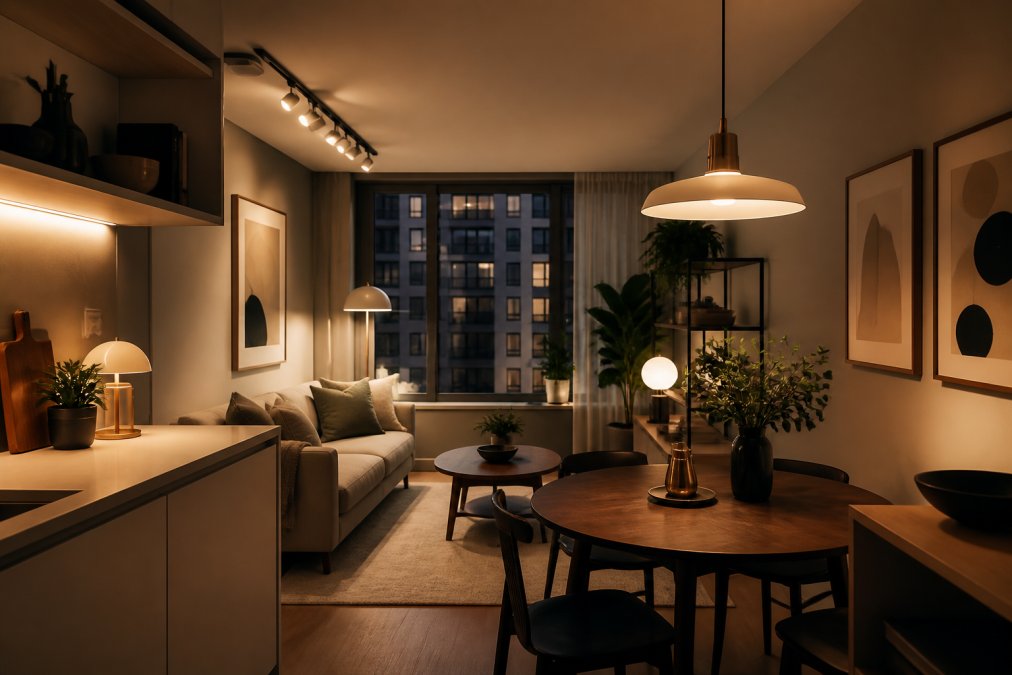
Apartments without ceiling fixtures offer an opportunity to build a layered scheme from scratch. Floor lamps, plug-in wall sconces, and LED strip lighting can produce ambient, task, and accent lighting without any installation.
Floor Lamps: Big Light, Small Floor Footprint
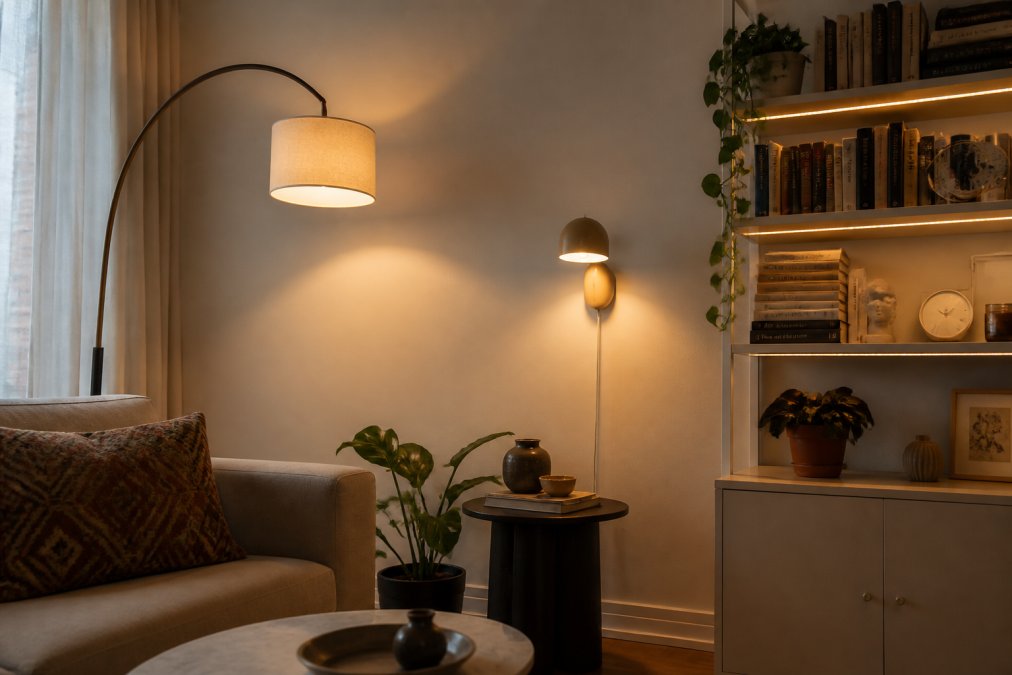
A well-placed arc lamp or torchiere can wash an entire room in diffused light using only one outlet. Torchiere floor lamps direct light upward toward the ceiling, which bounces back as soft ambient lighting, the closest approximation to a ceiling fixture without installation. Arc lamps extend over seating areas for task lighting; tripod lamps add visual height as accent pieces.
For small spaces, prioritize lamps with slim profiles and adjustable heads. Placing a floor lamp in a corner bounces light off two walls simultaneously, increasing perceived brightness without additional fixtures.
Plug-In Wall Sconces and Swing-Arm Lights
Plug-in wall sconces mount using adhesive hardware or a single hook and plug directly into standard outlets, delivering the visual effect of hardwired sconces without commitment. Swing-arm versions articulate outward to direct light precisely where needed, over a bed for reading, beside a desk for task work, or flanking a mirror for even illumination. Because they sit flush against the wall, they consume zero floor space.
Cord management clips keep wires tight against baseboards so they read as intentional. Some renters use narrow cord covers painted to match the wall for a cleaner finish.
Wall-mounted lighting at eye level fills the zone where people actually live, making a room feel more complete than relying entirely on floor-level or ceiling-level sources.
LED Strip Lighting and Under-Cabinet Applications
LED strips add light without visual bulk. Effective applications include under-cabinet lighting in kitchens, behind televisions to reduce eye strain, along bookshelves to highlight objects and emphasize vertical space, and under bed frames or sofas for subtle ambient glow that makes furniture appear to float.
Choose LED strips with warm white color temperature and a diffuser channel rather than bare strips. Diffused light eliminates the "dotted" effect and produces a smoother result. Most strips are self-adhesive and fully renter-friendly.
According to the U.S. Department of Energy's residential lighting guidance, LED technology now offers significant improvements in both energy efficiency and light quality compared to incandescent alternatives.
How to Layer Lighting in a Small Apartment
Layering lighting means deliberately combining three types of light sources so no single source does all the work.
Ambient, Task, and Accent Lighting Explained
Ambient lighting is the base layer providing general illumination. Floor lamps, plug-in pendants, and torchieres typically serve this function.
Task lighting is focused and purposeful, targeting specific activities like reading, cooking, or working at a desk. Table lamps, swing-arm sconces, and under-cabinet strips deliver brightness exactly where needed.
Accent lighting highlights architectural features, artwork, or decorative objects. A spotlight on wall art, LED strips inside a bookshelf, or a lamp illuminating a sculptural piece all qualify.
A practical layering approach for a small apartment living room:
- Start with one ambient source (torchiere or arc floor lamp) in a corner
- Add task lighting at the seating area (table lamp or swing-arm sconce)
- Include one accent source (LED strip on a shelf or small spotlight on decor)
- Connect sources to dimmer switches or smart bulbs for brightness adjustment
| Lighting Layer | Primary Purpose | Best Fixture Type | Placement |
|---|---|---|---|
| Ambient | General room illumination | Torchiere floor lamp, plug-in pendant | Corners, ceiling-adjacent |
| Task | Activity-specific brightness | Table lamp, swing-arm sconce | Desk, bedside, reading chair |
| Accent | Highlighting decor and features | LED strips, small spotlights | Shelves, artwork, sculptures |
Using Mirrors and Light Reflection to Expand the Space
Mirrors are a lighting tool. Placed opposite or adjacent to a light source, a mirror doubles the perceived brightness by reflecting light back into the space. The most impactful placement is directly opposite a window during daylight. At night, placing a mirror near a floor lamp or sconce achieves a similar effect.
Leaning a large mirror against a wall is fully renter-friendly. Light-colored walls and glossy finishes also distribute brightness; matte dark walls absorb it.
Warm vs Cool Light for Small Rooms
The color of your light matters as much as quantity. Most people make their biggest mistake by buying whatever bulb is on sale.
Understanding Kelvin, CRI, and Lumens
Kelvin (K) measures color temperature. Lower numbers produce warm, amber-toned light; higher numbers produce cool, blue-toned light.
- 2700K - 3000K (warm white): Creates a cozy, residential atmosphere ideal for living rooms, bedrooms, and dining areas. Makes small spaces feel inviting rather than clinical.
- 3500K - 4100K (neutral white): A middle ground suitable for home offices and kitchens where clarity matters.
- 5000K - 6500K (cool white / daylight): Mimics daylight and is best for task-heavy areas. In small living spaces, cool white can feel harsh and sterile.
For most small apartments, 2700K to 3000K is right for ambient and accent layers. Task lighting can go slightly higher, around 3000K to 3500K, for reading clarity.
CRI (Color Rendering Index) measures how accurately a light source renders colors compared to natural sunlight, on a scale of 0 to 100. A CRI of 80 or above is minimum for residential spaces; 90 or above is ideal for artwork and curated decor. Low-CRI lighting makes colors look flat and washed out.
Lumens measure actual brightness output. A standard 60-watt incandescent bulb produces roughly 800 lumens. For small apartments, total lumen count across all sources matters more than any single bulb's wattage.
A practical guide for small spaces:
- Living room (150-200 sq ft): Target 1,500-3,000 total lumens across all sources
- Bedroom: Aim for lower ambient lumens (around 1,000-2,000) with higher task lumens at bedside
- Kitchen: Prioritize task lighting at countertops; under-cabinet LEDs add targeted lumens where overhead fixtures fall short
Renter-Friendly Lighting: No-Drill Solutions That Work
Renter-friendly lighting solutions are also among the most design-forward options available.
Plug-in fixtures are the foundation of any renter-friendly scheme. Floor lamps, plug-in pendants, and plug-in sconces require only an outlet. Many plug-in pendants come with ceiling canopy kits that attach using a single adhesive hook.
Adhesive mounting systems can support wall sconces, small shelves, and cord management systems without leaving permanent marks. Always check weight ratings against your fixture.
Dimmer switches present a challenge for renters since most involve replacing the wall switch. Smart bulbs allow brightness and color temperature adjustment via app or voice control without touching any wiring. In-line cord dimmers plug between the outlet and lamp cord.
Electrical load and safety matter. Every outlet circuit has a rated amperage limit, typically 15 or 20 amps. LED bulbs dramatically reduce this concern because they draw far less wattage for equivalent lumen output. A lamp that once required a 60-watt incandescent now runs on an 8-10 watt LED.
According to the Electrical Safety Foundation International's home electrical safety guidance, overloaded outlets are among the leading causes of residential electrical fires. Using LED fixtures across multiple plug-in sources keeps total load well within safe limits.
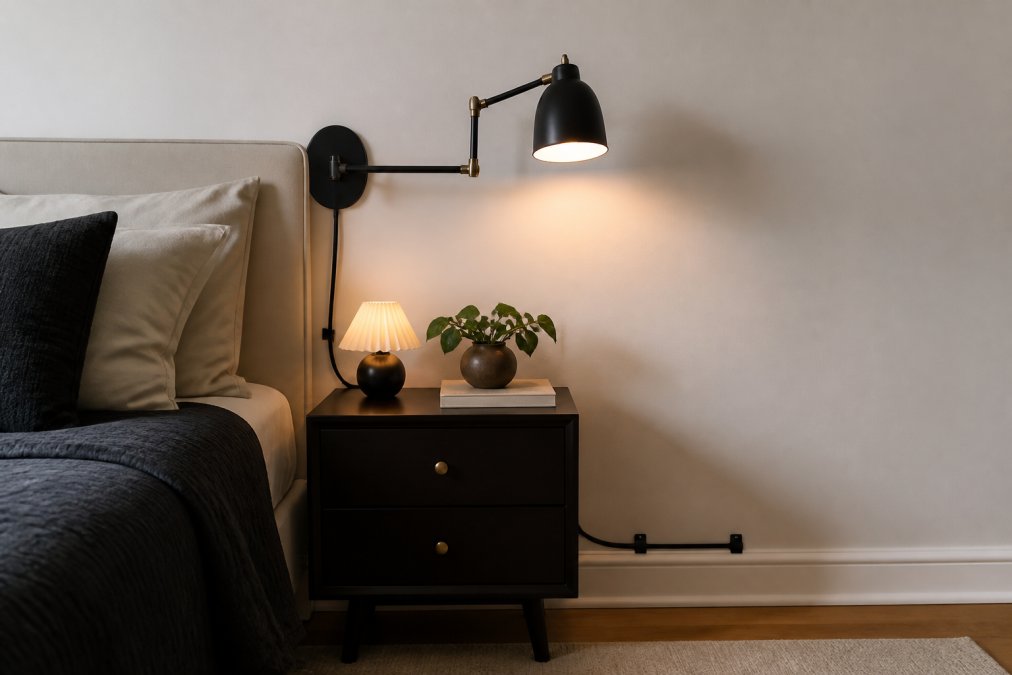
No-drill lighting solutions at a glance:
- Plug-in floor lamp in the main ambient position
- Plug-in swing-arm sconce at the bedside or reading chair
- LED strip lights under cabinets or shelves (self-adhesive)
- Smart bulbs in all existing sockets for dimming and color temperature control
- In-line cord dimmers on any lamp without a built-in switch
- Cord management clips along baseboards for a tidy finish
- Large leaning mirror opposite the primary light source
Choosing Small Apartment Lighting That Fits Your Style
Lighting fixtures are furniture. They occupy visual space, establish mood, and communicate something about the person who lives there.
Scale matters more than most people realize. A tiny table lamp on a large console looks tentative. A substantial arc floor lamp in a small room reads as confident and intentional. One well-proportioned statement lamp does more work than three undersized ones.
Fixture finish creates visual cohesion. Mixing brass, chrome, and matte black in a small space creates visual clutter. Choose one or two metal finishes and repeat them across fixtures and hardware.
Shade material affects light quality. Opaque shades direct light up or down, creating dramatic pools. Translucent fabric shades diffuse light softly. Glass shades refract light and add sparkle. For small spaces, diffused or upward-directed light generally works better than tightly focused downward beams.
Track lighting is worth mentioning for renters with a single ceiling outlet. A plug-in track lighting kit attaches to an existing ceiling outlet without hardwiring and lets you direct multiple adjustable heads across the room.
As the American Lighting Association's residential lighting design resources explains, layered lighting design is the single most impactful change renters can make to improve how a space feels, often before any furniture or decor changes are needed.
Choosing the right lighting for a small apartment solves the problem of dim rooms that feel wrong. The answer is almost always the same: too few sources, too little layering, and bulbs chosen without attention to Kelvin or CRI. Your Decor Essentials carries functional lighting and curated decor pieces designed to work together in exactly these spaces, including fixtures that complement the warm, high-CRI environments where abstract sculptures and resin accents show their best. Shop Now to find lighting that fits your space and your style.
Frequently Asked Questions
How do you light a small apartment without overhead lighting?
Floor lamps, plug-in wall sconces, and swing-arm lights are the most effective substitutes for ceiling fixtures. Place a tall floor lamp in a dark corner to spread ambient lighting upward, add a plug-in sconce at reading height beside a sofa or bed, and use LED strip lighting under shelves or along baseboards for layered brightness. Combining at least three light sources prevents flat, shadowy rooms and creates the same coverage overhead lighting would provide.
What is the best color temperature for small apartment lighting?
For living areas and bedrooms, warm white bulbs in the 2700K to 3000K Kelvin range create a cozy atmosphere that makes a small room feel inviting rather than clinical. For a home office or kitchen where you need focus and clarity, a neutral to cool white around 3500K to 4000K works better. Avoid bulbs above 5000K in small spaces; that daylight-range color temperature can feel harsh and make rooms look stark rather than spacious.
Can floor lamps make a small apartment feel cramped?
Only if you choose the wrong style. Bulky tripod bases or wide drum shades take up visual space. Slim torchiere-style floor lamps or arc lamps with a small base direct light upward and keep the floor footprint minimal. Placing a floor lamp in a corner rather than in the middle of a traffic path also prevents that cramped feeling while still delivering strong ambient lighting across the room.
How many light sources should a small living room have?
A small living room needs at least three light sources to avoid flat, single-point lighting. One ambient source handles overall brightness, one task light covers reading or work areas, and one accent light draws attention to artwork, shelving, or a decorative piece. This layering approach eliminates harsh shadows, reduces visual clutter caused by a single glaring bulb, and gives you control over the mood depending on the time of day.
This article was written using GrandRanker