 how-to
How to Evaluate Home Decor Construction Techniques
Last Updated: October 30, 2026
Quick Summary
To evaluate home decor construction, look past the finish and check the build itself: clean joints, sturdy support, and materials that match the price and purpose. Pieces built this way last longer and hold up to daily use better than ones that hide flaws under paint, stain, or resin.
- Look closely at every joint, since gaps, uneven seams, and visible glue signal weak construction.
- Press on flat surfaces, because wobble or flex means the piece has weak support.
- Ask the seller which material each part uses, and treat vague terms like "wood-look" as a warning.
- Match the joinery to the job: pieces that bear weight need dovetail or mortise-and-tenon joints or reinforced hardware.
- Ask about weight limits, dimensions, and return policy before you buy, especially online.
Table of Contents
- Why Construction Matters More Than Appearance in Home Decor
- Start With a Quality Checklist You Can Use in the Store or Online
- Compare Furniture Joinery Types and What Each One Signals
- How to Evaluate Furniture Materials: Solid Wood, Engineered Wood, and Veneer
- Inspect the Finish, Edges, and Surface Preparation
- Test Durability, Stability, and Load Capacity Before You Commit
- Assess Lighting Fixtures and Resin Accents as Construction Pieces
- Questions to Ask When Buying Furniture and Decor Online
- Booking Your Next Piece With Confidence at Your Decor Essentials
- Frequently Asked Questions
Why Construction Matters More Than Appearance in Home Decor
A decor piece can look perfect in a photo and still fall apart within a year. Construction decides how long a piece lasts, how it holds up to daily use, and whether it stays level on your shelf. Appearance gets you to the cart. Construction is what you live with afterward.
This guide shows you how to evaluate home decor construction techniques before you buy, whether you are shopping in a store or online. You will learn what to check, what each joint or material signals, and which questions to ask a seller.
Here's the core idea: look past the finish and into the build. A well-built piece usually has clean joins, even surfaces, and materials that match the price and purpose. A poorly built piece hides its flaws under paint, stain, or glossy resin.
At Your Decor Essentials, we focus on unique pieces like abstract sculptures, resin accents, furniture, and lighting. Each category has its own construction concerns, so the checks below apply across the board.
Start With a Quality Checklist You Can Use in the Store or Online
Before you fall for a piece, run through a short checklist. It takes two minutes and keeps you from buying on impulse.
- Check the weight. Solid pieces feel substantial for their size.
- Look at every joint. Gaps, uneven seams, and visible glue are warning signs.
- Press on flat surfaces. Wobble or flex means weak support.
- Inspect the finish in bright light. Bubbles, drips, and thin spots show up fast.
- Read the materials list. Vague terms like "wood-look" deserve a follow-up question.
- Confirm the dimensions. Scale mismatches cause returns.
Online, you cannot touch the piece, so lean on the product photos. Zoom in on corners, edges, and the back. Sellers who show these areas clearly usually have nothing to hide.
Compare Furniture Joinery Types and What Each One Signals
Joinery is how two pieces of material connect. It tells you more about how a piece will age than any finish or fabric. The goal here is not to memorize joint names, it is to look at a joint and predict whether it will loosen, crack, or hold.
What to look for at each joint type
Dovetail joints interlock like fingers and resist pulling apart. They appear on drawers and boxes. Tight, even dovetails with no gaps signal careful work. Run your finger along the seam: if you feel ridges or see light through the pins, the cut was rushed. Machine-cut dovetails are fine; uneven spacing is the warning sign.
Mortise and tenon joints fit a peg into a matching hole. They are strong and common in chairs, tables, and bed frames. Check that the tenon is pinned or glued securely, a tenon that wiggles when you twist the joint will loosen under load. On chairs, test the joint by gently rocking the back; movement at the joint means the glue has failed or the fit was poor.
Dowel joints use wooden pins to align pieces. They are cheaper and fine for light use, but they can loosen over time. Look for dowels that sit flush and are not backing out. A dowel joint that has already started to separate often shows a hairline gap at the seam.
Screws and cam fasteners are common in flat-pack furniture. They work well when installed properly, but they rely on hardware quality. Check that screws are not stripped, that cam locks are fully engaged, and that the panel edges are not crushed around the fastener. Crushed edges mean the hardware will not hold torque.
Staples and brad nails appear in lightweight pieces. They hold the frame in place but offer less long-term strength. They are acceptable for decorative trim and back panels, not for load-bearing frames.
Match the joint to the job
A quick rule: the more a piece will move or bear weight, the more you should care about the joinery. A wall accent needs less strength than a side table that gets bumped daily. For anything you lean on, sit on, or stack heavy objects onto, look for mechanical joints (dovetail, mortise and tenon) or reinforced hardware, not staples alone.
Repairability matters too
A joint you can tighten or reglue is worth more than one that fails permanently. Screws and bolts can be retightened. Dowel and mortise-and-tenon joints can often be reglued if the fit is still tight. Staples and brad nails are difficult to repair without disassembling the piece. Ask yourself: if this joint loosens in two years, can I fix it?
How to Evaluate Furniture Materials: Solid Wood, Engineered Wood, and Veneer
Material choice shapes durability, repairability, and how a piece handles moisture and wear. Most buying guides describe materials; this section compares them on the trade-offs that actually affect how long a piece lasts and whether you can fix it.
Solid wood
Solid wood is cut from one piece of timber. It handles weight well, can be sanded and refinished multiple times, and holds joinery securely. Check the grain: consistent, natural patterns that continue across a joint usually mean real wood. End grain on the edges is another giveaway.
- Durability: High for hardwoods; softer woods dent more easily.
- Repairability: High, scratches and dents can be sanded out, and the piece can be refinished.
- Moisture: Solid wood expands and contracts with humidity. A well-sealed finish reduces movement, but wide panels can still shift seasonally.
- Best use: Load-bearing frames, tabletops, chairs, and pieces you plan to keep for years.
Engineered wood
Engineered wood bonds layers or fibers into panels, often with particleboard or MDF cores. It is stable and affordable, but it can swell if exposed to moisture. Edges are the giveaway: look for a clean, sealed finish. Unsealed edges absorb water and swell first.
- Durability: Moderate. MDF and particleboard hold screws less securely than solid wood and can crumble if water reaches the core.
- Repairability: Low to moderate. Dents and water damage are difficult to repair; refinishing is limited.
- Moisture: Poor unless the core and edges are sealed. Keep engineered wood out of bathrooms and damp areas unless it is rated for moisture exposure.
- Best use: Shelving, cabinet boxes, and budget-friendly pieces in dry rooms.
Veneer
Veneer is a thin slice of real wood glued over a cheaper core. It looks rich and resists warping, but a deep scratch can expose the core underneath.
- Durability: Moderate. The veneer layer wears well, but the core determines strength.
- Repairability: Low. Deep scratches and chips are hard to match; patching is visible.
- Moisture: Depends on the core and adhesive. Water can lift veneer at the edges.
- Best use: Decorative surfaces, cabinet doors, and pieces where appearance matters more than heavy use.
Metal and composite materials
Metal frames and legs are common in shelving, lighting, and accent furniture. They resist moisture and hold weight well, but check for coating quality, chips expose bare metal and lead to rust. Composite materials vary widely; ask what the composite is and how it is finished.
The comparison that matters
| Material | Durability | Repairability | Moisture resistance | Typical use |
|---|---|---|---|---|
| Solid wood | High | High | Moderate (sealed) | Frames, tops, chairs |
| Engineered wood | Moderate | Low | Low | Shelving, cabinet boxes |
| Veneer | Moderate | Low | Moderate | Decorative surfaces |
| Metal | High | Moderate | High | Frames, legs, lighting |
Ask the seller which material each part uses. A product that says "solid wood top with engineered base" is telling you something useful about where the stress points are, and where moisture risk lives.
Inspect the Finish, Edges, and Surface Preparation
The finish is the first thing your eye catches, so it is also the easiest thing for a maker to disguise problems with.
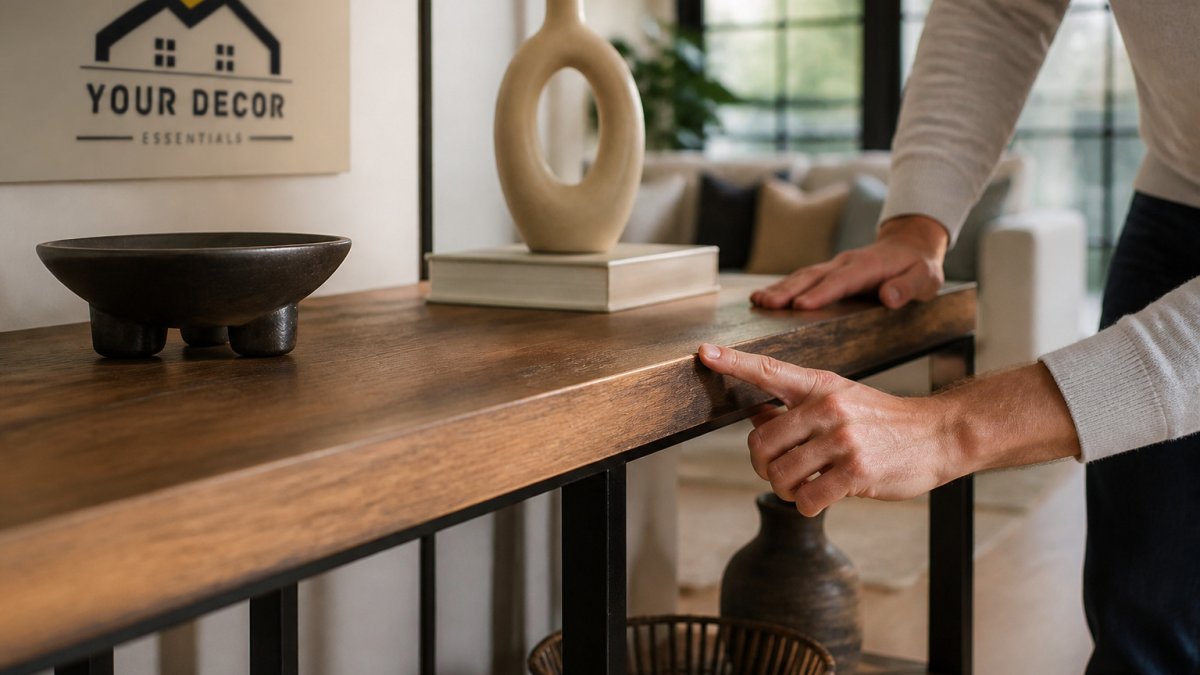
Look for these details:
- Even coverage. Uneven color or sheen suggests rushed prep.
- Clean edges. Rounded or sealed edges handle wear better than raw cut edges.
- Smooth surfaces. Run your hand across the piece if you can. Rough patches mean sanding was skipped.
- No pooling or drips. These point to poor application technique.
For resin pieces, check the surface for air bubbles, cloudy patches, and edges that look trimmed unevenly. Clear resin should look glassy. Anything milky or tacky deserves a closer look before you buy.
Surface preparation matters because paint and finish stick only to a clean, well-sanded base. A piece that peels or chips early often skipped this step.
Test Durability, Stability, and Load Capacity Before You Commit
Durability is about how a piece handles real life. Stability is about whether it stays put. Load capacity is how much weight it can hold.
Try these checks in the store:
- Set the piece on a flat floor and see if it rocks.
- Push the top edge gently in several directions.
- Open and close any drawers or doors several times. Smooth motion beats stiff or sticky action.
- For shelves, look for a center brace or thicker board on longer spans.
Online, look for listed weight limits and dimensions. If a shelf or table has no stated capacity, ask. Good sellers know this information.
Many buyers find that pieces with metal frames or reinforced corners handle daily use better than unsupported thin panels. A common approach is to match the piece to its job: decorative items can be lighter, while anything you lean on or set heavy objects on needs real structure.
Assess Lighting Fixtures and Resin Accents as Construction Pieces
Lighting and resin pieces are built differently from furniture, so the checks shift a bit.
For lighting fixtures, look at:
- Wiring and mounting. Hardwired fixtures should have clean, enclosed connections. Plug-in lamps should have a sturdy cord and base.
- Socket quality. Loose sockets cause flickering and can be a safety issue.
- Shade attachment. Shades should sit firmly and not rattle when you tap them.
- Base weight. A heavier base keeps a table lamp from tipping.
For resin accents, check for:
- Clean casting. Look for consistent color, no trapped debris, and smooth edges.
- Secure mounting points. Wall pieces need solid hanging hardware. Ask what weight the hardware supports.
- Full cure. A piece that feels soft, sticky, or smells strongly may not be fully cured.
Ask the seller for the wattage and bulb base on lighting, and the dimensions and mounting details on resin pieces. These specs help you avoid mismatches with your space.
Questions to Ask When Buying Furniture and Decor Online
Sellers who know their products can answer these quickly. Hesitation or vague replies tell you something too.
- What materials are used in each part of this piece?
- How is the piece joined together?
- What is the weight limit for shelves or tables?
- What finish is applied, and how should I clean it?
- What are the exact dimensions, including depth and height?
- What bulb type and wattage does this fixture need?
- How is the piece packed for shipping?
- What is your return policy if the build quality is not what I expected?
A seller who answers these with specifics is more likely to stand behind what they sell.
Booking Your Next Piece With Confidence at Your Decor Essentials
Once you know what to look for, shopping gets easier. Pick a piece, check its joinery and materials, test its stability through the photos or specs, and ask the questions above.
If you want to see how these checks apply to our selection, browse our curated collection of abstract sculptures, resin accents, furniture, and lighting. Each piece is chosen for its design and its build, so you can add visual interest to your home with confidence. Shop Now at Your Decor Essentials and find the piece that fits your space.
Frequently Asked Questions
How can you tell if a home decor item is well made?
Look at how the pieces are joined, how the finish is applied, and whether the edges and hardware feel solid when you handle them. Well-made items show clean, even joints with no gaps, consistent sanding and finish coverage, and fasteners that are set flush rather than rushed. If a seller can describe how the piece was built, including the joinery and materials, that transparency is a good sign. Ask for close-up photos of the underside and joints before ordering, and compare them against the checklist in this guide.
What construction details should you check before buying furniture?
Check the joinery first, since it determines how long a piece holds together under daily use. Look at drawer construction, corner joints, leg attachments, and whether the back panel is secured. Next, examine the materials, confirming whether the frame is solid wood, engineered wood, or veneer over a substrate. Finally, test the stability by gently rocking the piece and checking for wobble on a level floor. Each of these details reveals more about longevity than the photo alone.
How do you evaluate the quality of materials used in home decor?
Start by identifying the core material and then the surface. Solid wood is typically heavier and shows grain continuity across edges, while engineered wood and veneer show repeated patterns or layered edges. For resin and metal accents, check for consistent color, smooth surfaces free of bubbles or seams, and sturdy bases. Ask the seller to specify each material, and be cautious when descriptions use vague terms like premium or artisan without naming what the item is made of.
How can you assess whether a decor item will last?
Durability depends on the joinery, the material, and the finish working together. Look for mechanical joints or well-fitted glue joints rather than staples alone, a finish that covers all surfaces including the underside, and materials suited to the room, such as moisture-resistant finishes in bathrooms. Gently test the item for flex or movement under load. Documenting these checks when the item arrives also gives you a record if a defect appears later.