 blog
Is Geode Resin Art Durable? A 2026 Longevity Guide
Table of Contents
- How Long Does Resin Art Last? The Honest Durability Timeline
- Best Resin for Geode Art: Matching Viscosity to Design Control
- Does Epoxy Resin Yellow in Sunlight? UV Filters Explained
- Scratch Resistance and Surface Durability: What Actually Holds Up
- How to Clean Resin Wall Art Without Damaging the Finish
- Repairing Scratches, Chips, and Yellowing on Geode Resin Art
- Indoor vs. Outdoor: Where Geode Resin Art Should and Should Not Hang
- Resin Wall Art vs. Other Materials: A Durability Comparison
- Frequently Asked Questions
Last Updated: October 14, 2026
How Long Does Resin Art Last? The Honest Durability Timeline
Geode resin art is durable enough to stay beautiful for years indoors, but it is not indestructible. A well-made piece with a quality topcoat can hold its gloss and color for a decade or more when it hangs away from direct sun. A cheap pour stored on a sunny windowsill may start to look tired much sooner.
That is the honest answer to "is geode resin art durable." The material lasts a long time. The finish is what ages first.
Buyers worry about the wrong thing. They ask whether resin cracks or shatters. It rarely does. What actually fails is the surface: dull spots, fine scratches, and slow color shift from UV light.
So the real question is not whether geode resin art lasts. It is how you protect the finish that makes it worth hanging.
Below, we break down what shortens a piece's life, how to pick the right resin, and how to clean and repair your art so it keeps its shine.
What Shortens a Geode Piece's Lifespan
Four things age resin art faster than anything else:
- Direct sunlight. UV rays break down the clear coat over time.
- Heat swings. A piece near a radiator or oven expands and contracts.
- Abrasion. Dusting with the wrong cloth leaves micro-scratches.
- Harsh cleaners. Ammonia and alcohol strip the protective surface.
Keep those four in check and a geode piece can look new for a long time.
Best Resin for Geode Art: Matching Viscosity to Design Control
The best resin for geode art is a high-viscosity, art-grade epoxy with UV filters built in. Thick resin stays where you pour it, which is exactly what you need to control where crystals, gemstones, and pigments land.
Viscosity is the single biggest factor in how a geode design turns out. Thin resin spreads fast and pools at the edges. Thick resin holds its shape, so you can build rings of color and set stone inclusions without them sliding out of place.
Here is how the two compare for geode work:
| Resin Type | Flow Behavior | Best For | Watch Out For |
|---|---|---|---|
| High-viscosity | Stays put, slow spread | Crystal inclusions, layered rings | Slow to self-level |
| Thin/low-viscosity | Spreads quickly, self-levels | Coating, sealing a final layer | Pushes inclusions off course |
| Art-grade epoxy | Medium body, clear | Overall geode pours | Needs careful measuring |
For a geode design, art-grade resin gives you design control without fighting the flow.
High-Viscosity vs. Thin Resin for Crystal Inclusions
Thick resin is the clear winner when you are setting crystals, gemstones, or stone inclusions. It grips them in place while the piece cures.
Thin resin has one job: the final clear coating. It self-levels into a glassy, glossy finish with fewer bubbles.
Does Epoxy Resin Yellow in Sunlight? UV Filters Explained
Yes, epoxy resin can yellow in sunlight, and UV exposure is the main cause. That is why art-grade resin includes UV filters, which slow the color shift and protect the clear finish. But how fast does it happen, and what does the process actually look like?
Yellowing is not a defect in the resin. It is a chemical reaction. UV light breaks down the bonds in the cured epoxy, and the clear layer slowly turns amber. Pigments and crystals stay fine. The coating around them is what changes.
UV filters are additives that absorb or block that light before it damages the resin. They do not stop yellowing forever. They slow it down, often by years, especially on a piece that hangs indoors.
What the Yellowing Timeline Actually Looks Like
A quality art-grade epoxy with UV filters will show noticeable yellowing after 3 to 5 years of continuous direct sun exposure. In indirect indoor light, that timeline stretches to 7 to 10 years or more. A cheap resin without UV filters may start to shift within 6 to 12 months on a sunny windowsill.
The first sign is usually a slight warm tint in the clearest areas. A geode with a big glossy clear section will reveal a color shift long before a heavily pigmented one does. Over time, the amber deepens and the gloss may dull as the surface also accumulates micro-scratches.
How to Test UV Resistance Before You Buy
You cannot easily test UV resistance at home without a UV lamp and months of patience. But you can look for these indicators:
- Resin labeled "UV stable" or "non-yellowing", this usually means UV absorbers are added.
- Art-grade epoxy from a reputable brand, cheaper craft resins often skip UV filters.
- A clear topcoat with UV protection, some artists add a separate UV-blocking clear coat over the cured piece.
If you already own a piece, a simple real-world test is to place a small sample of cured resin (from the same batch, if possible) on a sunny windowsill for a few months and compare it to a piece kept in a dark drawer. This won't give you exact numbers, but it shows how your specific resin reacts.
What You Can Do to Slow Yellowing
- Keep resin art out of direct sun. Hang it in a bright room with indirect light.
- If you must place it near a window, choose a north-facing wall or use UV-filtering window film.
- Rotate pieces periodically so no single area gets constant exposure.
- Dust gently and avoid abrasive cleaners that can dull the surface and make yellowing more visible.
Keep resin art out of direct sun and the UV filters do their job. Hang it in a bright room with indirect light and you get the shine without the damage.
Scratch Resistance and Surface Durability: What Actually Holds Up
Cured epoxy is reasonably scratch-resistant, but no resin surface is scratch-proof. A geode piece handles normal indoor life well. It does not handle keys, rough cloths, or abrasive cleaners.
Surface durability comes down to two things: how hard the cured resin is, and how well you treat it.
A quality art-grade epoxy cures to a hard, glossy surface that resists everyday contact. Light dust, a passing sleeve, or a hand brushing the edge will not mark it. Dragging something sharp across the face will.
A common mistake is treating resin art like glass. Glass is harder. Resin is more forgiving of impact but softer against abrasion. That trade-off matters when you decide where to hang a piece.
- Safe contact: soft cloths, bare hands, gentle dusting
- Risky contact: rings, keys, pet claws, scouring pads
- Never: abrasive powders, ammonia, or alcohol-based sprays
Treat the surface with a little care and it holds its gloss for years.
How to Clean Resin Wall Art Without Damaging the Finish
The safe way to clean resin wall art is a soft microfiber cloth, lukewarm water, and a drop of mild dish soap. Skip the glass cleaner, skip the paper towels, and skip anything labeled abrasive.
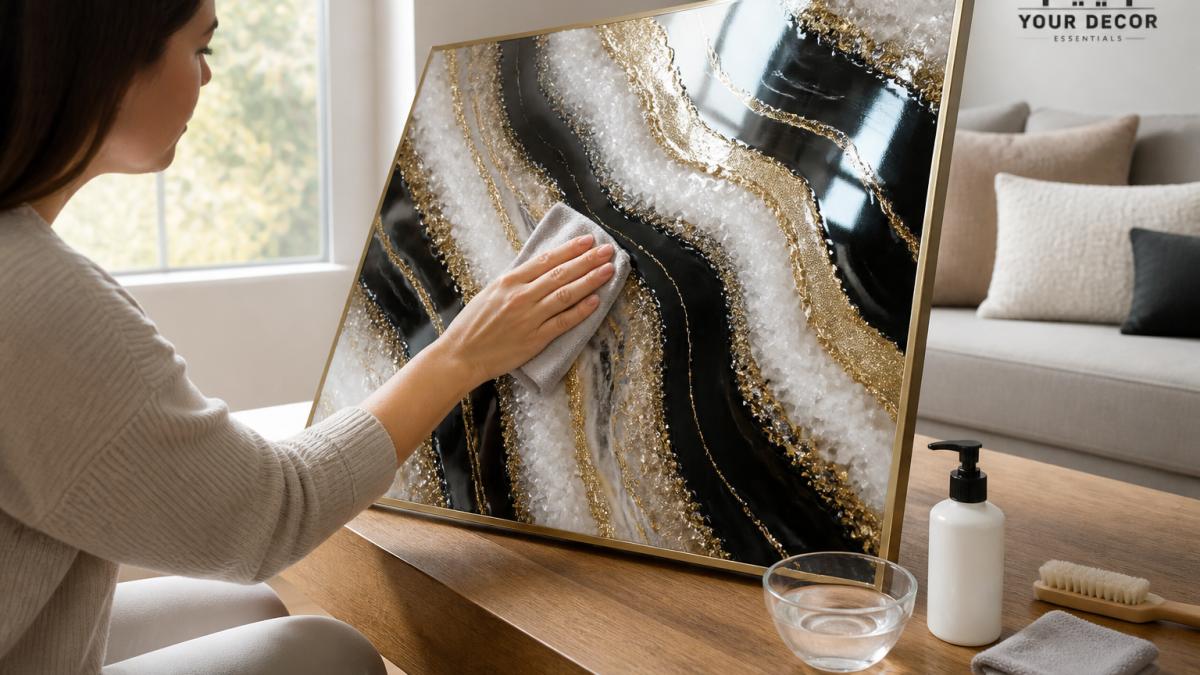
Here is the routine we recommend:
- Dust first with a dry microfiber cloth. This removes grit before it can scratch.
- Mix a drop of mild soap into a bowl of lukewarm water.
- Dampen a second cloth. Wring it out so it is barely wet.
- Wipe the surface gently in one direction. Do not scrub.
- Dry right away with a clean, dry cloth to avoid water spots.
Do this every few weeks and your piece stays glossy without any special products.
Repairing Scratches, Chips, and Yellowing on Geode Resin Art
Small scratches can often be buffed out, but deep chips and yellowing are much harder to fix at home. Knowing which problem you have saves you from making it worse.
Here is how to handle each one:
| Problem | Can You Fix It? | How |
|---|---|---|
| Light surface scratches | Yes | Buff with a plastic polish and soft cloth |
| Deep scratches | Sometimes | Needs a fresh clear topcoat |
| Chips at the edge | Rarely at home | A new resin layer or a professional repair |
| Yellowing | No | Cannot be reversed; prevent it with UV care |
For light scratches, a plastic polish made for clear finishes can bring back the shine. Work in small circles with a soft cloth and go slow.
Deep scratches and chips usually need a new thin topcoat of clear epoxy. That is a job for someone with resin experience. A rushed repair can leave bubbles or an uneven surface that looks worse than the scratch.
Yellowing is the one problem you cannot undo. Once the clear layer turns amber, the fix is a new topcoat or a replacement piece. That is why UV protection matters from day one.
Indoor vs. Outdoor: Where Geode Resin Art Should and Should Not Hang
Geode resin art belongs indoors. It is built for wall art in living rooms, bedrooms, and hallways, not for porches, patios, or anywhere it faces direct weather.
Indoors, a geode piece is in its element. Stable temperature, indirect light, and low humidity let the finish last for years.
Outdoors, everything works against it. Sun exposure speeds up yellowing. Temperature swings stress the resin. Moisture and dust work into the surface. Even a covered patio exposes a piece to UV and heat that indoor art never sees.
If you want resin art near a window, pick one that gets bright but indirect light. A north-facing wall or a spot away from the afternoon sun keeps the gloss intact.
- Best spots: interior walls, hallways, bedrooms, sheltered nooks
- Risky spots: sun-facing windows, kitchens near the stove, bathrooms
- Wrong spots: patios, porches, garages, anywhere outdoors
For outdoor spaces, choose materials made for the weather. Keep your resin art inside where it can hold its finish.
Resin Wall Art vs. Other Materials: A Durability Comparison
Resin wall art holds up well against other decor materials indoors, but each one has trade-offs. Resin wins on color depth and gloss. It loses to glass and metal on scratch resistance. But how do these materials actually compare over years of everyday life?
Here is how the common wall-art materials compare across impact resistance, weight, maintenance, and lifespan:
| Material | Impact Resistance | Weight (per sq ft) | Maintenance | Indoor Lifespan |
|---|---|---|---|---|
| Resin | Moderate (can chip at edges) | 1-2 lbs | Dust gently; avoid abrasives | 10+ years with care |
| Glass | Low (shatters) | 3-6 lbs | Glass cleaner; fragile | 20+ years |
| Metal | High (dents, not shatters) | 2-5 lbs | Dust; may rust if scratched | 15-20 years |
| Canvas/print | Low (tears, fades) | 0.5-1 lb | Dust; avoid moisture | 5-10 years |
| Wood | Moderate (dents, warps) | 2-4 lbs | Dust; may crack with humidity | 10-15 years |
Resin's edge is the look. No other material gives you the depth, the crystal inclusions, and the glassy finish of a geode piece in one object.
Its weakness is the surface. Glass and metal resist scratches better. Canvas fades faster but costs less to replace. Resin sits in the middle: more durable than a print, softer than glass.
How to Test Durability in the Real World
You can do simple checks yourself:
- Scratch test: On an inconspicuous area, gently rub with a coin or key. A quality resin will resist light pressure but may show a mark if you press hard. Glass will not scratch; canvas will tear.
- Heat test: Place a small cured sample near a radiator or in a hot car for a few hours. Resin may soften slightly but should return to shape. Wood may warp; canvas may sag.
- UV test: As described in the yellowing section, a windowsill comparison over months shows how your resin reacts to sun.
- Impact test: Drop a small cured sample from waist height onto a hard floor. Resin may chip at thin edges; glass will shatter; metal will dent.
These tests are not lab-grade, but they give you a realistic sense of how your piece will handle everyday life.
Matching Material to Room
- High-traffic areas (hallways, living rooms): Resin and metal hold up best. Avoid canvas and wood near doorways.
- Sunny rooms: Glass and metal resist UV best. Resin with UV filters is next. Canvas fades fastest.
- Humid rooms (bathrooms, kitchens): Metal and glass are safest. Resin can handle occasional humidity but avoid direct water. Wood warps.
- Kids' rooms: Resin and canvas are lighter and less likely to shatter than glass. Metal can dent but not break.
For a statement piece that catches light and draws the eye, resin is hard to beat. Just give it the indoor spot it deserves and handle it with care.
That is where a curated collection helps. At Your Decor Essentials, our resin accents and abstract sculptures are chosen for exactly this kind of display, so you get a piece built to be seen and easy to care for.
Frequently Asked Questions
Is geode resin art durable enough for everyday display?
Yes, when it is properly cured and finished. Fully cured epoxy resin forms a hard, glass-like surface that resists moisture, dust, and normal handling. The main threats are direct sunlight, which can cause yellowing over time, and abrasive cleaners or sharp objects that can scratch the gloss. Keeping a geode resin art piece indoors, away from harsh UV exposure, and dusting it with a soft cloth will help it stay clear and glossy for years. The durability depends heavily on the resin quality and how well the final layer was applied.
Does epoxy resin yellow in sunlight, and can it be prevented?
Epoxy resin can yellow when exposed to UV light, especially lower-grade formulas without UV inhibitors. Art-grade resins with UV filters slow this process significantly, but no resin is completely immune to long-term sun exposure. If a geode resin art piece hangs in a room with strong direct sunlight, rotating it periodically or using window film can reduce fading. For pieces displayed outdoors, yellowing and surface clouding are much more likely regardless of the resin used.
How do you clean geode resin art without dulling the finish?
Use a soft microfiber cloth and mild soapy water. Wipe gently in circular motions, then dry with a separate clean cloth to avoid water spots. Avoid alcohol-based cleaners, ammonia, acetone, and abrasive sponges, since these can break down the resin surface or leave it looking cloudy. For dust, a dry microfiber cloth or a soft brush is enough. If the piece has stone inclusions or crystals, use a slightly damp cloth around those areas and avoid soaking the edges where resin meets the frame or backing.
Can geode resin art be repaired if it gets scratched or chipped?
Minor scratches can sometimes be buffed out with a fine polishing compound designed for plastics or resin. Deeper scratches and chips usually require sanding the area and applying a fresh thin layer of resin to blend it back in. Yellowing is harder to reverse because it affects the resin itself rather than just the surface. In many cases, a professional refinish is the most reliable option. Preventing damage with proper placement and cleaning is far easier than repairing it.