 blog
How Can Smart Lighting Transform Your Studio Apartment?
Last Updated: October 27, 2026
Quick Summary
Smart lighting studio apartment setups let you dim, brighten, or change color temperature from your phone or voice command, giving you flexibility to create separate zones for sleeping, working, and relaxing in one room. Layered ambient, task, and accent lighting, controlled through scenes and automation, can make a small space feel intentional and larger without requiring rewiring.
- Layer three lighting types: ambient for general brightness, task for focused work areas, and accent for visual interest and depth.
- Start with one or two smart bulbs in your most-used fixtures like bedside and desk lamps, then expand gradually to ceiling and accent lights.
- Build four core scenes first: Wake, Work, Evening, and Wind-down, triggered by time schedules or sunrise/sunset offsets to automate your daily routine.
- Use warm color temperatures between 2200K and 2700K for bedside and evening lighting, and cool 4000K for desk task lighting to support focus.
- Wall sconces and floor lamps save floor and counter space in a studio by using vertical space instead.
Table of Contents
- Why Smart Lighting Matters in a Studio Apartment
- Layering Light: Ambient, Task, and Accent Lighting
- Small Apartment Lighting Ideas Using Multiple Sources
- Smart Bulbs for Apartments: Getting Started
- Creating Lighting Zones in a Studio Apartment
- Smart Lighting Scenes for Home: Automating Your Mood
- Color Temperature and Brightness: Technical Guidance
- Renter-Friendly Smart Lighting Without Rewiring
- Designing Your Studio Lighting Plan
- Frequently Asked Questions
Why Smart Lighting Matters in a Studio Apartment
In a studio, every square foot counts, and smart lighting studio apartment setups set the mood for sleeping, working, and relaxing in one room.
Smart lighting studio apartment setups let you dim, brighten, or change color temperature from your phone or voice command, flexibility that matters when your bedroom is also your office and living room.
Layered lighting can help a studio feel more intentional, energy at your desk, calm by your bed, warmth in your living area.
Layering Light: Ambient, Task, and Accent Lighting
Layered lighting is the foundation of any smart studio: three separate systems working together, each with a purpose.
Ambient lighting is your base layer, filling the room with soft, general light from a flush-mount ceiling fixture or pendant, comfortable, not harsh, enough to move around safely.
Task lighting focuses brightness where you need it, like your desk or kitchen counter. Task lights are directional and stronger than ambient, a desk lamp, under-cabinet strip, or focused pendant.
Accent lighting adds personality and depth by highlighting a wall, artwork, or architectural feature. Typically dimmer, it makes a small space feel designed, not cramped.
| Lighting Layer | Purpose | Best Fixture Type | Smart Control |
|---|---|---|---|
| Ambient | General room brightness | Ceiling fixture, pendant | Dimmer, scheduling |
| Task | Focused work areas | Desk lamp, under-cabinet | Brightness control |
| Accent | Visual interest, mood | Wall sconce, strip light | Color, dimming |
Small Apartment Lighting Ideas Using Multiple Sources
The biggest mistake in small spaces is relying on one light source. A single overhead fixture creates harsh shadows; multiple sources give you flexibility and make the space feel larger.
Floor and Table Lamps for Flexible Illumination
A floor lamp in the corner bounces light off the ceiling, creating soft ambient light without eating floor space. Place a tall one with a narrow base near your seating area for reading or relaxing.
Table lamps on nightstands, desks, and shelves create focused light exactly where you need it. A bedside smart bulb lets you control brightness without getting out of bed; a desk lamp with a flexible arm adjusts to your work angle.
Wall-Mounted Sconces and Space-Saving Fixtures
Wall sconces are brilliant for studios because they use vertical space instead of floor or counter space, leaving your surfaces clear.
Sconces work beautifully on either side of a bed as reading lights, sleek, space-saving, and intentional. A pair flanking a small mirror or artwork creates a polished look while providing functional light.
Sconces also work by your entryway or above a small desk, adding welcoming or task light without cluttering your workspace.
Pendant and Flush-Mount Ceiling Options
Flush-mount fixtures sit flat against the ceiling and work well in lower-ceiling studios, providing brightness without hanging into your limited space. A smart flush-mount with adjustable brightness and color temperature handles multiple moods.
Smart Bulbs for Apartments: Getting Started
A smart bulb screws into a standard socket, then connects to your phone via an app or voice assistant so you can control brightness, color temperature, and scheduling from anywhere.
Most smart bulbs work with common ecosystems like Alexa or Google Home. Some use a hub, others connect directly to WiFi, check compatibility before buying.
Start with one or two smart bulbs in your most-used fixtures, bedside and desk lamps are good candidates, then expand to ceiling fixtures and accent lights. You don't need to do everything at once.
Creating Lighting Zones in a Studio Apartment
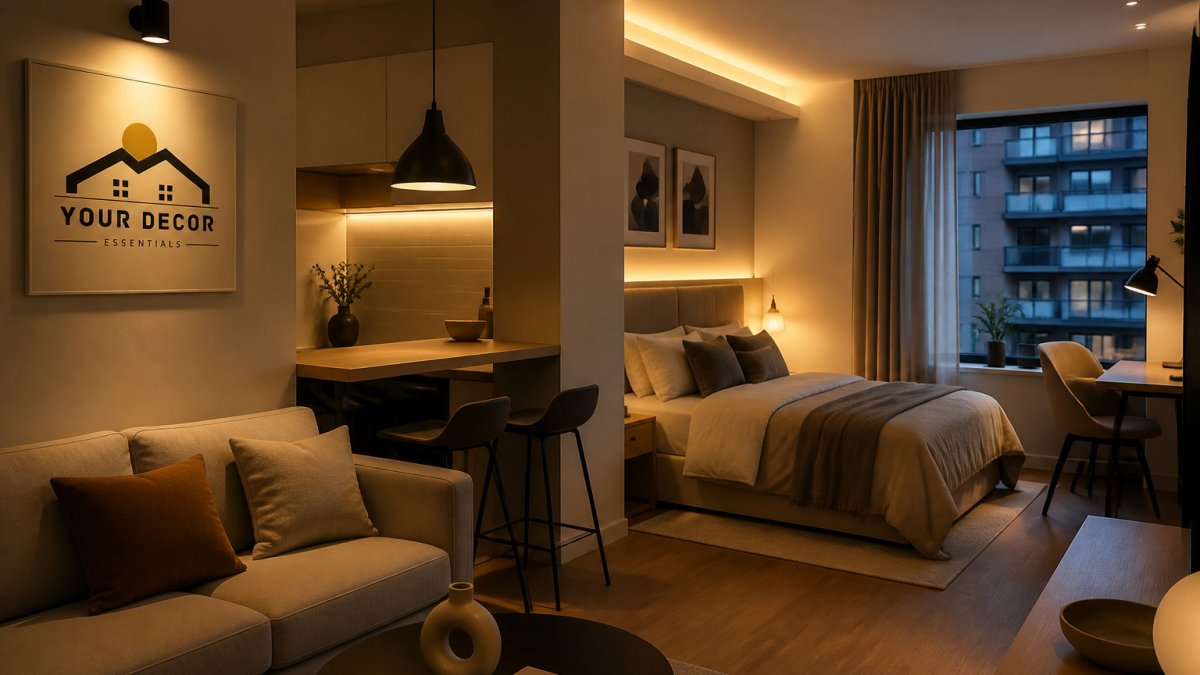
A studio can include sleeping, kitchen, and living areas. Lighting can help define each zone without walls.
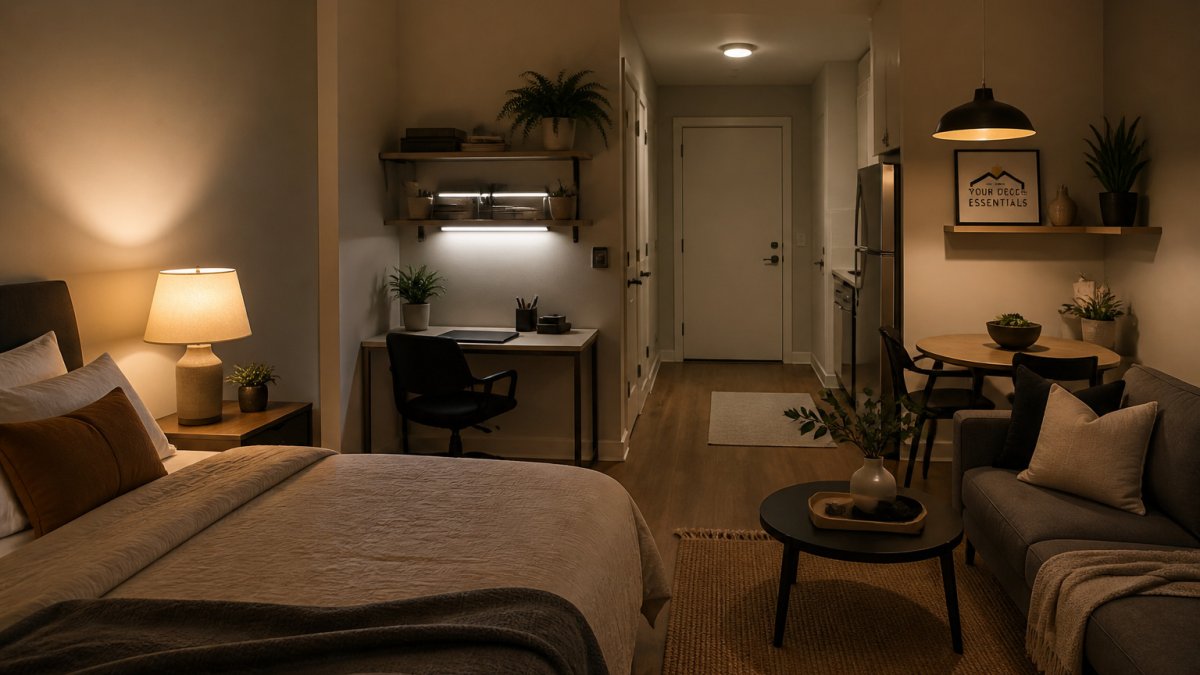
Sleeping Area Lighting
Automating your bedroom lights works well. Explore space saving lighting solutions for tiny bedrooms to design a sleeping area that maximizes your limited space. Set them to gradually brighten in the morning and dim in the evening. This mimics natural light and helps regulate sleep.
Kitchen and Work Zone Lighting
Keep task lighting separate from ambient lighting in your app. This way, you can have bright work light while the rest of the studio stays soft and warm.
Living and Relaxation Space
Your seating area deserves layered light. Combine ambient light from a ceiling fixture with accent light from a floor lamp or wall sconce.
A floor lamp in the corner can create warm, indirect light for relaxing or entertaining. A wall sconce adds visual interest and can help define the space. Together, they can make your living area feel intentional and separate from your work and sleep zones.
Smart Lighting Scenes for Home: Automating Your Mood
Scenes are where smart lighting stops being a remote control and starts being a system that runs your day. A scene is a saved combination of which lights are on, at what brightness, and at what color temperature. The real value in a studio is not the scene itself but the trigger that runs it automatically.
Build Four Core Scenes First
Most studio dwellers need four scenes. Build these before experimenting with anything more complex:
- Wake: Bedside lamp and ambient ceiling light ramp from 1% to about 60% over 15-30 minutes at 2700K-3000K. A gradual ramp is gentler than a hard on-switch and mimics sunrise.
- Work: Desk task light at 4000K and full brightness, ambient light dimmed to 30%, accent lights off. This concentrates light where you need it and reduces glare on screens.
- Evening: All lights at 2700K, ambient at 40%, accent light on at 20%, task light off. This is the default for cooking, eating, and relaxing.
- Wind-down: Bedside lamp only, at 2200K-2700K and 5-10% brightness. Everything else off.
Triggers: Schedules, Sunrise/Sunset, and Motion
Scenes become useful when they fire without you. The three trigger types that matter most in a studio:
Time schedules. Set the Wake scene to run at a fixed time on weekdays, and the Wind-down scene to run 30-60 minutes before your target bedtime. Most apps let you apply schedules to specific days, so weekends can run later.
Sunrise and sunset offsets. Rather than a fixed clock time, tie your Evening scene to sunset with a 30-minute offset. This keeps your lighting aligned with the season without you adjusting it four times a year. Most major smart lighting apps support sunrise/sunset triggers natively.
Motion and occupancy. A motion sensor near the entry can trigger a soft entry scene when you walk in, and turn lights off after a set period of no motion. In a studio, a single motion sensor placed near the door and angled toward the main living area can cover most of the room. Be careful with motion triggers in the sleeping zone, you do not want the bedside lamp turning on every time you shift in bed.
Work-to-Evening Transition: The Routine That Matters Most
The hardest transition in a studio is work to evening, because the same desk and the same room serve both. A practical routine:
- At a set time (for example, 6:00 p.m. on weekdays), the Work scene ends and the Evening scene begins.
- The desk task light fades off over 30-60 seconds rather than snapping off, which signals the end of work without jarring you.
- Ambient light warms from 3500K to 2700K and drops to 40%.
- The accent light fades up to 20% to add depth to the living area.
Presence Simulation and Away Routines
A studio that is empty during the day can use lighting to look occupied. Most smart lighting apps include a presence simulation or away mode that randomizes which lights turn on and off within a set window, usually in the evening. This is a low-effort safety measure and works best when at least two fixtures, one ambient and one accent, are included so the pattern looks natural.
What to Avoid
- Too many scenes. More than six or seven becomes a menu you scroll instead of a system you use. Four core scenes plus one or two special-purpose scenes (Movie, Guest) is plenty.
- Scenes that fight each other. If a motion trigger and a schedule both target the same lights, you can get flickering or unexpected changes. Assign each fixture to one primary automation and use manual scenes for exceptions.
- Cloud-dependent triggers for critical routines. If your Wake scene depends on a cloud service and your internet is down, it will not run. Where the app supports it, keep the most important schedules running locally on a hub rather than in the cloud.
Color Temperature and Brightness: Technical Guidance
Color temperature and brightness are the two settings you will adjust most often, and getting them right is what separates a smart studio that feels intentional from one that just feels like a gadget demo. Here is the practical guidance most lighting roundups skip.
Color Temperature: Kelvin Ranges That Actually Work
Color temperature is measured in kelvin (K). Lower numbers are warmer and more amber; higher numbers are cooler and more blue-white. For a studio where one room serves every function, you need bulbs that can span the full range, not fixed-temperature bulbs.
- 2200K-2700K (warm white): Best for winding down, bedside lamps, and evening ambient light. This range is closest to traditional incandescent and is the most flattering for skin tones and wood furniture.
- 3000K-3500K (soft white): A neutral-warm middle ground that works for general ambient lighting in living areas and kitchens when you are not doing detailed tasks.
- 4000K-5000K (cool white): Best for task lighting at a desk, over a kitchen counter, or in a bathroom mirror area. This range improves alertness and color discrimination for detailed work.
- 5000K-6500K (daylight): Rarely needed in a studio. Reserve it for short bursts of high-focus work or for matching daylight when you are on video calls during the day.
A common mistake is buying fixed 5000K bulbs for the whole apartment because they look bright in the store. In a small studio at night, 5000K ambient light feels clinical and makes it harder to relax. Prioritize tunable-white bulbs (often marketed as "white ambiance" or "tunable white") for any fixture you use after sunset.
Brightness: Lumen Targets by Zone
Brightness is measured in lumens (lm), not watts. Watts tell you energy use; lumens tell you actual light output. For reference, a traditional 60-watt incandescent bulb produces roughly 800 lumens, and a 100-watt equivalent produces roughly 1600 lumens.
Use these starting points for a studio apartment:
| Zone | Recommended Lumens | Notes |
|---|---|---|
| Bedside reading | 400-600 lm | Dimmable; warm 2700K |
| Desk task lighting | 800-1,200 lm at the work surface | Cool 4000K; position to avoid screen glare |
| Kitchen counter task | 800-1,200 lm per linear foot of counter | Under-cabinet strips work well |
| General ambient (living/sleeping) | 1,500-3,000 lm total across fixtures | Layer multiple sources rather than one bright ceiling light |
| Accent/wall wash | 200-400 lm | Dimmer; used for depth, not visibility |
These are starting points, not rules. A studio with dark walls or limited windows may need more ambient light; a light-filled unit with white walls may need less. The advantage of smart bulbs is that you can adjust without buying new hardware.
Color Rendering: The Spec Most Shoppers Ignore
Color rendering index (CRI) measures how accurately a light source shows colors compared with natural daylight, on a scale up to 100. A bulb with a CRI below 80 can make wood tones look muddy and clothing colors look off. Look for CRI of 90 or higher for any fixture used near a mirror, over a dining or coffee area, or in a workspace where you review documents or design work. Many mainstream smart bulbs list CRI in their specs; if a listing does not mention it, assume it is in the low 80s.
Dimming: Smooth Curves and Flicker
Not all smart bulbs dim equally. Cheap dimming can produce flicker at low levels, a stepped rather than smooth curve, or a minimum brightness that is still too bright for a bedside setting. When comparing bulbs, look for:
- Dimming range: The best tunable bulbs dim to 1% or lower; many stop at 5% or 10%. For a bedside lamp, a 1% floor matters.
- Dimming curve: A smooth logarithmic curve feels natural to the eye; linear dimming feels like it drops off too fast at the low end.
- Flicker: Read reviews for mentions of flicker at low dim levels. Flicker is more noticeable in a small room where the bulb is close to seating.
A Simple Rule for Studio Settings
Set your default ambient scene to 2700K at roughly 40-60% brightness for evenings, and 3500K at 70-80% for daytime general use. Keep task lighting at 4000K and full brightness for focused work. These three presets cover most of studio life without requiring you to think about kelvin and lumens every day.
Renter-Friendly Smart Lighting Without Rewiring
Even if your apartment allows small holes for sconce brackets, you can choose adhesive-mount options instead. The flexibility is yours.
Designing Your Studio Lighting Plan
Start by mapping your studio into zones: sleeping, working, and living. Each zone needs its own lighting strategy.
Write down what you do in each zone. Your bed is for sleep and relaxation, it needs soft, dimmable light. Your desk is for focus, it needs bright task light. Your seating area is for unwinding, it needs warm ambient light with accent options.
Visit your local home improvement store and see smart bulbs and fixtures in person. Check color temperature, brightness, and design. Imagine each piece in your space.
Your studio lighting plan doesn't need to be perfect immediately. Build it gradually. Smart lighting is flexible, you can adjust, add, and change as your needs evolve.
Layered ambient, task, and accent lighting can help create zones without walls. Thoughtful lighting choices can contribute to a beautifully styled home. Shop Now to explore functional lighting pieces.
Frequently Asked Questions
How can smart lighting ideas for small studio apartments help make the space feel larger?
Layered lighting with multiple sources can create depth. Using warm light in relaxation areas and brighter, cooler tones in work zones can visually separate functions. Positioning lights at different heights, floor lamps, wall sconces, and ceiling fixtures, can add visual interest.
What are smart bulbs for apartments, and do they work with existing lamps?
Smart bulbs are LED bulbs that connect to your home network via Wi-Fi or Bluetooth, allowing you to control brightness, color temperature, and scheduling from your phone or voice assistant. Most smart bulbs fit standard lamp sockets, so they work with your existing floor lamps, table lamps, and wall sconces without any rewiring. Check the base type (E26 or E27 for standard US fixtures) before purchasing. They're perfect for renters since they require no installation and are completely removable.
How do you create separate lighting zones in a studio apartment when everything is one room?
Divide your studio into functional zones using targeted lighting. Place a bedside lamp or wall sconce near your sleeping area, task lighting over your desk or kitchen counter, and ambient pendant or floor lamps in your living zone.
What color temperature should I use for different areas of my studio?
Use warm white light (2700K) in bedrooms and relaxation areas to create a cozy atmosphere and support better sleep. Neutral white (4000K) works well for kitchens and work zones where you need clear visibility and focus. Cool white (5000K+) is best for detailed tasks but can feel harsh in living spaces. Smart bulbs let you adjust color temperature throughout the day, warmer in the evening, brighter in the morning, which helps regulate your circadian rhythm and makes your studio feel more comfortable at different times.