 ultimate-guide
Tips for Buying High Quality Decor Online: 2026 Guide
Table of Contents
- Why Buying Decor Online Goes Wrong (and How to Prevent It)
- How to Measure for Home Decor Placement Before You Order
- Identifying Quality Materials in Home Decor Listings
- Setting a Realistic Budget and Allocating It Across Anchor Pieces
- Digital Tools for Visualization: See It in Your Room First
- Vetting Seller Credibility Before You Check Out
- Shipping Logistics, Return Policies, and What to Confirm Upfront
- Building a Cohesive Color Palette and Interior Design Style
- How to Style Abstract Sculptures in Any Room
- Best Unique Home Decor Online Shops: What Sets Them Apart
- Sustainable Decor, Handmade Pieces, and Ethical Sourcing
- Post-Purchase Care and Maintenance for Long-Lasting Decor
- Common Mistakes to Avoid When Buying Decor Online
- Conclusion
- Frequently Asked Questions
Last Updated: September 17, 2026
Why Buying Decor Online Goes Wrong (and How to Prevent It)
Buying decor online fails for one boring reason: you're shopping a photograph, not an object. A listing image is styled, lit, and cropped by someone whose job is to make the piece look its best. What arrives is the same item minus the staging, minus the three-meter ceiling, and minus the professional lighting rig.
That gap is where disappointment lives. Most shoppers blame the seller. The real culprit is a missing process: measure first, read specs second, check the seller third, and only then decide whether to buy. This guide from Your Decor Essentials walks through that process step by step, because tips for buying high quality decor online only work when they're applied in the right order.
Here's what most guides get wrong. They start with style and inspiration, then treat logistics as an afterthought. Reverse it. The pieces that survive years in your home are the ones that fit the wall, match the palette, and came from a seller who answered your questions before you paid.
How to Measure for Home Decor Placement Before You Order
Measure the wall, the floor, and the path the piece takes to get there. That's the short version, and it eliminates most returns before they happen.
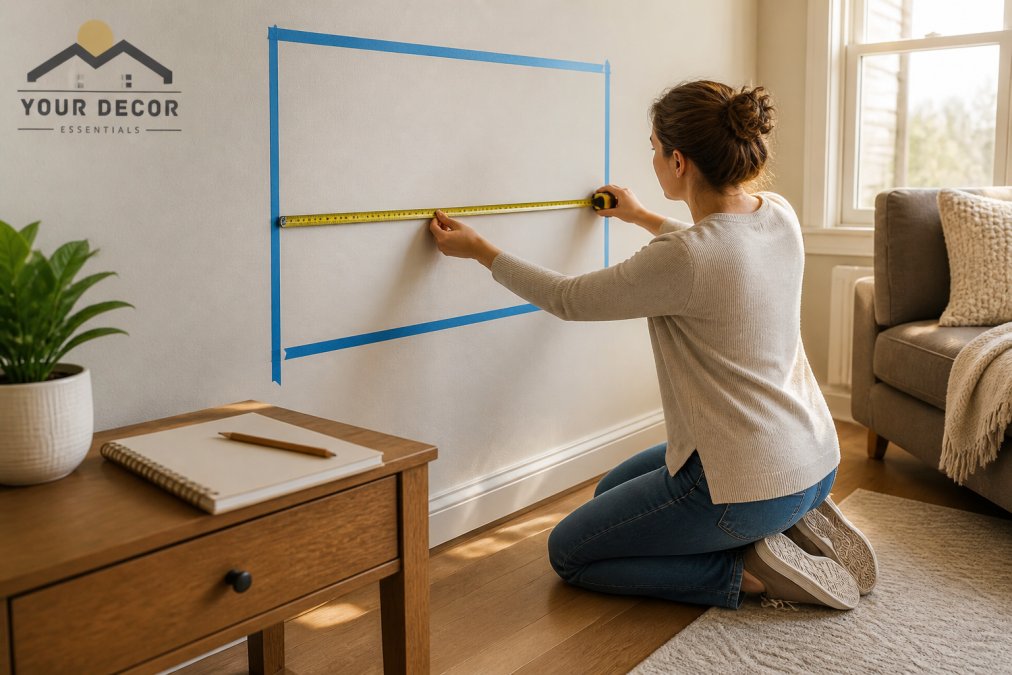
Start with the destination. For wall art and mirrors, mark the outer edges with painter's tape so you can see the footprint against your actual furniture. For floor pieces and accent furniture, tape the outline on the floor and live with it for a day.
Then measure the route. Doorways, stairwells, elevator interiors, and hallway turns decide whether a large piece physically reaches the room. A sofa that fits the wall but not the stairwell is a problem you cannot solve after delivery.
The Measurements That Matter: Scale, Proportion, and Clearance
Scale and proportion describe how a piece relates to the room around it, not how big it is on its own. A large sculpture in a small alcove reads as clutter. The same sculpture on an open console in a tall room reads as a focal point.
Clearance is the space you need to keep around a piece so the room still functions. Walking paths, cabinet doors, and chair pull-out all need room.
Three numbers to write down before you shop:
- Wall width available for the piece, measured edge to edge
- Ceiling height and the height of your tallest existing furniture
- Clearance required around the piece so doors and drawers still open
A useful rule for wall decor: the piece should occupy roughly two-thirds to three-quarters of the width of the furniture beneath it. Smaller and it floats. Larger and it overwhelms.
Identifying Quality Materials in Home Decor Listings
Quality shows up in the specification sheet, not the hero photo. A listing that names its materials, gives dimensions in centimeters and inches, and states the weight is telling you the seller knows the product. A listing that says "premium material" and nothing else is telling you something too.
For resin decor specifically, look for how the piece is finished. Hand-finished resin shows slight variation between units, which is normal and often desirable. Injection-molded pieces are identical, which is fine for some applications and disappointing for others.
Reading Product Specifications Like a Buyer, Not a Browser
Skim the description for the emotional language, then read the spec block for the facts. The spec block is where the honest information lives.
What to look for in any decor listing:
- Named materials: solid wood species, resin type, metal finish, stone variety
- Exact dimensions in both metric and imperial, with height, width, and depth
- Weight, which tells you about density and how the piece will feel in hand
- Assembly requirements, including whether hardware is included
- Care instructions, which reveal what the material can and cannot tolerate
A common mistake is treating "handmade" and "high quality" as synonyms. They aren't. Handmade describes the process, not the outcome. A hand-poured resin piece can still be poorly finished, and a machine-cut metal frame can be flawless.
Setting a Realistic Budget and Allocating It Across Anchor Pieces
Anchor pieces are the large, defining items that set the tone of a room: a statement sculpture, a sofa, a floor lamp, a major wall piece. Everything else supports them. Budgets fail when shoppers spend anchor money on accessories.
A workable split for most rooms is to put the majority of your budget into two or three anchor pieces, then fill in with smaller accents. The exact ratio depends on the room, but the principle holds: spend where the eye lands first.
A Practical Allocation Framework
Most interior designers use a rough percentage split when furnishing a room from scratch. A common pattern is:
- 50-60% on anchor pieces, the sofa, the large wall art, the statement floor sculpture, the primary light fixture
- 20-30% on secondary furniture, side tables, accent chairs, console tables
- 10-20% on accessories and textiles, throw pillows, vases, small resin accents, candles, books
- 5-10% on a contingency, for the piece you didn't plan for but can't stop thinking about
This framework matters more online than in a showroom because you can't negotiate. The price on the product page is the price. Your only leverage is deciding which tier a piece belongs to before you fall in love with it.
How Online Pricing Cycles Affect Your Budget
Online decor pricing follows predictable patterns. Most retailers discount during major holiday weekends, end-of-season clearance, and new-collection launches. If you're not in a hurry, adding a piece to your cart and waiting two to three weeks often reveals a price drop.
A common tactic is to set a price alert on a piece you want. Many browsers and shopping apps let you track a product page and notify you when the price changes. This turns patience into savings without requiring you to check the listing daily.
Be cautious of permanent sales. A listing that shows a crossed-out original price and a "sale" price every day of the year is using anchor pricing, not offering a real discount. Compare the current price against the same piece on other sites before assuming you're getting a deal.
Where to Save and Where to Spend
Save on:
- Trend-driven accessories, the resin accent that matches this season's palette may not match next year's
- Textiles, throw blankets, pillow covers, and table linens are easy to swap and rarely worth a premium
- Decorative books and small objects, these are filler, and filler should be affordable
Spend on:
- Anything structural, furniture that holds weight, lighting that requires wiring, wall pieces that need proper hanging hardware
- Pieces you touch daily, a console table you brush past every morning, a lamp switch you flip every night
- Materials that patina, solid wood, brass, and stone improve with age; resin and painted finishes show wear
The Return-Shipping Tax
Every return costs money and time. A piece that doesn't work out isn't just a refund; it's a return shipping label, a repacking job, and two weeks of a room that feels unfinished.
Because pricing on decor varies by material, size, and finish, Your Decor Essentials lists current pricing directly on each product page rather than quoting ranges that go stale. Check the live listing before you plan a room around a specific piece.
Digital Tools for Visualization: See It in Your Room First
Augmented reality apps and simple photo mockups close most of the gap between listing photo and living room. You do not need professional software.
Vetting Seller Credibility Before You Check Out
Seller credibility is the single most underserved part of buying decor online. Most guides skip it entirely, which is why so many shoppers get burned.
Shipping Logistics, Return Policies, and What to Confirm Upfront
Confirm four things before you pay: shipping carrier, packaging method, damage policy, and return window. Get them in writing, even if it's just a chat transcript.
| What to Confirm | Why It Matters | Where to Find It |
|---|---|---|
| Shipping carrier and method | Determines transit time and handling | Checkout page |
| Packaging description | Predicts damage risk in transit | Product page or support |
| Damage policy | Decides who pays for a broken piece | Return policy page |
| Return window | Sets your deadline to decide | Return policy page |
| Assembly requirements | Tells you what tools you need | Product specifications |
Building a Cohesive Color Palette and Interior Design Style
Pick a palette of three colors and a style direction, then filter every purchase through both. This is the step that prevents the "bunch of stuff that clashes" problem.
How to Build a Palette You Can Actually Shop With
A palette on a mood board is useless if you can't match it to a product listing. The fix is to translate your colors into hex codes and keep them where you shop.
Here's a practical method:
- Photograph your fixed elements, floor, wall, largest furniture piece, in natural daylight.
- Use a free color-picker tool to sample three to five hex codes from those photos. Write them down.
- Add one accent hex code from a piece you already love.
- Save these codes in a note on your phone so they're available when you're browsing product pages.
The Screen Calibration Problem
Every screen renders color differently. The warm terracotta on your phone may look like burnt orange on your laptop and dusty rose on your tablet. This is not a minor issue when you're buying decor online.
A few habits reduce the risk:
- View product images on at least two devices before buying. If the color shifts dramatically between them, treat the listing photo as unreliable.
- Look for listings that include a lifestyle photo, the piece styled in a real room, alongside the studio shot. Lifestyle photos are usually less color-corrected.
- Read the color name in the spec block, not just the image. "Antique brass" and "polished brass" are different finishes, and the name is often more accurate than the photo.
- Check customer photos in reviews. Real-world images show the piece under normal lighting, not studio conditions.
Filtering Style Without Overthinking It
Style direction is a filter, not a rulebook. The goal is to make quick decisions when you're scrolling through listings, not to pass a design exam.
Texture as a Quality Signal
Texture is where budget decor gives itself away. A room full of smooth, flat, matte surfaces reads as inexpensive regardless of what you spent, because the eye has nothing to catch on.
How to Style Abstract Sculptures in Any Room
Style an abstract sculpture by giving it space, a surface, and a light source. Crowding is the most common mistake, and it's the easiest to fix.
Best Unique Home Decor Online Shops: What Sets Them Apart
The best unique home decor online shops share three traits: a narrow, curated collection; detailed product specifications; and a support team that answers questions before you buy. Mass marketplaces win on selection and lose on all three.
Sustainable Decor, Handmade Pieces, and Ethical Sourcing
Sustainability in decor comes down to two questions: what is the piece made of, and how long will you keep it. A durable piece you own for a decade beats a trendy one you replace every year, regardless of the material.
Post-Purchase Care and Maintenance for Long-Lasting Decor
Care instructions are part of the product, not an afterthought. Ignoring them is how a piece that should last a decade lasts two years.
General rules that apply to most decor:
- Keep resin and polished surfaces out of direct, prolonged sun. UV exposure yellows some resins and fades finishes over time.
- Dust with a dry, soft cloth before reaching for any liquid. Most surface damage comes from the cleaner, not the dust.
- Avoid ammonia-based cleaners on resin, painted metal, and sealed stone.
- Re-tighten hardware on furniture and lighting a few weeks after assembly, then once a year.
- Store seasonal pieces wrapped, not stacked, so edges don't chip against each other.
Common Mistakes to Avoid When Buying Decor Online
The same handful of mistakes cause most online decor returns. Avoiding them is worth more than any styling trick.
- Buying before measuring. The piece is beautiful and the wall is 20 centimeters too narrow.
- Trusting the hero photo's scale. Styled listings make small pieces look large and large pieces look modest.
- Skipping the return policy. Finding out about a restocking fee after the piece arrives is an expensive lesson.
- Shopping without a palette. Individually great pieces that fight each other produce a room that feels off.
- Ignoring assembly requirements. A piece that needs two people and a drill changes your weekend plans.
- Overlooking the light source. A sculpture in a dark corner is invisible, no matter how good it is.
- Not asking the seller anything. The pre-purchase question is a free test of their customer support.
Conclusion
The hardest part of buying decor online isn't finding something beautiful. It's trusting that it will arrive intact, fit the space, and look right once it's there. That trust comes from a process: measure, read the specs, vet the seller, confirm the logistics, and check the palette before you check out.
Frequently Asked Questions
How can you tell if home decor is high quality when shopping online?
Start with the product specifications. Look for named materials (solid oak, kiln-dried wood, stoneware) rather than vague terms like 'wood blend.' Check customer reviews for mentions of weight, finish consistency, and how pieces look in person versus the photos. Zoom in on listing images to inspect seams, edges, and texture. If a seller does not list dimensions, weight, or material composition, that omission is a signal to keep looking or ask customer support directly before ordering.
What is the best online site for buying home decor?
The best site depends on whether you want mass-produced pieces or a curated collection. For unique, non-mass-produced items like abstract sculptures and resin accents, smaller specialty shops often carry pieces you will not see in every neighbor's home. Look for shops that publish detailed product specifications, show multiple angles, and have a clear return policy. Read customer reviews about shipping damage and customer support responsiveness before committing to a large order.
What are the best practices for measuring space before buying decor online?
Measure the wall or surface where the piece will go, then measure the piece's listed dimensions and mark the footprint with painter's tape on your floor or wall. For wall art and sculptures, leave at least 2 to 3 inches of breathing room on each side. For lighting, confirm the cord length, shade diameter, and whether the fixture needs hardwiring or plugs in. Account for doorways and stairwells too, since a piece that fits the room may not fit the path to get there.
How do you verify the authenticity of online home decor brands?
Check whether the brand has a verifiable business presence: a physical address, a customer service phone number, and an about page that explains who makes the pieces. Search the brand name plus 'reviews' and read third-party feedback, not just testimonials on the brand's own site. Reverse-image-search product photos to see if the same image appears across unrelated sellers, which can indicate a drop-shipped or copied listing. Established brands with artisan relationships will usually describe their sourcing and materials openly.
How do you mix and match different decor styles effectively?
Pick one dominant interior design style and let it account for roughly 70 percent of the room, then introduce a secondary style for about 30 percent. Tie the two together with a shared color palette of two to three colors and repeat one texture, such as natural wood or matte ceramic, in both groupings. A focal point like an abstract sculpture or statement lighting can bridge the styles. Keep scale and proportion in mind so no single piece overwhelms the room.
What should you look for in product descriptions when buying decor?
Look for exact dimensions in inches or feet, weight, material composition, finish type, and assembly requirements. A strong listing states whether the item ships assembled or flat-packed, what tools are needed, and whether hardware is included. For lighting, check wattage, bulb type, and whether the fixture is UL-listed. For textiles, look for fiber content and care instructions. If the description is thin on any of these details, reach out to customer support before ordering.