 ultimate-guide
Why Resin Art Is Popular in Modern Design
Table of Contents
- Why Resin Art Is Popular in Modern Design
- Resin Art Advantages Over Traditional Decorative Materials
- How Resin Art Fits Into Contemporary Interiors
- Resin Art for Home Decor: Where It Works Best
- How to Style Abstract Sculptures in Living Room Spaces
- Resin vs. Acrylic, Glass, and Ceramic: What Sets Resin Apart
- Caring for Resin Art: Durability, Cleaning, and Placement
- How to Choose Resin Art for Your Home
- Frequently Asked Questions
Last Updated: October 13, 2026
Why Resin Art Is Popular in Modern Design
Resin art has moved from craft-fair curiosity to a fixture of contemporary interiors, and the reasons are practical as much as aesthetic. Resin art is a form of three-dimensional and wall-based artwork created by pouring, layering, and curing a liquid polymer into shapes, colors, and finishes that hold their gloss for years. This guide from Your Decor Essentials breaks down why the material has earned its place in modern homes, and how to choose pieces you will still love in a decade.
The appeal starts with versatility. Resin can be poured into almost any sculptural form, tinted to nearly any color, and finished to look like glass, stone, or something entirely its own. That flexibility lets designers create abstract sculpture with fluid lines and deep, saturated color that few traditional materials match at a comparable weight.
Below, we cover the advantages resin holds over older decorative materials, where it fits in contemporary rooms, and how to care for it so it keeps looking like the day it arrived.
Resin Art Advantages Over Traditional Decorative Materials
Resin wins on weight, color range, and design freedom, three things that matter most when you are furnishing a real room rather than a gallery. A resin sculpture can deliver the visual presence of cast bronze or carved stone without the heft, which means you can place a substantial piece on a console or shelf without reinforcing anything.
Compare the trade-offs honestly:
| Material | Weight | Color Range | Outdoor Suitability | Care Level |
|---|---|---|---|---|
| Resin | Light | Very wide | Limited, shaded spots only | Low |
| Bronze | Heavy | Patina-limited | Good | Moderate |
| Glass | Moderate | Wide, translucent | Poor | High |
| Ceramic | Moderate | Wide | Poor | Moderate |
| Stone | Very heavy | Earth tones | Good | Low |
The color range is where resin pulls ahead for modern interiors. Deep translucent blues, milky pastels, and metallic swirls are all achievable in a single pour, and the surface finish can be glossy, matte, or satin depending on how the piece is finished.
How Resin Art Fits Into Contemporary Interiors
Contemporary design favors clean lines, open space, and a few strong focal points rather than rooms packed with objects. Resin fits that brief because a single well-chosen piece can carry a shelf, a console, or a coffee table without competing with everything around it.
The material also plays well with the neutral palettes that dominate modern rooms. Against white walls, oak floors, and gray sofas, a saturated resin accent reads as intentional rather than busy. Designers often use one resin piece as the color anchor in an otherwise quiet room, then repeat a smaller tone from it elsewhere in the space.
Scale is the other reason resin suits modern layouts. Because it is light, you can go bigger than you would with stone or bronze, and a larger sculptural form gives an open-plan room the visual weight it needs to feel finished.
Resin Art for Home Decor: Where It Works Best
Resin art for home decor works best where you want color and form without heavy maintenance: entryway consoles, living room shelving, bedroom nightstands, and home offices. These are spots where a piece gets seen daily but does not need to survive weather or heavy handling.
A few placements consistently work well:
- Entryway console: A medium abstract sculpture sets the tone the moment guests walk in.
- Living room shelf: A smaller piece adds a hit of color between books and vases.
- Bedroom dresser: A soft-toned accent keeps the room calm rather than busy.
- Home office desk: A compact sculptural form breaks up the screen-and-paper monotony.
Outdoor use is more limited. Resin can handle a covered porch or a shaded patio, but direct sun and freeze-thaw cycles will dull the finish over time. If you want a piece outside, keep it under an overhang and bring it in during hard freezes.
How to Style Abstract Sculptures in Living Room Spaces
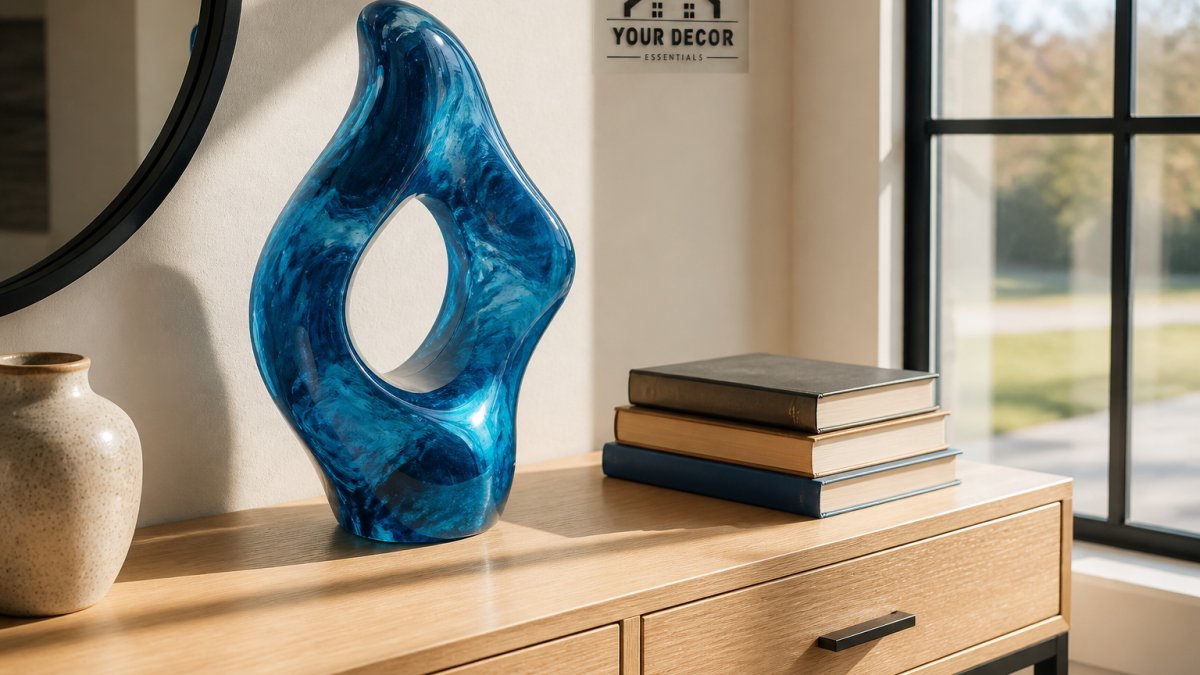
Styling abstract sculptures in a living room comes down to three moves: pick one anchor piece, give it breathing room, and repeat one of its colors elsewhere in the room. Abstract work has no literal subject, so the eye reads shape, color, and finish instead, which means the piece needs space around it to register.
Here is how we would approach it:
- Choose the anchor. Pick the largest piece first, ideally one that echoes a color already in the room.
- Clear the surface. Leave roughly two-thirds of the console or shelf empty around it.
- Add one supporting object. A stack of books, a small vase, or a candle, but not all three.
- Repeat the color once. A cushion, a throw, or a small tray in the same tone ties the room together.
- Adjust the height. Stack books under a small piece if it sits too low to catch the eye.
That last step matters more than people expect. A sculpture placed at eye level when you are seated reads as part of the room; one placed too low disappears.
Resin vs. Acrylic, Glass, and Ceramic: What Sets Resin Apart
Resin differs from acrylic, glass, and ceramic mainly in how freely it can be shaped, colored, and finished. Acrylic is typically cut and formed from sheet, glass is blown or cast at high heat, and ceramic is shaped wet and fired in a kiln. Resin is poured as a liquid, which lets a maker build up layers, suspend inclusions, and create depth that the other materials cannot easily replicate.
The practical differences show up in daily life:
- Resin vs. acrylic: Resin holds deeper color and more complex internal patterns; acrylic tends to be flatter and more uniform.
- Resin vs. glass: Resin is lighter and far less likely to shatter, though it can scratch more easily.
- Resin vs. ceramic: Resin resists chipping better, but ceramic handles heat and outdoor exposure more gracefully.
None of these materials is universally better. Resin is the right choice when you want bold color, complex form, and light weight in one piece.
Caring for Resin Art: Durability, Cleaning, and Placement
Resin holds up well indoors with minimal care, but it is not indestructible. The two things that age a resin piece fastest are prolonged direct sunlight and heat, both of which can soften the surface and dull the finish over time. Understanding how resin compares to other sculptural materials on durability, care, and placement helps you protect your investment and avoid costly mistakes.
Material-by-Material Durability and Care
| Material | Moisture Resistance | Sunlight Sensitivity | Impact Resistance | Cleaning Method |
|---|---|---|---|---|
| Resin | High (sealed surface) | High (UV yellows and dulls) | Moderate (can crack under sharp impact) | Soft microfiber, mild soap, dry immediately |
| Bronze | Moderate (patina changes) | Low (patina darkens) | High | Dry cloth, wax occasionally |
| Stone (marble, granite) | Low (stains, etches) | Low | Low (chips, cracks) | pH-neutral stone cleaner only |
| Wood | Low (swells, warps) | Moderate (fades, cracks) | Moderate | Dry dust, occasional wood conditioner |
| Ceramic | Moderate (glaze seals) | Low | Low (chips easily) | Damp cloth, avoid thermal shock |
| Glass | High | Low | Low (shatters) | Glass cleaner, lint-free cloth |
| Plaster | Low (absorbs moisture) | Low | Low (crumbles) | Dry dust only, never wet |
Resin's main vulnerabilities are UV exposure and heat, not moisture. A sealed resin surface resists water well, but prolonged sun exposure breaks down the polymer chains, causing yellowing, cloudiness, and surface tackiness. Most practitioners find that a resin piece kept out of direct sun retains its finish for many years, while one in a sun-drenched window can show dulling within a single season.
Condition Assessment Checklist Before You Buy
Inspect any resin piece, new or resold, for these issues:
- Cloudiness or yellowing: Signals UV damage; may not be reversible.
- Fine scratches or scuffing: Common from abrasive cleaning or sliding.
- Tacky or soft surface: Indicates heat exposure or incomplete curing.
- Cracks or crazing: Can spread; check edges and thin sections.
- Unstable joins: If the piece has a base or mixed materials, test for wobble.
- Repairs or touch-ups: Look for color mismatches or uneven gloss.
- Bubbles or voids: Some are intentional; large ones near the surface can weaken the piece.
Catching these early makes any fix easier, and some issues, like UV yellowing, are not repairable at all.
Placement: Indoor vs. Outdoor
Resin is an indoor material first. It can handle a covered porch or a shaded patio, but direct sun and freeze-thaw cycles will dull the finish over time. If you want a piece outside, keep it under an overhang and bring it in during hard freezes.
- Indoor, indirect light: Ideal. Resin keeps its gloss and color for years.
- Indoor, direct sun: Risky. Use UV-filtering window film or rotate the piece.
- Covered porch: Acceptable if shaded and above freezing.
- Open patio or garden: Not recommended. UV, rain, and temperature swings degrade the finish.
Total Ownership Costs Beyond the Purchase Price
The purchase price is only part of what you will spend. Shipping a large resin piece requires custom crating to prevent flex damage, and crating costs scale with size and fragility. Installation may require a wall anchor or a weighted base for tall pieces. Insurance riders for fine art may be needed if the piece is valuable. Conservation or repair, should damage occur, often requires a specialist, and not all resin damage is reversible. Maintenance is low, but UV-protective window film or a display case can add upfront cost. Budget for these before you buy, especially for larger or one-of-a-kind works.
How to Choose Resin Art for Your Home
Choosing resin art comes down to four questions: does the color work with your room, does the scale suit the space, does the finish match your light, and does the maker disclose how the piece was made. Get those right and you will rarely regret a purchase. But the fourth question, about making and disclosure, deserves more attention than most buyers give it, because it determines whether you are buying a unique work or a reproduced design, and how the piece will hold up and hold value.
Authenticity, Fabrication, and Material Disclosure
Before you buy, ask the seller or maker:
- What exactly is the material? "Resin" can mean epoxy, polyurethane, polyester, or a blend. Each has different UV stability, hardness, and care needs. Epoxy resin generally resists yellowing better than polyester, but formulations vary.
- How was the piece made? Was it poured by hand, cast in a mold, or produced in a studio edition? Hand-poured pieces often have unique internal patterns; mold-cast pieces may be identical across an edition.
- Who made it? Was the artist involved in the fabrication, or was it produced by a studio or foundry from the artist's design? Both are legitimate, but they affect value and provenance.
- Is there documentation? A certificate of authenticity, a signed edition number, or a studio record helps confirm what you own.
- Is it a unique work or a limited edition? Edition size tells you how many identical or near-identical pieces exist. A unique work or a small edition (often 8, 12, or 25) is more collectible than an open edition.
Evaluating Personal Taste and Artistic Appeal
Abstract work has no literal subject, so the eye reads shape, color, and finish instead. Ask yourself:
- Does the piece hold your attention after a week, not just a minute?
- Does it work in your room's light, day and night?
- Does it feel like a focal point or a filler?
- Would you still want it if it were not trendy?
Price, Value, and Buying Considerations
Resin art spans a wide range, from affordable decorative pieces to collectible sculptures. Value depends on the artist's reputation, the uniqueness of the work, the quality of fabrication, and the condition. A piece by a known artist in a small edition will hold value better than a mass-produced decorative object. Ask about return policies, shipping protection, and whether the piece can be repaired if damaged.
Displaying Resin Art and Choosing a Location
Placement affects both enjoyment and longevity. Keep resin out of direct sun and away from heat sources. Use a felt or rubber pad under the base to protect surfaces. For wall-mounted pieces, ensure the mounting hardware is appropriate for the weight and wall type. Rotate the piece occasionally if it sits near a window to even out any light exposure.
Run through this checklist before you buy:
- Does the piece repeat or complement a color already in the room?
- Is the scale right for the surface it will sit on?
- Will the finish read well in your room's light, day and night?
- Does the listing state the material and how the piece was made?
- Is the piece described as a unique work or part of a limited edition?
- Can you return it if the color does not match in person?
- Is there documentation of authenticity?
- Have you budgeted for shipping, crating, and potential insurance?
That fourth and fifth point matter more than most buyers realize. Material disclosure and edition size are the two details that tell you whether you are looking at a one-off piece or a reproduced design, and they affect both how the piece feels in your home and how it holds value.
At Your Decor Essentials, our curated selection focuses on abstract sculptures and resin accents chosen for exactly this kind of fit: pieces that introduce visual interest without overwhelming a room. We keep the range tight on purpose, so the odds of a neighbor showing up with the same piece stay low.
Frequently Asked Questions
Why is resin art so popular in modern design?
Resin art fits modern interiors because it offers a glossy, seamless finish that reflects light and adds depth to a room. Unlike traditional materials, resin can be poured into nearly any shape, so designers use it for bold, fluid forms that draw the eye. It also holds vivid color without fading, which keeps a statement piece looking sharp over time. For homeowners furnishing a first property or refreshing a living space, resin art delivers visual impact without the weight or fragility of glass or ceramic.
What are the advantages of resin art for home decor?
Resin art advantages include durability, color retention, and design flexibility. Resin resists moisture and everyday knocks better than clay or plaster, so it holds up in busy rooms. It can be cast into thin, curved, or oversized shapes that would be difficult in stone or wood. The surface wipes clean with a soft cloth, and the material does not chip easily. These traits make resin art a practical choice for shelves, consoles, and coffee tables where a piece might get bumped.
How do you style abstract sculptures in a living room?
Start with scale: a large sculpture works on a console or open shelf, while a smaller piece suits a side table or mantel. Group no more than three objects so the sculpture stays the focal point. Match the sculpture's finish to the room's palette, a glossy resin piece pairs well with matte textiles and natural wood. Place it where light hits the surface, such as near a window or under a picture light, to bring out the depth and color.
Is resin art durable enough for everyday interiors?
Resin art handles everyday life well when placed thoughtfully. It resists moisture and most household knocks, but direct sunlight over long periods can dull the surface, so keep pieces away from constant harsh sun. Clean with a soft, damp cloth and mild soap, and avoid abrasive pads or solvents. For outdoor use, check with the maker first, because not all resin formulas are rated for full weather exposure. With basic care, a resin piece can stay vibrant for years.
Furnishing a room around art is harder than it looks, and the wrong piece can make a whole space feel off. Your Decor Essentials curates abstract sculptures and resin accents alongside functional lighting and stylish furniture, so you can build a room that reflects your taste rather than a catalog page. Browse our collection to find a piece that fits your space, your palette, and your style. Shop Now.