 How-to
7 Steps to Styling Abstract Art on Open Shelves
Last Updated: November 18, 2026
Quick Summary
To style abstract art shelves on open shelving units, measure each shelf first, then size the artwork to fill about 60 to 75 percent of the clear height. Lean framed pieces against the back wall, layer smaller items in front, and leave roughly one-third of the shelf empty.
- Measure each shelf's clear height, depth and width separately before buying or hanging anything.
- Size artwork to fill 60 to 75 percent of the clear height, leaving 25 to 40 percent as breathing room.
- Lean framed pieces against the back wall with rubber or felt pads at the bottom corners.
- Keep objects at least 2 inches from the front edge to reduce the chance of being knocked off.
- Secure heavy sculptures with museum putty and check that brackets are rated for the load.
Table of Contents
- Choosing Abstract Art Sized for Your Shelves
- Step 1: Measure Each Shelf Before You Buy or Hang
- Step 2: Lean Framed Pieces Against the Back Wall
- How to Layer Art on Shelves Without Crowding Them
- How to Style Shelves with Art and Sculptures
- How to Display Art on Shelves for Balance and Height
- How to Decorate Shelves Without Looking Cluttered
- Securing Heavy Pieces and Protecting Art from Light
- Building Your First Abstract Shelf Display This Weekend
- Frequently Asked Questions
Abstract art shelves can turn a plain open shelf into the most interesting spot in a room, but only when they are styled with care. Many first-time buyers hang a piece, step back, and feel that something is off. The shelf looks busy, or the art looks lost.
Styling abstract art shelves on open shelving units is less about having a big collection and more about making deliberate choices. The seven steps below walk through sizing, placement, layering, decluttering, safe display and a simple first project you can finish in a weekend.
Choosing Abstract Art Sized for Your Shelves
Start with the shelf, not the art. Measure the clear height from the shelf surface to the underside of the shelf above, the usable depth from the back wall to the front edge, and the full width. Write those three numbers down for every shelf, because shelves in one unit often differ by an inch or more.
A reliable proportion for abstract art on open shelving is to let the artwork occupy roughly 60 to 75 percent of the clear height, leaving 25 to 40 percent as breathing room above the frame or sculpture. That is a tighter range than the old one-third rule, and it keeps a piece from looking lost on a tall shelf. For a shelf with 14 inches of clearance, for example, a framed piece 9 to 10 inches tall sits comfortably; a 6-inch piece will read as an afterthought, and a 13-inch piece will feel wedged in.
Match the format to the shelf shape:
- Narrow shelves (under 24 inches wide): Choose one vertical abstract piece or a single sculpture. A horizontal frame wider than the shelf's usable width will overhang and look unstable.
- Deep shelves (12 inches or more): A flat frame leaned at the back can look thin and lonely. Pair it with a sculpture 4 to 6 inches deep in front, or choose a canvas with visible depth.
- Long shelves (48 inches or more): Treat the shelf as two or three zones and give each zone its own anchor piece, rather than stretching one small frame across the middle.
- Shallow ledges (under 8 inches deep): Skip deep canvases and bulky sculptures. A slim frame leaned against the wall, or a low-relief piece, fits without crowding the front edge.
Visual weight matters as much as inches. A dark, high-contrast abstract pulls the eye harder than a pale piece of the same size, so on a shelf already holding books and plants, choose one larger anchor and let smaller objects support it rather than competing with it.
A quick check is to lay the art on the floor against the wall at the height you plan to place it, then step back two or three feet. Measure the outer dimensions of the finished piece, including the frame or the sculpture's base, before you drill any holes.
Step 1: Measure Each Shelf Before You Buy or Hang
Measure every shelf separately, because shelves in one unit often differ in height. Write down three numbers for each shelf: the clear height from shelf top to the shelf above, the usable depth, and the width.
- Height: Leave at least 4 to 6 inches of clearance above any sculpture so it does not touch the shelf above. For a leaned frame, add the lean allowance: a frame tilted back about 10 degrees loses roughly 1 to 2 inches of effective height, so a 12-inch frame needs about 13 to 14 inches of clearance.
- Depth: Keep objects at least 2 inches from the front edge to reduce the chance of a bump knocking them off. A leaned frame also eats depth at the base, so a 1-inch-deep frame tilted back can occupy 3 to 4 inches of shelf depth at the bottom.
- Width: Allow open space between objects so each piece gets room to breathe. As a working rule, leave at least 2 inches between a frame and the next object. If your space is compact, see choosing abstract sculptures for small spaces.
Shelf type changes the math:
- Bookcases: Measure the interior clear height of each bay, not the outside of the case. Adjustable shelves let you re-space a bay to fit a taller anchor piece, so check the peg or ladder positions before you buy.
- Floating shelves: Confirm the bracket rating and the shelf thickness. A thin floating shelf flexes under a heavy sculpture, so keep heavy pieces toward the wall and centered over the bracket.
- Built-ins: Watch for trim, crown molding, and back panels that reduce usable depth. A back panel also gives you a stable surface to lean a frame against.
- Shallow ledges: Measure depth first. If the ledge is under 8 inches, plan on slim frames and low-relief pieces rather than deep canvases.
Measure twice before you buy. A sculpture that is 12 inches tall will not fit a shelf with 10 inches of clearance, no matter how much you love it. Watch out: forgetting to subtract the height of a picture light or a shelf lip is a common miss that turns a perfect fit into a cramped one.
Measure each shelf separately and note these three numbers before you buy or hang anything.
| Measurement | What to check | Article guidance |
|---|---|---|
| Height | Clear space above the shelf | Leave 4 to 6 inches above a sculpture |
| Height (leaned frame) | Clearance needed for a tilted frame | A 12-inch frame needs about 13 to 14 inches |
| Depth | Space from the back wall to the front edge | Keep objects at least 2 inches from the front |
| Width | Space between objects | Leave at least 2 inches between a frame and the next object |
| Bookcase bays | Interior clear height | Measure the bay, not the outside of the case |
| Shallow ledges | Usable depth | Under 8 inches calls for slim frames and low-relief pieces |
Step 2: Lean Framed Pieces Against the Back Wall
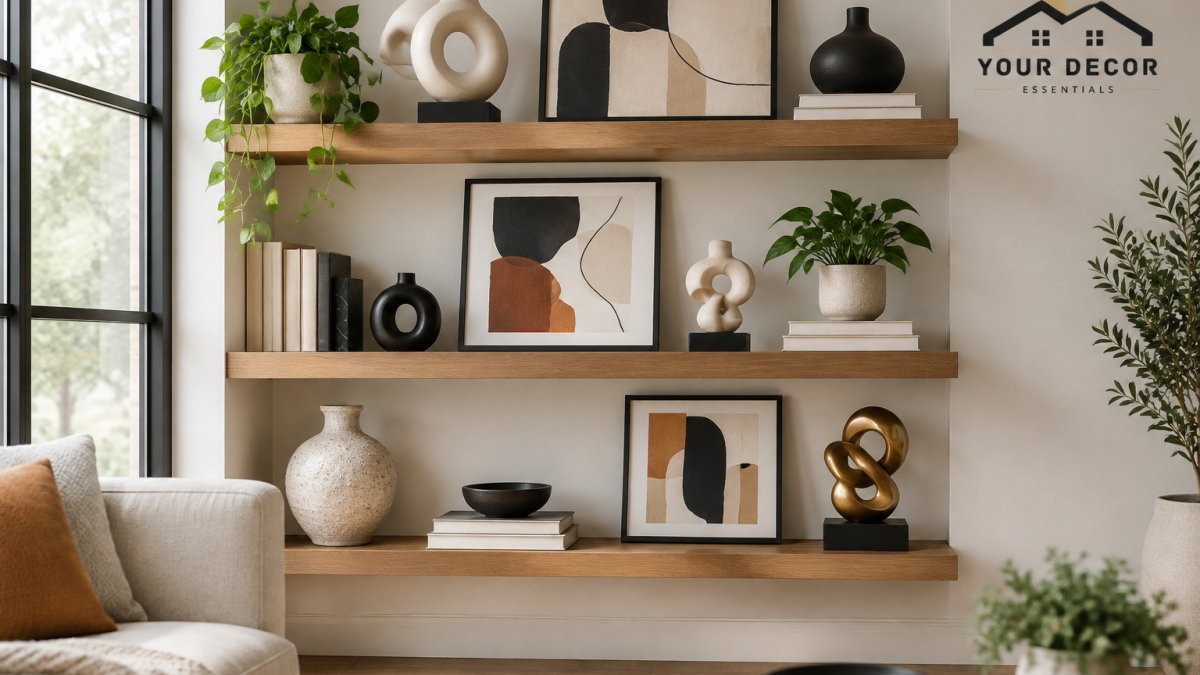
Leaning is the easiest way to make framed art look relaxed and collected. Place the frame against the back wall of the shelf, with the bottom edge resting on the shelf surface. Tilt it slightly forward so the top of the frame stays stable.
To keep it from sliding, place a small rubber or felt pad at the bottom corners. For a larger frame, rest a book or a low bookend beside it for extra support.
Leaning also lets you change the look quickly. Swap a canvas for a print, or move a frame to a different shelf, without touching the wall. Many renters prefer this method for that reason.
How to Layer Art on Shelves Without Crowding Them
Layering means placing smaller pieces in front of larger ones. It adds depth and a sense of a curated collection. The trick is to leave gaps so each piece still reads clearly.
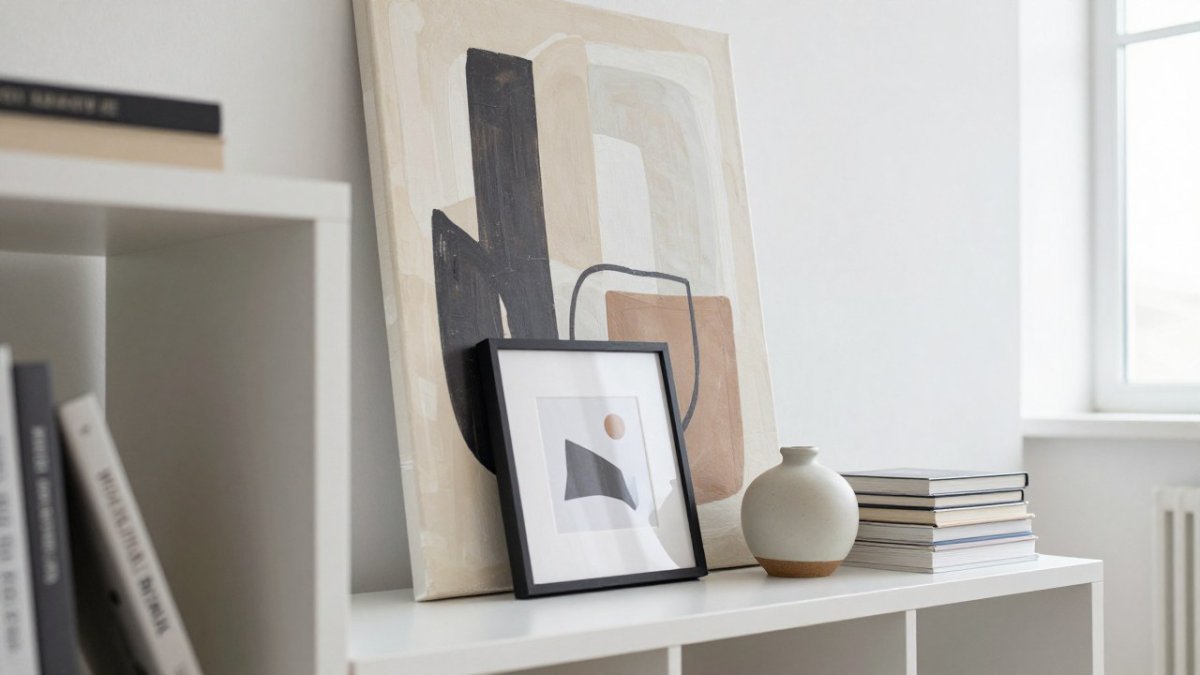
Follow this simple pattern:
- Put the largest piece at the back, leaning against the wall.
- Place a medium piece in front, overlapping the lower third of the large piece.
- Add one or two small objects, such as a ceramic bowl, in the open space beside them.
- Stop when you have one empty area to rest your eye.
If the shelf feels crowded, remove the smallest item first. One fewer object often makes the whole arrangement look more intentional.
How to Style Shelves with Art and Sculptures
Sculptures bring a three-dimensional quality that flat art cannot match. Mix their shapes with the artwork around them. A round, smooth sculpture next to an angular framed abstract creates contrast without any clash.
Keep the color palette connected. Choose two or three main colors and repeat them across the shelf. If your art uses warm ochre tones, a neutral stone sculpture or a cream vase will sit comfortably beside it.
Vary the heights. For more ideas on arranging these pieces in a living room, see styling abstract sculptures in a living room. Place one tall piece, one medium piece and one low piece. This sets up a visual rhythm that the eye enjoys following. Avoid lining everything up at the same height, since that flattens the display.
How to Display Art on Shelves for Balance and Height
Balance is the difference between a display that looks pleasing and one that looks tipped to one side. Divide the shelf into thirds in your mind. Place your main piece in one third, a supporting piece in another, and leave the last third quieter.
Height matters as much as width. Your eye rests best when the tallest point sits slightly off center. A centered, symmetrical arrangement looks formal, while an off-center one feels more relaxed and modern.
When you style several shelves in one unit, check the top shelf and the bottom shelf together. The heaviest-looking pieces should not all sit on one side of the unit.
How to Decorate Shelves Without Looking Cluttered
Clutter usually comes from too many objects of similar size. Before you add anything, ask whether the shelf still has room to breathe. A useful rule is to leave about one-third of each shelf empty.
Here are common mistakes to avoid:
- Buying several pieces in one size, which makes the shelf look uniform and busy.
- Filling every corner with small items.
- Stacking art too high, so the shelf above it feels cramped.
- Mixing too many colors and textures without a shared thread.
If you are unsure, remove one item and look again. Most shelves look better with fewer, bigger choices.
Securing Heavy Pieces and Protecting Art from Light
Safety matters, especially with heavy sculptures and resin pieces. Use museum putty or a small adhesive gel on the base of any sculpture that could tip. Check that the shelf brackets are rated for the weight you plan to place on them. The bracket or shelf label usually lists a maximum load.
Protect your art from direct sunlight. Strong light can fade paints and prints over time, and it can also cause glare on glossy frames. Position shelves away from a sunny window where possible, or use sheer curtains to soften the light.
Keep resin pieces out of direct heat, such as above a radiator or near a fireplace, since heat can warp or cloud the surface.
Building Your First Abstract Shelf Display This Weekend
You can finish a complete display in a single weekend. Here is a simple plan:
- Saturday morning: Measure each shelf and note the clearance heights.
- Saturday afternoon: Choose one anchor piece and two supporting items in a shared color palette.
- Sunday morning: Lay the pieces on the shelf without hanging anything. Adjust until the balance feels right.
- Sunday afternoon: Secure heavy items with putty, lean the frames, and step back to check the final look.
Take a photo before you finish. It helps you remember the arrangement and makes future changes easier.
Ready to start? Browse our curated abstract sculptures and resin accents at Your Decor Essentials. Choose one anchor piece, measure your shelf, and build your first display this weekend.
Frequently Asked Questions
How do you style an open shelving unit with abstract art?
Start by choosing one anchor piece, usually the largest abstract print or sculpture, and place it on the lowest or most visible shelf. Lean it slightly against the wall so it reads as relaxed rather than hung. Add one or two smaller framed pieces in front of or beside it, then fill remaining space with a few books, a ceramic vase, or a sculptural object in a related color. Leave gaps of open wall visible so the arrangement feels curated. Step back after each addition and check that visual weight is spread across the shelf rather than clustered on one side.
How do you choose the right size abstract art for open shelves?
Measure the depth and height of each shelf before shopping. Pieces should leave at least a few inches of clearance above them and should not overhang the shelf edge. For a standard shelf, a canvas or print roughly two-thirds the shelf width often looks balanced, while smaller shelves suit prints that are about half the width. Consider how much vertical space you have between shelves, since leaning work needs room to tilt without touching the shelf above. Choosing dimensions based on the shelf, not the wall, is the most common way to avoid a display that looks too big or too small.
How do you keep abstract art secure on open shelves?
Place heavier pieces, such as thick canvases or sculptures, toward the back of the shelf and closer to the wall. Use small furniture pads or museum putty under the base of objects and frames to prevent sliding. Check that the shelf brackets are rated for the combined weight of the arrangement, and anchor tall shelves to studs where possible. Keep the most fragile pieces on lower shelves, away from foot traffic and doors, and avoid placing glass-fronted frames near the edge of any shelf.
How do you mix abstract art with books and other shelf decor?
Treat books and objects as the supporting cast for your artwork. Stack a few books horizontally to create a base, then lean a framed abstract piece against them. Vary heights with a vase, a small sculpture, or a candle, and repeat one color from the artwork in at least one object to tie the display together. Keep the palette limited to three or four colors and mix textures, such as ceramic, wood, and resin, so the shelf feels intentional rather than assembled at random.