 how-to
How Do You Choose Abstract Sculptures for Small Spaces?
Last Updated: October 24, 2026
Quick Summary
Choosing abstract sculptures small spaces requires measuring your wall dimensions, viewing distance, and available surface depth, then applying proportion rules where the sculpture occupies 5-15% of your visual space. Match the sculpture's size to your viewing distance: pieces 12-18 inches tall work well for close viewing at 3-5 feet, while 18-24 inch pieces suit viewing from 8-12 feet away.
- Measure wall height, width, depth, and viewing distance before selecting a sculpture size
- A sculpture should occupy roughly 5-15% of the visual space you're decorating
- Pieces 12-18 inches tall work for close viewing, while 18-24 inches suits 8-12 feet distance
- Leave at least 2 inches clearance on shelf sides and 6 inches on console tables to prevent tipping
- Position accent lighting at a 30-45 degree angle to maximize shadow definition and three-dimensional form
Table of Contents
- Understand Your Space: Measuring and Planning
- How to Choose the Right Size Sculpture for a Room
- Scale and Proportion: Making Abstract Sculptures Work in Compact Rooms
- Where to Place Sculptures in Your Home
- How to Display Art in a Small Space Without Clutter
- Selecting Materials, Color, and Finish for Your Space
- Small Living Room Sculpture Ideas and Display Options
- Lighting and Shadow: Bringing Your Sculpture to Life
- Start Your Sculpture Search at Your Decor Essentials
- Frequently Asked Questions
Understand Your Space: Measuring and Planning
Before you bring home any abstract sculptures small spaces, you need to know your actual space. Most people skip this step and end up with pieces that feel too big, too small, or just wrong for the room. Take time to measure.
Start with wall dimensions. Measure the height and width of the wall where you're thinking of placing a sculpture. Note any obstacles: windows, doors, light switches, outlets. If you're considering a tabletop or shelf display, measure that surface too. Write down the depth available. This matters more than people realize.
Next, consider viewing distance. How far will you stand from the sculpture most of the time? If it's across a small living room, you'll see it from about 8-12 feet away. If it's on a console table near an entryway, you might view it from 3-5 feet. This distance changes how size feels. A sculpture that looks perfect at arm's length can disappear when viewed from across a room.
Document your room's overall dimensions. Measure length, width, and ceiling height. Take photos of your space from different angles. These visuals help you visualize how a new piece will fit before it arrives.
| Measurement | Why It Matters | Where to Record |
|---|---|---|
| Wall height and width | Determines max sculpture size | Notebook or phone |
| Viewing distance | Changes how scale feels | Photo notes |
| Tabletop or shelf depth | Prevents overhang issues | Measurements list |
| Ceiling height | Affects vertical balance | Room dimensions |
| Obstacles (outlets, windows) | Influences placement options | Sketch or photo |
How to Choose the Right Size Sculpture for a Room
The right size sculpture for a room depends on the room's total volume, your viewing distance, and the footprint of the display surface. Most people make mistakes here. They either choose something so small it gets lost, or so large it dominates and overwhelms. A repeatable method removes the guesswork.
Start with a proportion rule. A common guideline among interior designers is that a sculpture should occupy roughly 5-15% of the visual space you're decorating. For a wall display, aim for the piece to cover about one-eighth to one-quarter of that wall's visible area. For a tabletop, the sculpture should be taller than the furniture it sits on but not so tall that it blocks sightlines or feels precarious. Learn how to size abstract sculpture for a console table for specific guidance on proportions and placement. For floor pieces, the sculpture's height should not exceed one-third of the ceiling height in a compact room, or it will feel cramped.
Measure the footprint, not just the height. Before buying, measure the depth and width of your shelf, console, or floor area. A sculpture's base or footprint should leave at least 2 inches of clearance on all sides on a shelf, and at least 6 inches on a console table, to avoid overhang and tipping risk. For floor pieces, ensure the base extends at least 12 inches from the wall to prevent accidental knocks in walkways.
Account for circulation. In small rooms, walkways are often 24-36 inches wide. A floor sculpture placed in a corner should not protrude more than 18 inches into the walking path. For tabletop pieces, check that the sculpture does not block the view of a TV, artwork, or a seated person's sightline. A simple test: sit where you normally sit and see if the sculpture intrudes on your field of view.
Match scale to nearby furniture. If your sculpture sits on a console table next to a mirror, lamp, or other decor, it shouldn't dwarf those items. A good rule is that the sculpture's height should be no more than 1.5 times the height of the tallest neighboring object, and no less than half the height of the shortest. This keeps the vignette balanced.
Use viewing distance to judge visual weight. A sculpture viewed from 8-12 feet across a small living room will appear smaller than one viewed from 3-5 feet in an entryway. As a rule of thumb, a piece that is 12-18 inches tall works well for close viewing (3-5 feet), while a piece 18-24 inches tall holds its own at 8-12 feet. Anything over 24 inches starts to feel large in a room under 150 square feet.
Safety and stability. Small spaces often mean tighter clearances. Avoid placing sculptures on narrow ledges or high shelves where they can be knocked over. Use museum putty or mounting brackets for tabletop pieces in high-traffic areas. Keep floor sculptures away from door swings and pet paths. Check for sharp edges or fragile protrusions if you have children or pets.
By measuring your space, applying these proportion rules, and testing with a template, you can choose a sculpture that fits without overwhelming the room.
Scale and Proportion: Making Abstract Sculptures Work in Compact Rooms
Scale is about how big the sculpture looks relative to everything around it. Proportion is about the relationship between the sculpture's own parts, its height, width, and depth.
In compact rooms, proportion matters more than raw size. A sculpture with an interesting silhouette and varied proportions feels larger and more engaging than a chunky, uniform piece of the same actual height. Abstract forms work here because they naturally create visual interest through shape variation.
Choose sculptures where the proportions feel balanced to you. If it's very tall and thin, make sure that feels intentional and elegant, not spindly. If it's wide and low, ensure it looks grounded, not squat. Stand back and ask: does this feel right in this space?
The material and finish also affect how scale reads. A lightweight ceramic or resin sculpture feels more delicate and takes up less visual weight than a dense metal piece of the same size. This is useful in small spaces, you can go slightly larger without the piece feeling heavy or oppressive.
Where to Place Sculptures in Your Home
Placement determines how much impact your sculpture has. The best spot depends on your room layout, lighting, and how you use the space.
Wall placement works when you have a clear, uncluttered wall section. Floating shelves, ledges, or wall-mounted brackets display sculptures beautifully. The wall becomes a gallery. This approach saves floor and table space, ideal for compact rooms.
Tabletop and shelf placement puts the sculpture at eye level or slightly below. A console table in an entryway, a bookshelf in a bedroom, or a side table in a living room all work well. The sculpture becomes part of a vignette, grouped with other objects like books, plants, or lighting.
Floor placement works for larger sculptures or statement pieces. A tall abstract sculpture in a corner, next to a window, or beside a sofa can anchor a room. Make sure it doesn't block walkways or create clutter.
Avoid high shelves unless you want the sculpture purely for visual interest from a distance. Sculptures are three-dimensional and reward close viewing. Placing one too high or too far away wastes its detail and impact.
The key is choosing a spot where the sculpture gets natural light during the day and where people naturally pause to look at it. An entryway, a reading nook, or a bedroom dresser are all strong choices.
How to Display Art in a Small Space Without Clutter
Clutter happens when you display too many pieces or when pieces compete for attention. In a small space, less is more. One strong sculpture beats three mediocre ones.
Start with a focal point. Choose one wall, one shelf, or one corner as your display zone. Everything else in that area should support the sculpture, not distract from it. This might mean removing other decor temporarily to see what works.
Negative space is your friend. Leave room around the sculpture. Don't surround it with books, plants, and candles all at once. A sculpture on a bare shelf with just a small plant or a single book nearby feels intentional and calm. A sculpture buried in stuff feels like clutter.
Group sculptures thoughtfully if you're displaying more than one. Three small abstract pieces work better together than five scattered around the room. Group them on the same shelf or wall, leaving breathing room between each one.
Consider the background. A sculpture against a plain wall reads clearly. Against a busy wallpaper or a wall full of other art, it gets lost. If your wall is already visually busy, choose a simpler sculpture or find a clearer display spot.
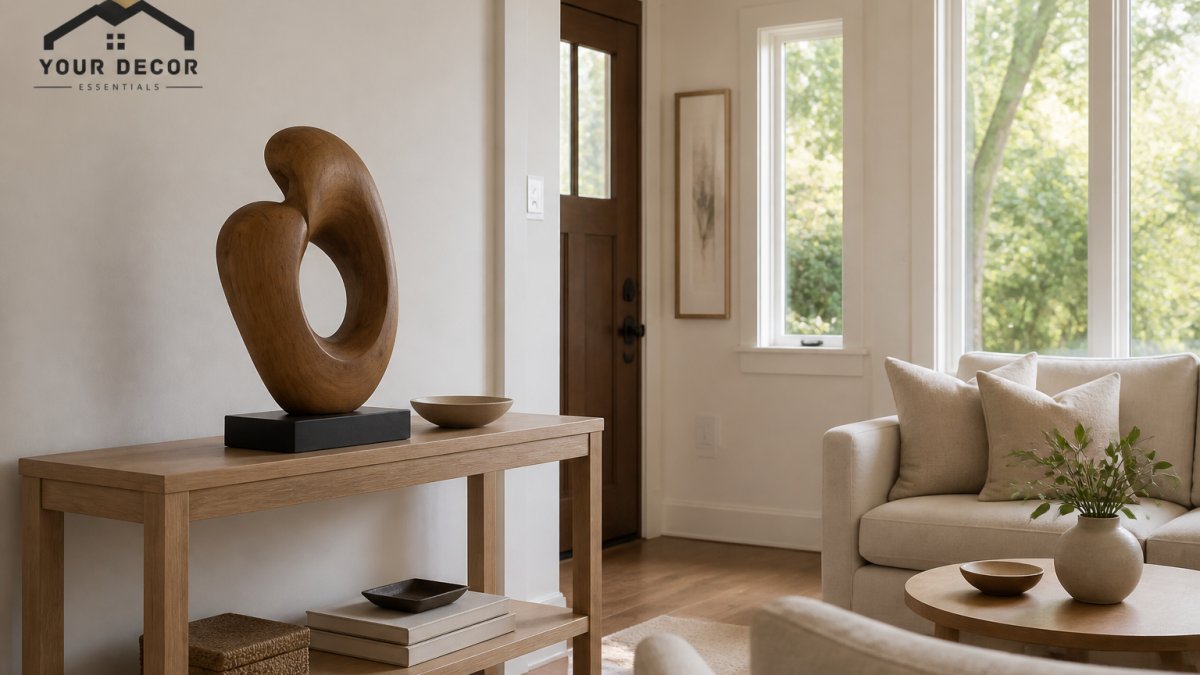
For those looking for specific guidance on how to arrange multiple pieces, styling abstract sculptures in your living room offers concrete ideas and inspiration for different room types.
Selecting Materials, Color, and Finish for Your Space
Material, color, and finish shape how a sculpture fits your space. They're not afterthoughts, they're central to whether the piece works.
Material choices include ceramic, wood, resin, metal, and stone. Each has a different feel. Ceramic and resin feel lighter and more approachable. Wood adds warmth. Metal feels modern and sleek. Stone feels permanent and grounded. In small spaces, lighter materials often feel better because they don't overwhelm the room visually.
Color should either complement or intentionally contrast with your room's palette. If your room is neutral (whites, grays, beiges), a sculpture in a bold color becomes a statement. If your room already has color, a neutral sculpture prevents visual chaos. Look at your existing furniture, walls, and textiles. Does the sculpture's color feel like it belongs?
Finish matters too. A matte finish feels calm and understated. A glossy finish feels contemporary and can bounce light around a small space. A textured finish adds tactile interest and catches light in interesting ways.
For detailed guidance on materials and finishes, explore the abstract sculpture materials collector's guide to understand the trade-offs between different options.
Small Living Room Sculpture Ideas and Display Options
Small living rooms are perfect for abstract sculptures small spaces. The limited space forces you to be intentional, which often results in better design.
A single tall, narrow sculpture in a corner draws the eye upward and makes the room feel less cramped. It adds vertical interest without eating up floor space. Pair it with minimal other decor, maybe a floor lamp or a single plant, to keep the vignette clean.
A tabletop sculpture on a console table or side table works beautifully in a small living room. It's at eye level, easy to see, and doesn't require wall space. Group it with one or two other small objects to create a composed display.
Floating shelves above a sofa or chair let you display a sculpture at eye level while sitting. This creates an intimate viewing experience. The sculpture becomes part of your comfort zone, not a distant focal point.
A sculpture on a bookshelf, nestled between books or near a window, integrates naturally into your existing decor. It doesn't feel like an "art installation", it feels like part of how you live.
Lighting and Shadow: Bringing Your Sculpture to Life
Lighting transforms a sculpture. The same piece looks completely different in bright direct light versus soft indirect light. Shadows created by the sculpture add depth and drama. In small spaces, where the sculpture is often viewed up close, understanding how light interacts with three-dimensional form is essential.
Natural light is ideal if you can manage it. A sculpture placed near a window gets changing light throughout the day. Morning light creates long, dramatic shadows. Midday light is bright and clear. Evening light is warm and soft. Each creates a different mood. However, direct sunlight can cause glare on glossy finishes and fade certain materials over time. Rotate the sculpture periodically to ensure even exposure.
Artificial lighting lets you control the effect. A spotlight or track light positioned to one side of the sculpture creates dramatic shadows and emphasizes its three-dimensional form. Light from above flattens the sculpture slightly. Light from below creates an unusual, theatrical effect. Avoid lighting the sculpture from directly in front, it feels flat and boring. Angle the light to create shadows and depth. Even a simple table lamp positioned nearby can work if it's angled correctly.
Plan for shadows. Abstract sculptures often have negative spaces and protrusions that cast interesting shadows. In a compact room, these shadows can become part of the visual composition. Position the light source at a 30-45 degree angle to the sculpture's primary axis to maximize shadow definition. If the sculpture is on a shelf, ensure the light doesn't cast distracting shadows onto the wall behind it, use a diffuser or adjust the angle.
Avoid glare. Glossy or metallic finishes can bounce light into the viewer's eyes, especially in small rooms where the sculpture is close. Use a matte finish or position the light so it grazes the surface rather than hitting it directly. If glare is unavoidable, consider a lower-wattage bulb or a dimmer switch.
Layer your lighting. Combine ambient light (from ceiling fixtures or windows) with accent light (a spotlight or picture light) to create depth. In a small room, a single accent light aimed at the sculpture can make it a focal point without lighting the entire room. Use warm white bulbs (2700-3000K) for a cozy feel, or cool white (4000-5000K) for a modern look.
For more specific guidance on how to light abstract sculptures effectively, learn how to light abstract art sculptures at home covers the technical details and creative approaches.
Start Your Sculpture Search at Your Decor Essentials
Choosing the right abstract sculpture for a small space comes down to honest measurement, clear thinking about scale, and understanding how light and color work in your room. At Your Decor Essentials, we specialize in curated abstract sculptures and resin accents.
Our collection focuses on pieces that work in compact spaces. We understand that small rooms demand intentionality. Every sculpture we select is chosen for its ability to add visual interest without overwhelming a space. We offer varied materials, finishes, and sizes so you can find something that matches your room's proportions and your personal style.
The pieces in our collection are designed to be viewed up close and from a distance. They're meant to live in your home, not just hang on a wall. Whether you're filling a console table, a shelf, or a corner, we have sculptures that bring calm, sophistication, and personality to small spaces.
Shop Now to explore abstract sculptures designed for homes like yours.
Choosing abstract sculptures for small spaces doesn't require a design degree. It requires honest measurement, clear thinking about proportion, and an understanding of how light and color affect your room. Your Decor Essentials makes this easier by offering a thoughtfully curated selection of pieces designed for real homes. Start by measuring your space, understanding your viewing distance, and thinking about the colors and materials that complement your existing decor. Then browse our collection and find the sculpture that transforms your room.
Frequently Asked Questions
How do I know what size abstract sculpture will work in my small space?
Start by measuring your room's dimensions and identifying your display location. For a shelf or tabletop, choose sculptures that occupy no more than one-third of the surface width. For floor placement, aim for sculptures that are one-fifth to one-quarter of your room's ceiling height. A good rule: if your eye travels past the piece without stopping, it's likely too small; if it dominates the entire room, it's too large. The sculpture should command attention without overwhelming the space.
What's the best way to display art in a small space without making it feel cluttered?
Choose one statement sculpture rather than multiple pieces competing for attention. Create negative space around it by clearing the surrounding area of other objects. If you display on a shelf, position the sculpture off-center and leave breathing room on either side. Avoid grouping abstract sculptures with other decorative items; let each piece stand alone. This approach maintains visual balance and prevents your small room from feeling crowded or chaotic.
Should I choose a tabletop sculpture, wall-mounted piece, or floor sculpture for my small living room?
Tabletop sculptures work best in compact rooms because they don't consume wall or floor space and can be repositioned easily. Wall-mounted pieces are ideal if floor space is limited but wall space is available. Floor sculptures create a focal point but require at least 3-4 feet of clear space around them. Consider your room's layout and traffic patterns. A side table or console sculpture often provides the best balance for small living rooms, offering visual impact without sacrificing functional space.
How can I make sure the sculpture's color and material will match my room?
Before purchasing, gather samples of your room's existing color palette, paint swatches, fabric samples, or photos of furniture. Compare these against product images and descriptions. Abstract sculptures in neutral tones like white, gray, or natural wood blend with most interiors, while bold colors require more intentional coordination. Consider the material's finish: matte finishes feel calm and grounded, while glossy finishes reflect light and add energy. Request detailed product photos from multiple angles and in different lighting conditions to assess how the piece will look in your specific environment.