 listicle
How to Choose the Best Modular Furniture for a Studio
Last Updated: November 6, 2026
Quick Summary
The best modular furniture for a studio apartment is pieces you can rearrange, add to, or split apart as your needs change. A modular sofa is usually the largest decision, so start there. Measure your floor plan and keep at least 30 inches of walkway.
- Mark each planned piece on the floor with painter's tape and walk around it for a day.
- Leave at least 30 inches of walkway where you move most often.
- A sofa that fills no more than about one-third of the longest wall leaves room for other furniture.
- A sleeper mattress is usually 4 to 6 inches thick, so plan a topper for nightly use.
- Wall beds must be anchored into wall studs, so confirm your lease allows the hardware.
Table of Contents
- Why Modular Furniture Works in a Studio Apartment
- How to Measure Your Studio Before You Shop
- Modular Sofas for Small Apartments
- Multifunctional Beds, Sleepers and Wall Beds
- Space-Saving Furniture for Studio Apartments: Storage and Dining
- Building a Studio Apartment Furniture Package
- Furniture for Studio Apartments: Comparing Retailer Options Including IKEA
- Arranging Your Modular Pieces to Define Zones
- Your Next Step: Plan Your Studio Layout Before You Buy
- Frequently Asked Questions
Why Modular Furniture Works in a Studio Apartment
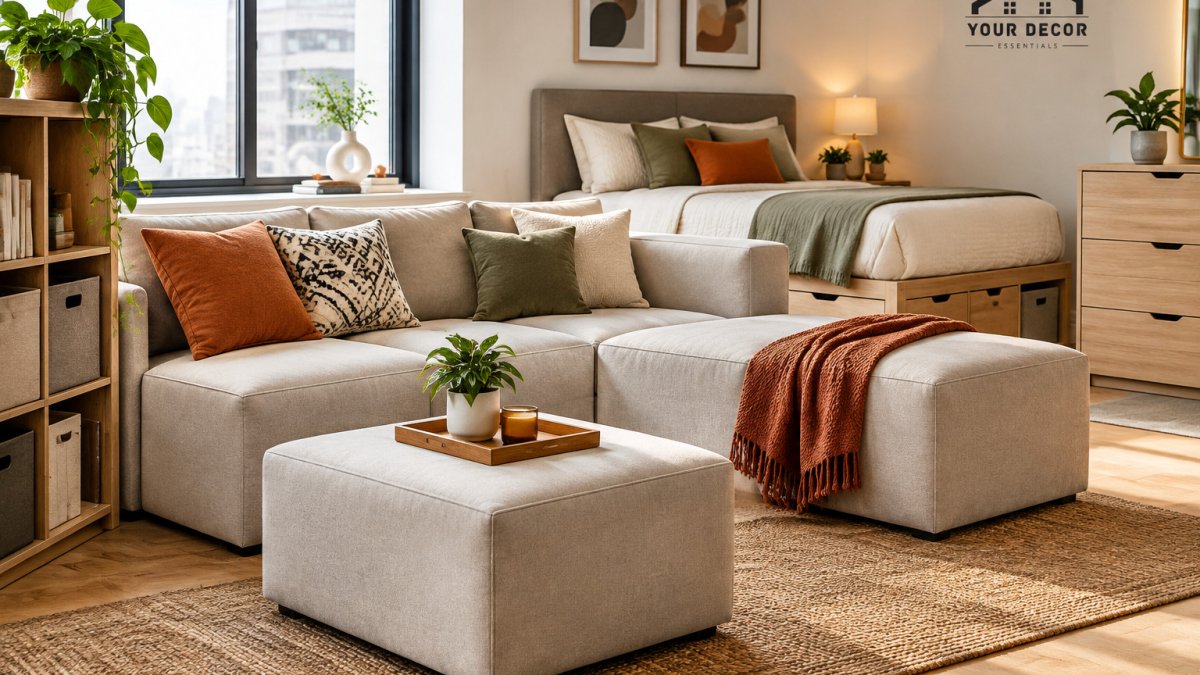
Modular furniture is built from separate pieces that you can rearrange, add to, or split apart as your needs change. In a studio, where the bed, sofa, and dining area all share one room, that flexibility matters more than almost anything else. A single sofa can become a sleeping area, a divider, or a dining bench depending on the day.
Most studio owners discover the same problem within a few months. The layout that worked on move-in day stops working once a desk, a second chair, or a guest arrives. Modular pieces solve that by letting you reshape the room instead of buying a replacement.
At Your Decor Essentials, we select pieces with clean lines and flexible configurations, so the room can grow with you. Our curated collection includes stylish furniture and functional lighting designed to keep a compact space feeling intentional rather than crowded.
Some modular pieces are worth the investment in a small home, and others are not. Apartment Therapy's small-space furniture guidance suggests focusing on multi-use pieces first. For a deeper look at the trade-offs, see is modular furniture worth it for apartments.
How to Measure Your Studio Before You Shop
Measure before you browse. Record the wall lengths, ceiling height, door widths, and the path from the entrance to the window. Note radiator, outlet, and window positions too, because they limit where furniture can sit.
Mark the planned footprint of each piece on the floor with painter's tape. Walk around it for a day. If the tape blocks the bathroom door or the route to the kitchen, the piece is too big, no matter how well it looks online.
A common mistake is measuring only the room and forgetting clearance. Leave at least 30 inches of walkway where you move most often. Account for the swing of any bed or sofa that folds out.
Modular Sofas for Small Apartments
A modular sofa is usually the largest decision in a studio, so it deserves careful planning. Look for modules you can separate, a depth that suits your height, and arms that can be removed or swapped. Those details decide whether the sofa still works after a move.
Sectionals That Split Into Individual Pieces
Sectionals that separate into individual units are the most flexible option. You can use one module as a loveseat, push two together for a sofa, and use the third as an ottoman. The trade-off is that each separated piece needs a clear place in the room.
When comparing modular sectionals, look for pieces that split into sections light enough for one person to move, which helps renters who relocate often. Confirm current dimensions and pricing directly with each retailer before you order.
Sizing a Modular Sofa to Your Floor Plan
Before you compare styles, work out the numbers. A standard sofa seat depth runs about 22 to 24 inches, and a comfortable seat height is roughly 17 to 19 inches. In a studio, a sofa depth over 40 inches starts to eat into the walkway, so measure the depth of the room's main traffic path first.
Use this quick sizing guide as a starting point, then verify against the retailer's listed dimensions:
- One-module loveseat: about 60 to 66 inches wide, seats two, suits a wall run of 6 feet or more.
- Two-module sofa: about 72 to 84 inches wide, seats three, needs a wall run of at least 7 feet.
- Three- or four-module sectional: 90 to 120 inches wide, seats three to four, best when you can float it or place it against a long wall.
A common pattern is to choose a sofa that fills no more than about one-third of the longest wall. That leaves room for a side table, a floor lamp, or a walkway without crowding the room.
Loveseats and Compact Three-Seaters
If a full sectional is too much, a loveseat or compact three-seater can give you seating without dominating the room. When shopping for a loveseat or compact three-seater, compare listed dimensions against your floor plan before you decide.
Watch out: listed sofa widths sometimes exclude armrests, so add the arm width to the seat width before you decide a piece fits your wall.
Configuration Examples for Common Studio Shapes
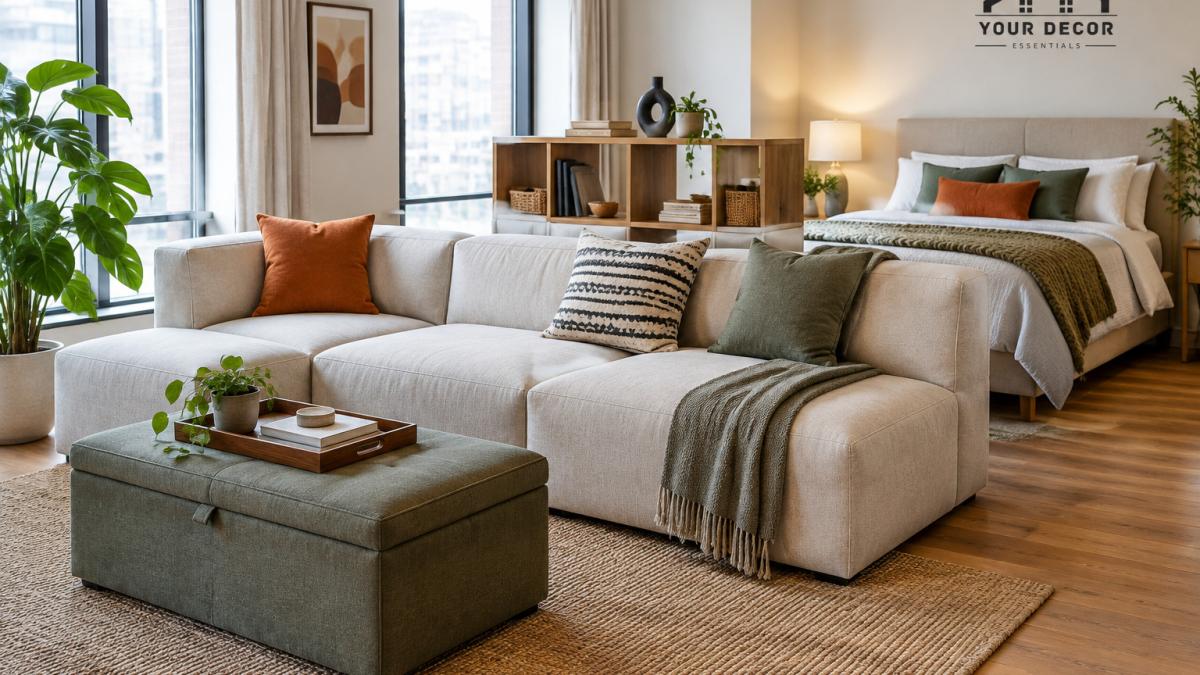
A long, narrow studio usually works best with a two-module sofa placed against the long wall, facing the sleeping area, with a low console behind it to mark the zone. A square studio often suits an L-shaped arrangement: two modules on one wall and one module turning the corner, leaving the center open for a rug and a coffee table. A studio with a single window wall should keep the sofa low-backed so it does not block light, and float it a few inches off the wall to define the living zone.
What to Check Before You Order
Confirm the seat height and depth against your own measurements, ask whether the covers are removable and washable, and check the return window. A modular sofa is a long-term purchase, so the ability to replace a single cushion or module matters as much as the initial look.
Multifunctional Beds, Sleepers and Wall Beds
In a studio, the bed often has to double as a sofa or disappear entirely during the day. Sleeper sofas, storage beds, and wall beds each solve that problem differently.
Sleeper Sofas
Sleeper sofas are the easiest to find and cost the least. Their drawback is that the mattress is usually thinner than a standard bed. A typical sleeper mattress is about 4 to 6 inches thick, compared with 8 to 12 inches for a standard mattress, so plan on a mattress topper if you will sleep on it nightly. Check the conversion mechanism too: a pull-out bed needs clear floor space in front of the sofa equal to the bed's length, usually about 75 inches for a full-size sleeper.
Storage Beds
Storage beds with drawers or lift-up bases add capacity without extra footprint. Drawer depth is usually 12 to 18 inches, so measure the clearance between the bed and the nearest wall or door before you buy. A lift-up base gives you the full footprint of the bed for storage but requires about 24 inches of clearance above the mattress to raise the platform.
Wall Beds
Wall beds fold up against the wall, freeing the floor, but they require secure installation and a wall that can take the load. Most wall-bed systems need to be anchored into wall studs, and a queen-size wall bed can weigh several hundred pounds with the mattress. If you rent, confirm the lease allows wall-mounted hardware before you order. A wall bed also needs clear floor space in front of it equal to the bed's length when folded down, so measure that path first.
Mattress and Conversion Trade-offs
Before buying, check how the mattress is accessed and how long it takes to convert. A bed you dread unfolding will end up staying folded out. A common pattern is that sleeper sofas work best for occasional guests, storage beds suit daily sleepers who need extra capacity, and wall beds make sense when floor space is the top priority and you can install hardware.
Watch out: a wall bed installed into drywall without stud anchoring can pull free under load, so confirm the installation method before you buy.
Dimensions to Confirm
Ask the retailer for the bed's dimensions in both positions: folded and extended. A queen wall bed typically needs about 85 inches of wall width and 90 inches of floor clearance when open. A full-size sleeper sofa usually needs about 75 inches of clearance in front. Write those numbers next to your floor plan before you commit.
Space-Saving Furniture for Studio Apartments: Storage and Dining
Storage and dining furniture are where studios most often run out of room. Look for storage ottomans, nesting tables, and shelves that go up rather than out. Vertical storage keeps the floor clear for walking and moving.
For dining, an expandable table or a drop-leaf design is usually the best fit. A compact table can seat two most days and extend for guests. Pull-out or wall-mounted tables work well where a permanent table would block traffic.
Choose pieces where storage is built in, not added as separate boxes. Built-in storage reduces clutter, and the room looks more finished as a result.
The article's storage and dining guidance comes down to a few clear choices, summarised below.
| Furniture type | Best for | Key difference |
|---|---|---|
| Storage ottomans | Extra storage | Keeps floor clear |
| Nesting tables | Flexible surfaces | Tuck away when not needed |
| Shelves | Vertical storage | Uses wall height, not floor |
| Expandable dining table | Daily use and guests | Seats two, extends for more |
| Drop-leaf table | Tight spaces | Folds down to save room |
| Pull-out or wall-mounted table | Keeping traffic paths open | Avoids a permanent footprint |
| Built-in storage | Reducing clutter | Looks more finished than add-on boxes |
Building a Studio Apartment Furniture Package
Buying one piece at a time often leads to a room that looks assembled from unrelated parts. A better approach is to plan a package: a modular sofa, one multifunctional bed, a compact dining set, and storage that matches in finish and scale.
Start with the largest piece and build around it. Choose a color palette of three to four tones and keep metals and wood finishes consistent. Budget for the whole package, not just the sofa. Delivery, assembly, and any rug or lighting you add all change the total.
Many shoppers compare retailers for affordable modular basics, then add a few more distinctive accents to avoid a generic look. For inspiration on combining styles, see how to mix modern furniture styles.
Furniture for Studio Apartments: Comparing Retailer Options Including IKEA
Retailers differ in price, lead time, and how easily pieces reconfigure.
When comparing, check the return policy, assembly requirements, and whether the piece can be moved without disassembly. Read dimensions carefully, since listed sizes sometimes exclude legs or armrests. Ask about delivery into upper-floor walk-ups if that applies to you.
Arranging Your Modular Pieces to Define Zones
Modular furniture can mark separate zones within one room without walls. Position the sofa with its back toward the sleeping area, use a low storage ottoman as a boundary, and anchor each zone with a rug.
Keep the path between zones at least 30 inches wide. Test the arrangement with the tape you used for measuring before moving anything heavy. If you want current style direction for the look you are building, see 10 best contemporary furniture trends for 2026.
Your Next Step: Plan Your Studio Layout Before You Buy
Sketch your floor plan with real measurements, then decide which pieces must do double duty. Start with the sofa, add a multifunctional bed or sleeper, and fill storage gaps last. Build the package slowly so each piece earns its place.
Explore the curated pieces at Your Decor Essentials to find modular furniture and lighting that suits your studio. Measure first, shop second, and your room will feel deliberate from the first day.
Frequently Asked Questions
What is the best furniture for a studio apartment?
The most useful pieces for a studio are the ones that do two jobs: a sofa that converts to a sleeping surface, a bed with built-in drawers, a dining table that folds or extends, and ottomans with hidden storage. Choose pieces by their footprint when open and closed, not just their look. Measure your floor plan and mark the clearance you need to walk around each piece before you order. Furniture that can be separated into smaller sections also helps when moving into a walk-up or elevator building.
What are some good modular sofa options for small apartments?
Modular sofas for small apartments usually come as separate sections, often with an ottoman or a chaise that can be repositioned. Look for sections light enough for one person to carry and a configuration you can reduce to a loveseat or a three-seater. Product details such as dimensions, weight and current price vary by seller and change often, so confirm them on the manufacturer's or retailer's page before you buy.
How do you arrange modular furniture in a studio apartment?
Start by placing the largest piece, usually the sofa, to mark the edge of the living zone. Use the back of a sectional or a low shelf to suggest a boundary between the sleeping and living areas without blocking light or airflow. Keep at least one clear walkway through the room, and test each arrangement by walking the path from the door to the kitchen and bathroom before you finalize it.