 How-to
How to Use Mirrors to Reflect Light in Small Rooms
Last Updated: November 16, 2026
Quick Summary
Place a mirror where it catches daylight or lamplight and bounces it across the room. A mirror across from a window works best, since it doubles the daylight reaching the room's interior. Mirrors reflect light already in the room, so brightness comes from placement, not extra fixtures.
- Hang a mirror across from a window so daylight bounces into the room's center.
- Choose clear glass with a slim frame, since tinted mirrors reflect less light.
- Hang the mirror so its center sits roughly at eye level.
- A mirror covering at least a quarter of the wall reflects more light.
- Keep the mirror clear of clutter and window frames for a clean reflection.
Table of Contents
- Why Mirrors Work Better Than You Expect in Small Rooms
- Mirror Types and Their Reflective Properties
- Mirror Placement to Brighten a Room
- Using Mirrors to Increase Sunlight in Rooms With Limited Windows
- Redirecting Light Through a Doorway or Hallway
- Do Mirrors Make Rooms Look Bigger? Size, Shape and Frame Choices
- Common Placement Mistakes to Avoid
- Planning Your Mirror Layout Before You Hang Anything
- Frequently Asked Questions
Small rooms can feel cramped and dim, but a well-placed mirror can change that fast. Mirrors bounce light around a room, so a single piece on the right wall can brighten a corner and make the space feel larger. A few simple placement choices can turn a dark room into one that feels open and bright. This guide shows you how to use mirrors to reflect light in small rooms, step by step.
The idea is simple: a mirror does not create light, but it reflects the light already in the room. Place it where daylight or lamplight can hit its surface, and that light spreads across walls, floors and furniture. Position it well, and you get more brightness without adding a single fixture.
Why Mirrors Work Better Than You Expect in Small Rooms
Most people think of mirrors as tools for checking their appearance. In a small room, they do much more. A mirror adds a second view of the space, so the eye reads the room as deeper than it really is.
Light also matters here. A mirror placed across from a window doubles the daylight that reaches the room's interior.
- A mirror reflects light instead of absorbing it
- Reflections make a room feel deeper and more open
- One well-placed mirror can outperform a extra lamp
Mirror Types and Their Reflective Properties
Not every mirror reflects light the same way. Two things matter most: the glass and the frame.
Clear glass mirrors reflect the most light. They are the best choice when brightness is the goal. Frameless designs also let more of the mirror face catch light, since a wide frame can block part of the reflective surface.
Tinted or antique mirrors look warm and aged, but they reflect less light.
When shopping, look for a mirror with a bright, even surface and a frame that stays slim. A slim frame keeps the focus on the glass, where the light bounces.
Mirror Placement to Brighten a Room
Placement does most of the work. Ask one question first: where does the light come from? Once you know the answer, you know where the mirror should go.
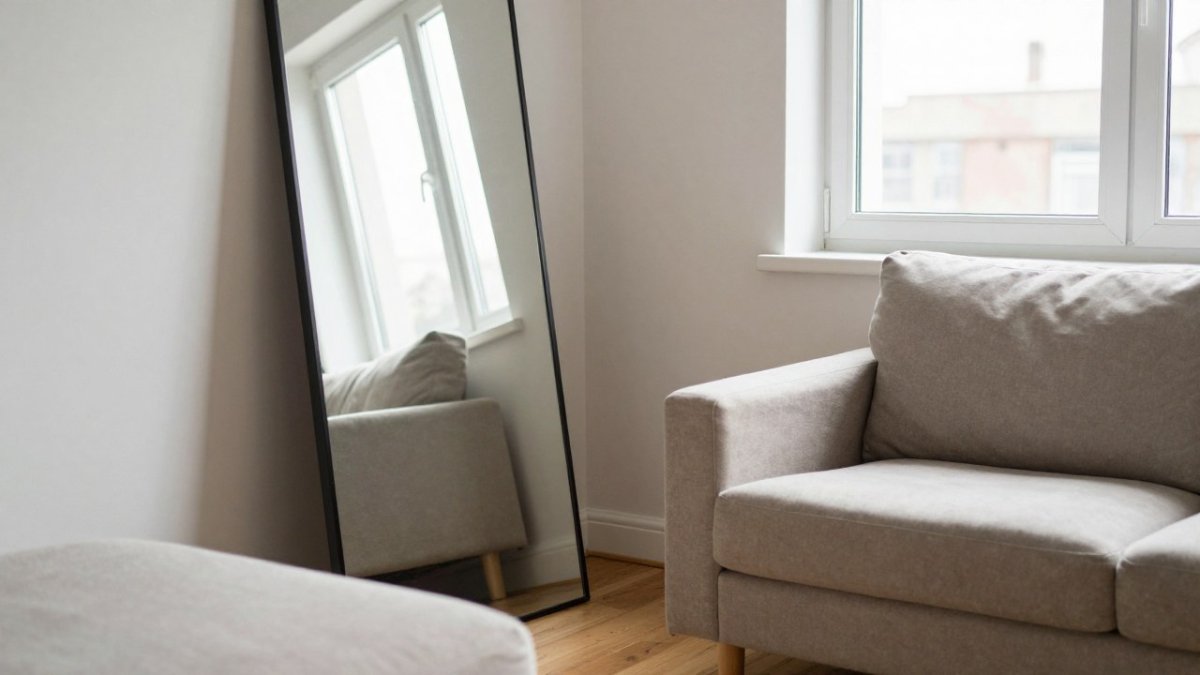
Follow these steps:
- Find your main light source, usually a window or a lamp.
- Stand where you would normally sit and look toward the light.
- Hold a mirror (or imagine one) on the wall that catches that light.
- Check that the reflection shows a bright area of the room, not a blank wall or clutter.
Good spots for brightening a room:
- Across from a window, so daylight bounces into the room's center
- Next to a window, to catch light at an angle
- On a wall facing a lamp, to spread warm light across the space
Placing a Mirror Opposite a Window
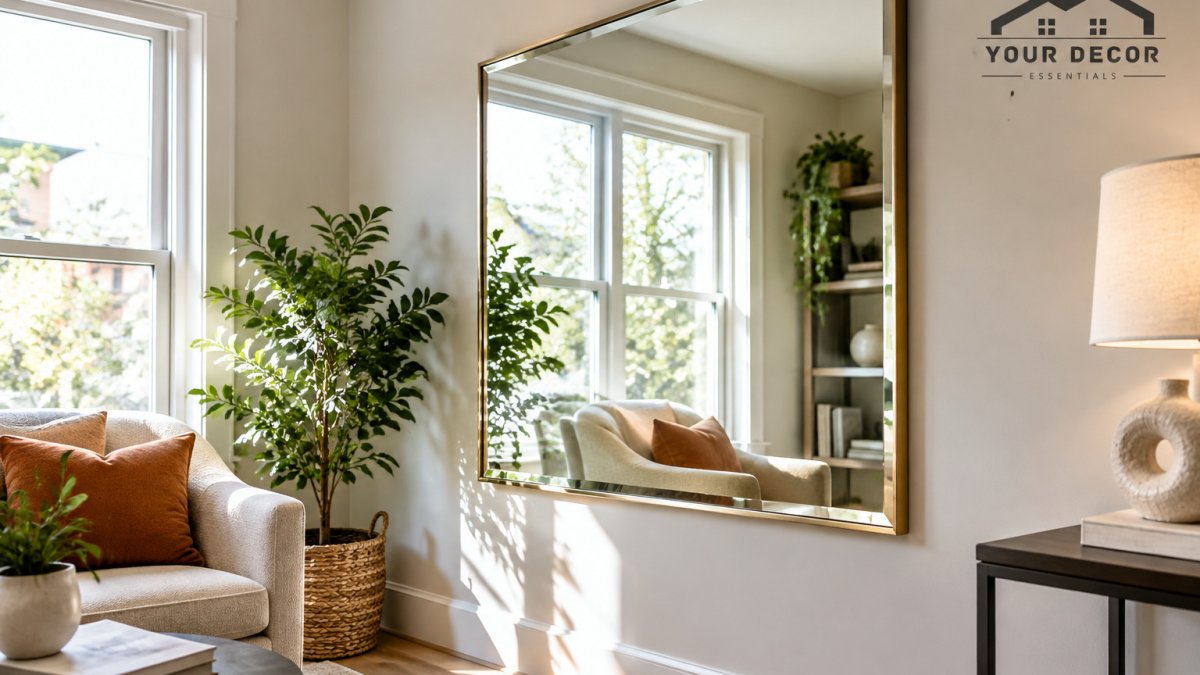
A mirror opposite a window is the classic choice. Daylight hits the glass and bounces straight back into the room, often reaching the darkest corner.
Hang the mirror so its center sits roughly at eye level, and keep it clear of the window frame so the reflection stays clean. A large mirror works best here because it catches more of the incoming light. A common mistake is hanging the mirror so it reflects only a wall or a dark corner. Check the reflection from the sofa or desk before you drill any holes.
Positioning a Mirror Beside or Perpendicular to a Window
When the wall opposite the window is already full, place the mirror beside the window or on a perpendicular wall. Light enters at an angle and hits the mirror, then spreads across a different part of the room.
This setup works well in narrow rooms, where a mirror opposite the window would reflect the whole length of the space and look odd. Try a mirror leaning against the wall, tilted slightly toward the window, and adjust until the brightest reflection lands where you need it.
Using Mirrors to Increase Sunlight in Rooms With Limited Windows
Some small rooms have only one window, or a window that faces a neighboring wall. In those cases, a mirror can stretch the light you already have.
Place a mirror on the wall that faces the window, at a height that reflects the sky rather than the floor. The reflection then carries light from the window across the room.
Keep these points in mind:
- Mirrors reflect light most strongly from direct sun or a bright sky
- A dark window with no sun will reflect very little
- Clean the mirror and the window glass so dust does not dull the reflection
Redirecting Light Through a Doorway or Hallway
A windowless room can still borrow daylight from another part of the home, but it takes more than hanging a mirror near the door. The goal is to create a relay: a window in one room, a mirror in the hallway or adjacent room, and an open doorway that lets the bounced light travel into the dark room. Treat it as a path, not a single reflection.
Here is a step-by-step method that works in most layouts:
- Map the light path. Stand in the windowless room with the door open. Identify the brightest window in the adjacent room or hallway. Note the straight line between that window and the doorway.
- Place the first mirror in the bright room. Hang or lean a large mirror on a wall that faces the bright window, positioned so the mirror catches the window's light and throws it toward the doorway. The mirror does not need to be opposite the window; a 30- to 45-degree angle often sends light through the door more effectively than a straight-on placement.
- Place the second mirror in the dark room. Put a mirror on the wall beside or just inside the doorway, angled so it catches the light coming through the door and reflects it toward the room's darkest corner or ceiling. Angling it slightly upward spreads light across the ceiling and back down, which softens shadows better than a floor-level bounce.
- Test with a flashlight before drilling. Have someone stand at the bright window and shine a flashlight at the first mirror. Watch where the beam lands. Adjust the angle of each mirror until the beam reaches the far wall of the dark room. This dry run saves you from patching holes later.
- Open the door fully and keep the path clear. Furniture, a door that swings shut, or a coat rack in the hallway will block the relay. The doorway needs to stay open during the hours you want the light.
A few practical adjustments make the relay stronger:
- Use the largest mirror you can fit in the bright room. A bigger reflective surface catches more of the window's light and sends a wider beam through the door.
- Keep both mirrors clean. Dust on either surface cuts the amount of light that reaches the dark room, and the loss compounds across two bounces.
- Paint the hallway or adjacent room a light color. Light-colored walls bounce light toward the doorway instead of absorbing it, which supports the mirror relay.
- Angle the second mirror toward the ceiling. Light that hits the ceiling first spreads more evenly than light aimed straight at a wall, which can create a hot spot.
Watch out: a mirror placed directly across from an open door can throw glare into the dark room at night when a lamp is on in the hallway, so test the setup in the evening as well as in daylight and adjust the angle or add a sheer curtain at the doorway if the glare is uncomfortable.
If the hallway has no window and the adjacent room's window is small, the relay may produce only a modest lift. In that case, combine the mirror path with a lamp in the dark room so the mirror has a steady light source to reflect after sunset.
Do Mirrors Make Rooms Look Bigger? Size, Shape and Frame Choices
Yes, mirrors can make rooms look bigger, but size and shape change the effect.
A large mirror makes more of a difference than a small one. It reflects more of the room and more light. A tall, narrow mirror suits a hallway, while a wide, round mirror suits a small bedroom or bathroom.
For frames, choose one that suits the room without visually weighing it down:
- A simple frame keeps the focus on the reflection, while a framed mirror wall art piece shows how a mirror-based design can serve as the focal point.
- A thin metal frame adds a modern touch without blocking light
- A heavy wood frame can make a small room feel crowded
Common Placement Mistakes to Avoid
Even a good mirror can fail in the wrong spot. Watch for these common errors:
- Hanging it across from clutter. The mirror will reflect the mess and make the room feel busier.
- Blocking the window. A mirror that covers part of the glass cuts the light you want to reflect.
- Facing a blank wall. The mirror needs something bright or open to reflect.
- Placing it too high or too low. Hang it so its center sits near eye level for the best view.
- Ignoring glare. A mirror aimed at a bright light source can cause harsh glare, so test the angle at different times of day.
Planning Your Mirror Layout Before You Hang Anything
A mirror that looks right in the store can disappoint on the wall if the size, height, or angle is off. Planning with a few measurements and a paper template prevents most of the common failures and takes less than an hour.
Size the mirror to the wall and the light source. As a working rule, a mirror used for light reflection should cover at least a quarter of the wall it hangs on, and wider is generally better than taller for catching daylight from a window. A mirror narrower than the window it faces will catch only part of the incoming light. For a small room, a mirror in the 30- to 36-inch-wide range is a practical minimum for a reflective effect; anything smaller reads as decoration rather than a light tool.
Set the height by the reflection, not the wall. The center of the mirror should sit near eye level when you are seated in the room's main seat, typically 54 to 60 inches from the floor. For a mirror meant to bounce light, tilt the top edge slightly toward the light source, a lean of about 5 to 10 degrees is enough to aim the reflection without looking crooked.
Measure the distance to the light source. The strongest reflection comes when the mirror is within roughly 10 to 15 feet of the window or lamp it is reflecting, with a clear line of sight between them. Beyond that distance, the reflected light spreads and weakens. Use a tape measure to confirm nothing, a cabinet, a door swing, a tall plant, blocks the path.
Run a paper template test. Cut a sheet of paper or cardboard to the mirror's exact dimensions and tape it to the wall at the planned height. Sit in your main seat and check three things: whether the reflection shows a bright area rather than a blank wall, whether the mirror looks proportionate to the wall, and whether the top edge clears any furniture. Live with the template for a day and check it in the morning, at midday, and in the evening.
Test at different times of day. Daylight moves. A spot that catches strong morning sun may reflect only a dim wall by late afternoon. Note which hours you use the room most and choose the placement that performs best then. If the room is used mainly in the evening, plan the mirror around lamp positions rather than the window.
Plan for mounting and safety. A large mirror is heavy, and a small room often means furniture close to the wall. Anchor wall mirrors into studs or use heavy-duty wall anchors rated for the mirror's weight, and add safety straps or clips at the top and bottom. Avoid leaning a tall mirror in a room with young children or pets unless it is secured to the wall. Keep the bottom edge at least 12 inches above the floor so a vacuum or a pet cannot strike it.
Coordinate with lighting and surface colors. Pair the mirror with layered lighting, a floor lamp and a table lamp on opposite sides of the room, so the mirror has a light source to reflect after dark. For guidance on positioning those lamps, see how to arrange living room lamps for task lighting. Light-colored walls, ceilings, and furniture reflect more light and let the mirror do less work. For fixture ideas to pair with a mirror, browse these modern lighting picks. A dark accent wall opposite the mirror will absorb much of what the mirror sends its way.
Watch out: hanging a mirror before checking the reflection from your main seat is the most common planning mistake, a mirror that looks well placed from the doorway can reflect a blank wall or a cluttered corner from where you actually sit, so always confirm from the seat, not the door.
Before you hang a mirror, these planning measurements help it reflect the most light in your room.
| Planning step | Guideline | Why it matters |
|---|---|---|
| Mirror size | Covers at least a quarter of the wall | Catches more daylight |
| Minimum width | About 30-36 inches | Smaller reads as decoration |
| Center height | 54-60 inches from floor | Near eye level when seated |
| Top edge tilt | About 5-10 degrees toward light | Aims the reflection |
| Distance to light | Roughly 10-15 feet | Strongest reflection |
| Bottom edge clearance | At least 12 inches above floor | Keeps mirror safe from pets and vacuums |
Ready to brighten your space? Shop the Your Decor Essentials collection and find a mirror that fits your room and your style.
Frequently Asked Questions
Do mirrors make a small room look bigger?
Yes, when they are placed well. A mirror reflects the room back on itself, which adds visual depth and makes walls seem farther apart. The effect is strongest when the mirror reflects a window, a light source or an attractive view rather than clutter or a dark corner. Choose a large mirror, hang it at a comfortable eye level, and position it so it catches daylight. A mirror that reflects a cluttered closet or a blank wall adds less than one that captures light and open space.
Where should I place a mirror to get the most natural light?
Place it directly opposite a window or at a right angle to it so the mirror can catch incoming daylight and bounce it deeper into the room. Avoid positioning it where direct sun will hit the glass and create glare for you or the people in the room. Test the spot at different times of day, since the sun's angle changes how much light reaches the mirror. A large mirror placed this way often brightens the darkest part of the room more than a second lamp would.
Can mirrors help brighten a room without windows?
Mirrors cannot create light, but they can spread existing light more evenly. In a windowless room, place a mirror opposite a lamp or a light fixture so it reflects that source and fills dim areas. Reflective surfaces paired with light-colored walls and layered lighting give the best result. A mirror placed next to a doorway may also reflect light from a brighter adjoining room into a dark space.
Can a mirror reflect sunlight into another room?
A mirror can redirect sunlight through a doorway or down a hallway if it is angled correctly. Position the mirror near the window so it catches the sun, then tilt it so the reflected beam travels toward the target room. Check the result at several times of day, because the sun moves and the beam will shift. Keep the mirror secured and out of reach of children and pets.