 how-to
7 Benefits of Adjustable Task Lighting for Reading
Last Updated: October 31, 2026
Quick Summary
Adjustable task lighting reduces eye strain by directing light onto the page instead of the whole room, cutting glare and shadows that cause visual fatigue. It also sharpens focus, controls glare and shadows, and adapts to any reading nook or workspace, so you can read longer in comfort.
- Place the lamp on the opposite side of your dominant hand so your shadow falls away from the page.
- For a typical paperback at arm's length, 300-500 lumens is a comfortable starting range for most adults.
- Readers over 60 may need two to three times the light intensity of a reader in their 20s.
- Angle the lamp head so light slants across glossy pages instead of striking them straight down.
- Check for flicker by pointing your phone camera at the lamp and looking for rolling bands.
Table of Contents
- Why Adjustable Task Lighting Beats a Fixed Overhead Light
- Benefit 1: Less Eye Strain and Visual Fatigue
- Benefit 2: Sharper Focus and Longer Reading Sessions
- Benefit 3: Glare and Shadow Control on the Page
- Benefit 4: Flexibility for Every Reading Nook and Workspace
- How to Position a Reading Lamp for Comfort and Coverage
- Reading Light Brightness: Finding the Right Level
- Color Temperature for Reading: Warm, Neutral, or Cool
- Choosing an Adjustable Reading Lamp at Your Decor Essentials
- Frequently Asked Questions
Why Adjustable Task Lighting Beats a Fixed Overhead Light
Most reading problems at home are not about having too little light. They are about having light in the wrong place. A fixed overhead fixture floods the whole room with ambient lighting, but it rarely puts focused illumination where you actually need it: on the page in front of you.
Adjustable task lighting fixes that. A reading lamp you can aim and reposition delivers light exactly where your eyes are working, which is the whole point of task-specific lighting. For more on arranging living room lamps for task lighting, see our dedicated guide.
Here at Your Decor Essentials, we think about light the way we think about any decor piece: it should work hard and look good doing it. Below, we'll walk through seven real benefits of adjustable task lighting for reading, plus the practical setup steps most guides skip. But first, here's what the average living room gets wrong.
Overhead lights create a bright ceiling and a dim book. The contrast between the two forces your eyes to constantly readjust. An adjustable lamp closes that gap by bringing the light source close to the page.
- Fixed overhead light: lights the room, not your book
- Adjustable task light: lights the page, spares your eyes
- Layered lighting: uses both, each doing its own job
That third option is the one designers reach for. Ambient light sets the mood. Task light does the work.
Benefit 1: Less Eye Strain and Visual Fatigue
The biggest payoff of adjustable task lighting is comfort over long reading sessions. When light lands on the page from a well-placed lamp, your eyes stop fighting to see.
Eye strain during reading usually comes from three things: poor light intensity, glare bouncing off the paper, and shadows falling across the text. A fixed ceiling light can cause all three at once. A lamp you can angle fixes them one by one.
- Aim the beam so it hits the page, not your eyes
- Dim the light to match the room, not fight it
- Kill the shadows by moving the lamp to your writing side
A common mistake is cranking brightness to the max. Brighter is not always better. Light that is too intense creates glare and makes fatigue worse, not better.
Benefit 2: Sharper Focus and Longer Reading Sessions
Good task lighting does more than protect your eyes. It helps you concentrate. Focused illumination narrows your visual field to the page, and that single point of attention is easier to hold than a room full of competing light.
Think about where you actually read. A reading nook with a dedicated lamp feels different from a couch under a bright ceiling. The lamp creates a small pocket of light that signals "this is where you read." That cue is real, and it helps.
- Contrast: a lit page against a softer room sharpens the text
- Consistency: steady, flicker-free lighting lets your eyes settle
- Comfort: when your eyes relax, you read longer without noticing
If your current setup makes you squint or shift the book around, the light is the problem. Not your attention span.
Benefit 3: Glare and Shadow Control on the Page
Glare is the quiet thief of reading comfort. It shows up as a bright reflection on glossy paper or a nearby screen, and it forces your eyes to work around it. Shadows are the other half of the problem: your hand, your body, or the lamp itself can block the light right where you need it.
Adjustable task lighting gives you two tools to fight back: beam direction and lamp positioning. But the most useful fixes go beyond tilting the head.
- Pivoting lamp head: angles light away from reflective surfaces
- Flexible arm: lifts the light above your hand to avoid shadows
- Adjustable brightness: lowers intensity when glare creeps in
Watch out: a lamp placed directly in front of you throws your own shadow onto the page. Move it to the side and angle the head down. The page brightens, the shadow disappears.
Handedness and shadow placement
Most readers set the lamp on the same side as their dominant hand, but that is exactly backwards for shadow control. If you are right-handed, place the lamp on your left so your writing hand does not cast a shadow across the page as you turn pages or take notes. Left-handed readers should mirror this: lamp on the right, head angled left. This simple swap eliminates the most common shadow problem without moving the lamp mid-session.
Glare from glossy pages and screens
Glossy magazine paper and tablet screens reflect light like a mirror. A lamp aimed straight down can bounce a bright spot right into your eyes. To reduce this, angle the head so the beam strikes the page at a slant rather than perpendicularly. For screens, position the lamp to the side rather than behind or in front, and dim the screen brightness to match the room. If you read on a laptop or e-reader, a matte screen protector can also cut reflections.
Flicker: the invisible irritant
Some LED lamps flicker at a frequency you may not consciously see, but your eyes and brain still register it. Over long reading sessions, flicker can contribute to fatigue and headaches. To identify flicker, use your phone’s camera: point it at the lamp while the lamp is on, if you see rolling bands or strobing on the screen, the lamp flickers. Choose lamps with high-quality drivers or those labeled “flicker-free” to avoid this issue.
Quick glare and shadow checklist
- Lamp on the opposite side of your dominant hand
- Head angled to slant light across the page, not straight down
- Screen brightness matched to room brightness
- No visible flicker when viewed through a phone camera
- No bright reflection on paper or screen from your seating position
These adjustments take a minute and can transform a fatiguing reading session into a comfortable one.
Benefit 4: Flexibility for Every Reading Nook and Workspace
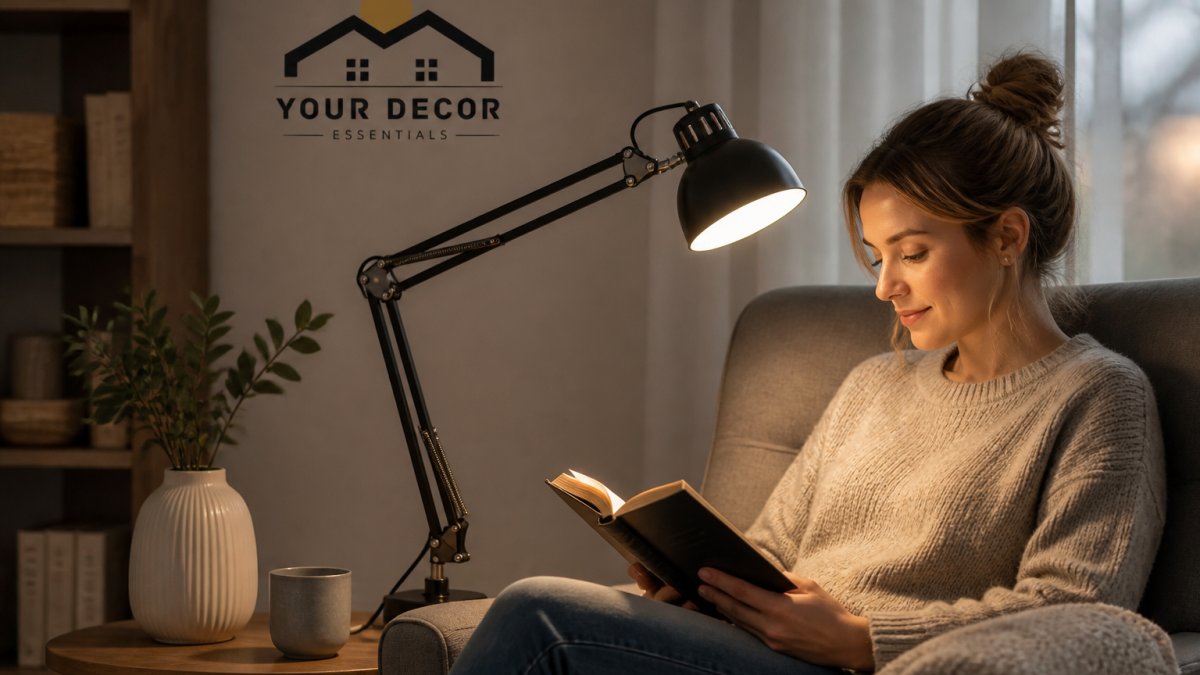
No two reading spots are the same, and that is exactly why adjustable lighting wins. A bedside table, a corner armchair, a home office desk: each one needs light from a different angle and height.
A flexible lamp adapts to the space instead of forcing the space to adapt to it. For inspiration on floor lamps for reading nooks with modern decor, see our curated picks. That versatility matters when you are furnishing a first apartment or reworking a room. One well-chosen lamp can serve reading, working, and unwinding.
- Bedside: low, warm, angled toward the pillow
- Armchair: tall and reachable, head tilted to the page
- Desk: overhead-ish, wide spread, dimmable
The lamp should move with you. That is the whole benefit.
How to Position a Reading Lamp for Comfort and Coverage
Positioning is where most people get it wrong, and it is the easiest thing to fix. The goal is simple: light the page, not the eyes, and avoid your own shadow.
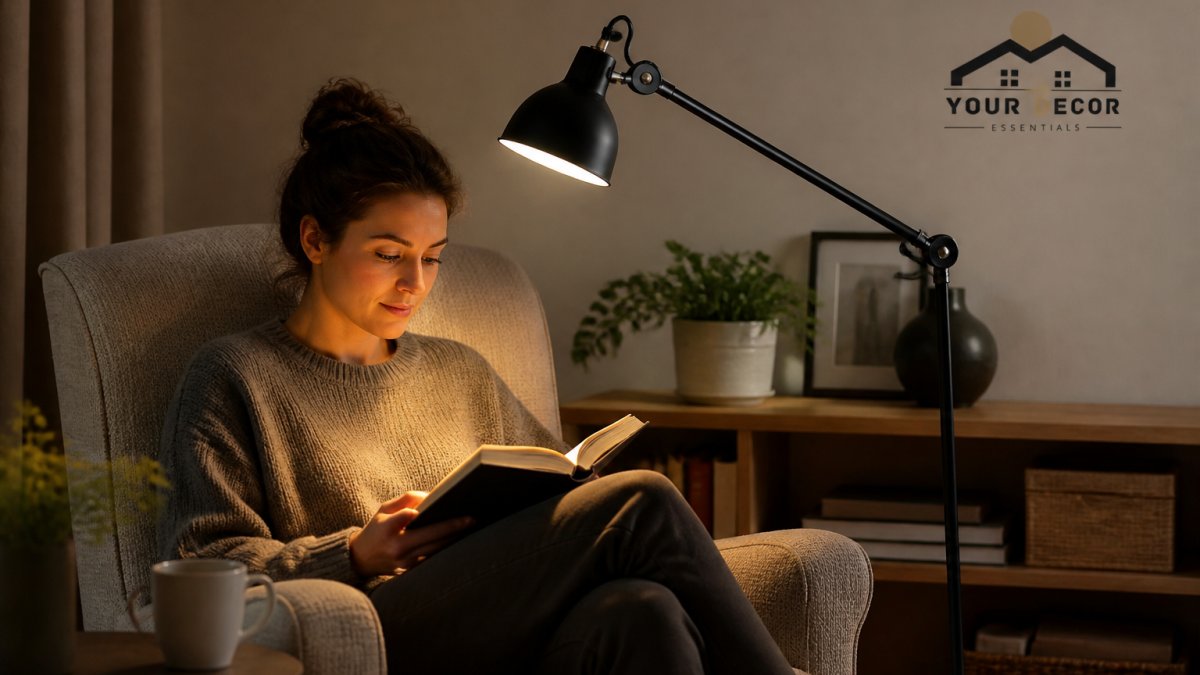
Here is how we would set it up:
- Pick your side. Place the lamp on the side of your dominant hand so your shadow falls away from the page.
- Set the height. The lamp head should sit slightly above and behind your shoulder, angled down at the book.
- Aim the head. Tilt it so the beam lands on the page, never straight into your face.
- Check for glare. Look for a bright spot on the paper. If you see one, angle the head further down.
- Test it. Read a full page. If you squint or shift, adjust before you settle in.
Left-handed readers should mirror the setup: lamp on the left, head angled right. Small change, big difference.
Reading Light Brightness: Finding the Right Level
Reading light brightness is not about maxing out the dial. It is about matching the light to the task and the room. Too dim and you strain. Too bright and you get glare.
The right level is the one where the page is clearly lit and your eyes feel relaxed. You should not have to squint, and the light should not feel harsh. But “relaxed” is subjective, here are concrete starting points.
Brightness ranges for common reading tasks
Most reading lamps list brightness in lumens. For a typical paperback or hardcover at arm’s length, a lamp output of 300-500 lumens directed at the page is a comfortable starting range for most adults. For detailed work like reading small print, maps, or sheet music, 500-800 lumens may be more appropriate. For bedtime reading where you want to wind down, 150-300 lumens with a warm color temperature is often enough.
These are starting points, not rules. Your age, vision, and the room’s ambient light all shift the ideal number.
Adjusting for age and vision changes
As eyes age, the lens stiffens and the pupil narrows, so older readers often need more light to see the same page clearly. A common pattern is that readers over 60 may need two to three times the light intensity of a reader in their 20s for the same task. If you find yourself holding the book closer or squinting, increase brightness first. For readers with low vision or light sensitivity, a dimmable lamp with a wide range, from very low to quite bright, lets you fine-tune without being locked into preset steps.
Matching brightness to ambient light
Brightness is relative. A lamp that feels perfect in a dark room will feel dim in a sunlit room. During the day, raise the lamp’s output to balance window light; at night, lower it to avoid a harsh contrast between the page and the surrounding room. The goal is to keep the page slightly brighter than the room, not dramatically brighter.
Dimmability: stepless vs. stepped
A lamp with stepless dimming lets you dial in exactly the right level, while stepped dimming gives you a few fixed settings. For reading, stepless is more flexible because you can adjust in small increments as daylight fades or as your eyes tire. If you choose a stepped lamp, look for at least three levels, low, medium, and high, so you have options for different times of day.
- Dim rooms: 150-300 lumens, warm tone
- Daytime reading: 300-500 lumens to balance daylight
- Late-night reading: 150-300 lumens, warm and easy on tired eyes
- Detailed reading: 500-800 lumens for small print or close work
Adjustable brightness control is the feature that makes this possible. A stepless dimming floor lamp with adjustable color temperature lets you fine-tune brightness for any reading task. A lamp with stepless dimming lets you fine-tune instead of choosing between three fixed settings.
These lumen ranges are the article's suggested starting points for common reading situations.
| Reading situation | Suggested brightness | Note |
|---|---|---|
| Typical paperback or hardcover at arm's length | 300-500 lumens | Comfortable starting range for most adults |
| Detailed work like small print, maps, sheet music | 500-800 lumens | May be more appropriate |
| Bedtime reading to wind down | 150-300 lumens | Warm color temperature often enough |
| Dim rooms | 150-300 lumens | Warm tone |
| Daytime reading | 300-500 lumens | Balances daylight |
| Late-night reading | 150-300 lumens | Warm and easy on tired eyes |
Color Temperature for Reading: Warm, Neutral, or Cool
Color temperature changes how a page feels, and it is one of the most overlooked settings. Warm light feels cozy. Cool light feels alert. Neutral sits in between.
For reading, warm to neutral light is usually the most comfortable, especially at night. Cool light can feel harsh on the eyes during long sessions, though it works well for daytime focus.
- Warm light: best for evening and bedside reading
- Neutral light: a safe all-rounder for any time of day
- Cool light: sharp and alert, better for daytime tasks
A lamp that lets you switch between color temperatures gives you options for every mood and hour. That flexibility is a big part of why adjustable task lighting works so well for readers.
Choosing an Adjustable Reading Lamp at Your Decor Essentials
Choosing the right lamp comes down to a few practical checks: adjustability, brightness control, color temperature, and how it fits your space. Get those right and the rest is style.
At Your Decor Essentials, our functional lighting is designed to bring visual interest to a room. Lighting is one way a space can be transformed.
- Adjustable lighting: aim the light where you need it
- Style that fits: a lamp that earns its place in the room
The best reading lamp is the one you forget about because it just works. Start there, then let the design follow.
Frequently Asked Questions
What are the benefits of adjustable task lighting for reading?
Adjustable task lighting puts light where you need it and lets you change it as you shift positions. The main benefits are reduced eye strain, sharper focus, fewer glare and shadow problems, and the flexibility to read in a chair, at a desk, or in bed. Because you can aim the head and change brightness, the same lamp works for long novels, magazines, and close work. It also adds a layered, styled look to a reading nook rather than relying on one flat ceiling light.
How bright should a reading light be?
There is no single number that fits every reader. Start at a moderate level and raise it until text is crisp without the page glowing or washing out. If you find yourself squinting or leaning in, add brightness; if the page feels harsh or you see afterimages, lower it. A dimmable adjustable lamp makes this easy to fine-tune. Older readers and anyone with low vision often need more light, so choose a lamp with a wide brightness range.
Where should you position a task light when reading?
Place the lamp to the side of your reading hand, slightly in front of you, with the head angled down toward the page. If you are right-handed, put it on your left so your hand does not cast a shadow over the words. Keep the bulb or LED out of your direct line of sight and aim the beam at the page, not at your face. A flexible arm or pivoting head lets you adjust the angle as you change posture.
Does adjustable lighting reduce eye strain while reading?
It can help by giving you control over glare, contrast, and brightness, which are common sources of visual discomfort during long reading sessions. A lamp you can aim and dim lets you avoid a hot spot on the page and keep the surrounding room softly lit. That said, eye strain has many causes, including uncorrected vision, screen use, and fatigue. If discomfort persists, see an eye care professional. Use the lamp as one part of a comfortable reading setup.
Setting up a reading corner that feels as good as it looks takes the right light and the right pieces working together. At Your Decor Essentials, we curate functional lighting, abstract sculptures, and resin accents that bring a room to life, with a focus on pieces that reflect your own style rather than a catalog look. Explore our collection and find the lamp that turns your reading nook into the best spot in the house. Shop now and start with the light.