 Listicle
Best Modular Sofa Designs for Flexible Living Spaces
Last Updated: November 24, 2026
Quick Summary
The best modular sofa designs for flexible living spaces are low-profile, armless-and-corner component systems with washable covers, deep seats, and a frame you can add to later. A modular sofa is built from separate pieces, such as armless seats, corner units, chaises, and ottomans, that lock together and can be rearranged or expanded as a room changes.
- Measure walkways at 36 inches wide in main traffic areas and 24 inches in secondary paths.
- Buy one or two extra armless seats from the start to expand seating when guests arrive.
- The Mirewood Halo lists every cover, including seat-cushion covers, as machine-washable.
- Seat depth should be around 20 to 22 inches for upright sitting, deeper for lounging.
- Confirm single replacement modules and covers are sold separately before you buy.
Table of Contents
- What are the best modular sofa designs for flexible living spaces?
- Quick Comparison: Modular Sofa Designs at a Glance
- Modular Sofas for Small Spaces
- Modular Sofa Configurations That Adapt to Any Room
- Best Sectionals with Washable Covers for Everyday Life
- How to Arrange a Sectional in a Narrow Living Room
- Comfort, Cushion Firmness, and Seat Depth to Check Before You Buy
- Long-Term Ownership: Costs, Repairability, and Material Transparency
- Choosing Your Modular Sofa and Styling It with Your Decor Essentials
- Frequently Asked Questions
What are the best modular sofa designs for flexible living spaces?
The best modular sofa designs for flexible living spaces are low-profile, armless-and-corner component systems with washable covers, deep seats, and a frame you can add to later. A modular sofa is a seating system built from separate pieces, such as armless seats, corner units, chaises, and ottomans, that lock together and can be rearranged or expanded as a room changes. At Your Decor Essentials, we've watched that flexibility become the deciding factor for first-time homeowners who plan to move or reconfigure a room within a few years.
Below, we'll show you exactly how to compare modular sofa designs by configuration, cover care, seat depth, and long-term cost, so you buy once instead of replacing a sofa that stops fitting your space.
Quick Comparison: Modular Sofa Designs at a Glance
Here is how the leading modular designs stack up on the factors that actually decide a purchase.
| Design | Configuration Style | Cover Care | Best For |
|---|---|---|---|
| HERNEST Brisa 84" Modular Sofa | Modular, deep seats | Not specified | Deep seating in flexible layouts |
| Mirewood Halo | Cloud-style modules | Machine-washable covers | Soft look, easy cleaning |
| Kova Box | Box-module system | Not specified | Family homes, mixed room sizes |
| TOV Calliope Modular Sectional | Sectional modules | Vegan upholstery | Flexible layout, soft feel |
| Silk & Snow Sectional | Modular sectional | Not specified | Value for size and quality |
| Living Spaces Modular Sectionals | Customizable sectional | Varies by item | Browsing a wide selection |
Two names worth a closer look for most shoppers: the HERNEST Brisa for supportive deep seats, and the Mirewood Halo if washable covers matter most. Neither listing shows pricing in the supplied results, so confirm current pricing with each retailer before you commit.
Modular Sofas for Small Spaces
For a small space, the winning modular sofa is the one that fits your longest wall without blocking a walkway, and that grows later instead of being replaced. A two-piece armless setup plus an ottoman usually beats a full sectional in a studio or tight apartment.
Measure three things first: the wall length, the walkway width you need to keep open, and the depth from wall to seat front. Many apartment living rooms simply cannot take a deep chaise without choking the path to the door.
A practical room-planning routine makes the difference between a sofa that fits and one that merely looks like it will:
- Map the floor plan. Sketch the room on graph paper or use a free room-planning app, marking doors, windows, radiators, and outlets. Note the swing arc of every door, a sofa that blocks a door swing is a sofa that will be moved.
- Measure the path, not just the wall. Walkways should stay at least 36 inches wide in main traffic areas and no less than 24 inches in secondary paths. Measure doorways too: a standard interior door is about 30 to 32 inches wide, and a module wider than that will not pass through without disassembly.
- Check the delivery envelope. Measure the front door, hallway width, stairwell turns, and elevator interior. A deep seat module that clears the room may still fail the hallway.
- Match modules to the plan. Armless seats slide into corners and along walls; ottomans double as extra seating or a footrest; corner units turn an L-shape into a compact lounge. Place the longest run on the longest uninterrupted wall and keep at least one open path to each door.
- Leave breathing room. A common pattern is to leave 18 to 24 inches between the sofa front and a coffee table, and 2 to 3 inches between the sofa back and the wall so covers can be removed.
For a studio or tight one-bedroom, a two-seat armless run plus an ottoman typically seats three and can be split into a facing pair later. If you're furnishing a studio or a tight one-bedroom, our guide on how to choose the best modular furniture for a studio walks through layout picks that keep small rooms open.
Watch out: a low-back design keeps a narrow room from feeling walled in, but very low backs can leave taller sitters without neck support, test the back height against the people who sit most.
Modular Sofa Configurations That Adapt to Any Room
A modular sofa configuration is the specific arrangement of modules you choose, and the most adaptable setups are built from a small set of repeatable pieces. Think of it as a component system: armless seats, corners, chaises, and ottomans that combine into an L, a U, a straight run, or two facing sofas.
The trick most guides miss is buying one or two extra armless seats from the start. They store flat, and they turn a three-seat sofa into a four-seat sofa the week guests arrive.
- Straight run: three armless seats in a line for a narrow room.
- L-shape: two seats plus a corner for a corner nook.
- U-shape: two corners plus seats for a large open-plan living room.
- Facing pair: two short runs facing each other for conversation.
Reconfigurable modules also mean a move to a new home doesn't strand the sofa. You rearrange, not replace.
Best Sectionals with Washable Covers for Everyday Life
The best sectionals with washable covers are the ones where every cover, including seat cushions, can be removed and machine-washed, which matters most in homes with kids, pets, and daily snack traffic. The Mirewood Halo stands out here because its listing describes every cover, including seat-cushion covers, as machine-washable.
Washable covers change the math on ownership. A spill on a fixed-cover sofa can mean a professional cleaning bill; a removable cover goes in the wash.
Watch out: always check the care label before the first wash, because some "washable" covers still require cold water and air drying to avoid shrinkage.
If pets share the sofa, our piece on whether modular furniture is good for pets covers durability and cover care in more detail.
How to Arrange a Sectional in a Narrow Living Room
To arrange a sectional in a narrow living room, push the long run against the longest wall, keep the chaise or corner at the far end, and leave a clear walkway of at least the width of a doorway. Floating the sofa in the middle of a narrow room usually kills the path through it.
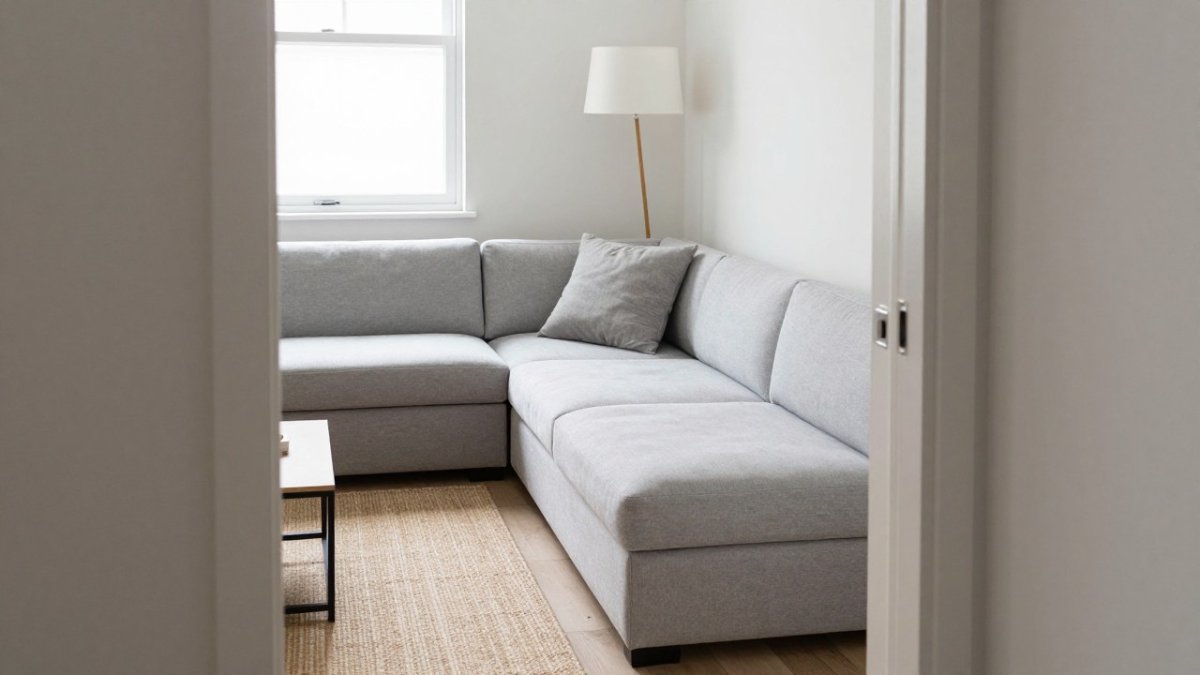
A few rules that hold up in practice:
- Put the corner unit in the room's corner, not mid-wall.
- Use a slim console behind a floating sofa to define the walkway.
- Choose a low-back design so the room doesn't feel walled in.
- Skip the chaise if it eats the only path to the door.
What most guides miss is the doorway test. If you can't walk a laundry basket through the gap without turning sideways, the arrangement is too tight.
Comfort, Cushion Firmness, and Seat Depth to Check Before You Buy
Seat depth is the single most important comfort number, and it should match how you sit: around 20 to 22 inches for upright sitting, deeper for lounging. Cushion firmness then decides whether that depth feels supportive or sink-in soft.
Seat height matters too, especially for older family members who need to stand up easily. A lower seat looks modern but can be harder to rise from.
- Seat depth: measure from front edge to back cushion.
- Seat height: check it against the people who sit most.
- Cushion firmness: firm for support, soft for lounging.
- Back height: low backs keep narrow rooms open.
If you're weighing an armless minimalist design, our guide to armless sofas, pros and cons covers how seat depth and arm style affect comfort.
Long-Term Ownership: Costs, Repairability, and Material Transparency
Long-term cost is where modular sofas earn their keep, because you can replace a single worn module or cover instead of the whole sofa. Ask three questions before buying: can I buy one replacement module, can I buy replacement covers, and what is the frame made of?
Repairability is the quiet advantage of a component system. A sagging seat cushion is a swap, not a new sofa. To compare designs on ownership cost, build a simple five-year view:
- Replacement modules: confirm single units are sold separately and ask whether the same fabric and color will remain available. A module you cannot match in two years is not truly replaceable.
- Replacement covers: check they're sold after purchase and whether seat-cushion covers are included. Covers that are dry-clean only shift the cost to a professional cleaning bill.
- Warranty coverage: ask what the warranty covers, frame, cushions, covers, and mechanisms are often treated separately, and how long each part is covered. A long frame warranty with a short cushion warranty tells you where the maker expects wear.
- Cleaning costs: machine-washable covers you can launder at home cost far less over time than professional cleaning or replacement.
- Expansion cost: adding a module later should cost roughly the price of that module, not a new sofa. Confirm the system stays in production and that connectors are standardized.
- Frame material: ask what the frame is made of and how it's joined. Kiln-dried hardwood and reinforced corner blocks are common markers of a frame built to be repaired rather than replaced.
- Material transparency: request fabric content, foam density, and care details. Foam density affects how quickly a seat cushion loses shape, and a higher-density foam usually lasts longer before replacement.
Pricing for modular sofas varies by retailer, size, and fabric, so confirm current prices directly with each seller rather than relying on a listing snapshot. For a deeper look at value versus trade-offs, read whether modular furniture is worth it for apartments.
Watch out: a low upfront price can hide a short cushion warranty and covers that are not sold separately, that combination usually means replacing the whole sofa sooner than expected.
Choosing Your Modular Sofa and Styling It with Your Decor Essentials
Styling a modular sofa starts with the room's palette, then layers in texture through throws, rugs, and lighting. A neutral sofa is the easiest base, because it lets accent pieces do the talking.
This is where Your Decor Essentials fits naturally. Our curated selection of abstract sculptures, resin accents, and functional lighting adds visual interest without fighting the sofa. A sculptural piece on a console behind the sofa, or a warm floor lamp in the corner, finishes a flexible layout.
- Start with a neutral cover and one accent color.
- Add texture with a woven rug and throws.
- Use lighting to define the seating zone.
- Place one statement sculpture as a focal point.
general furniture care guidance from the American Cleaning Institute is a useful reference for keeping upholstery and covers in shape. For help mixing styles once the sofa is in place, our guide on how to mix modern furniture styles shows how to pull the look together.
Flexible living spaces ask a lot of a sofa, and the right modular design answers by changing shape with you. Your Decor Essentials curates the finishing pieces that make a modular sofa feel intentional: abstract sculptures, resin accents, and functional lighting that add visual interest and warmth. Browse the collection to find the accents that complete your layout, and let your seating setup reflect your own style.
Frequently Asked Questions
What is a good sectional sofa for a narrow living room?
Look for a modular sofa with a shallow seat depth and a straight or L-shaped layout that sits flush against one long wall. Armless seats and corner units let you keep the footprint tight, and an ottoman can double as seating or a coffee table without blocking the walkway. Measure your room first, then map the walkway you want to keep clear, and choose modules that fit inside that plan. Reversible chaise modules give you flexibility if you later move the sofa to another wall.
Are modular sofas a good choice for small living rooms?
Yes, when you choose the right configuration. Modular sofas for small spaces work best with fewer, deeper modules rather than many shallow ones, so you get comfortable seating without a long footprint. An armless seat paired with a corner unit can form a compact L-shape, and individual modules can be moved or added later. Avoid oversized chaise sections in tight rooms, and check that each module fits through your door and hallway before ordering.
Can modular sofa pieces be rearranged into different layouts?
Most modular sofa configurations can be rearranged, which is the main reason they suit flexible living spaces. You can switch a chaise from one end to the other, split a long sectional into two smaller seating groups, or add an ottoman as a temporary extension for guests. Check how the modules connect, whether they use brackets or simply sit side by side, and confirm the covers are removable so you can clean them after moving pieces around.
What are the disadvantages of modular sofas?
Modular sofas can cost more per seat than a fixed sofa, and the gaps between modules sometimes let crumbs and pet hair collect, so vacuum the seams regularly. Some designs have limited color options, and delivery may arrive in several boxes that you assemble yourself. Washable covers help with maintenance, but check the care instructions before buying. Weigh these trade-offs against the flexibility you gain, especially if you plan to move or reconfigure your room.