 How-to
Can You Mix Abstract Sculptures With Vintage Accessories?
Last Updated: November 13, 2026
Quick Summary
Mixing abstract sculptures with vintage home accessories works because the two styles balance each other. The clean lines of a modern piece keep an old room from feeling heavy, while worn wood and brass keep a sleek sculpture from feeling cold. Aim for roughly two-thirds of one style and one-third of the other in any single room.
- Give each abstract sculpture its own breathing room and pair it with one contrasting vintage item per surface.
- A pedestal or plinth raises a sculpture to eye level and turns it from an accessory into a focal point.
- Use the 3-5-7 rule to group objects in odd numbers at varying heights for a natural look.
- Place a felt or cork pad under stone pieces sitting directly on antique wood to prevent scratches.
- Buy the sculpture new and the vintage pieces secondhand to save money and build a personal mix.
Table of Contents
- Why Abstract Sculptures and Vintage Accessories Work Together
- How to Style Abstract Sculptures in Living Room Spaces
- Mixing Vintage and Modern Decor: A Framework for Balance
- Mixing Abstract Sculptures With Vintage Home Accessories DIY
- How to Avoid Clutter When Mixing Vintage and Modern Decor
- Material Compatibility: Pairing Resin and Stone With Antique Wood
- Lighting and Framing Techniques for a Timeless Look
- Budget-Friendly Sourcing for Curated Decor
- Choosing Your First Abstract Sculpture and Vintage Pairing
- Frequently Asked Questions
Why Abstract Sculptures and Vintage Accessories Work Together
Mixing abstract sculptures with vintage home accessories works because the two styles balance each other. The clean lines of a modern piece keep an old room from feeling heavy. The worn wood and brass of a vintage find keep a sleek sculpture from feeling cold.
At Your Decor Essentials, we see this pairing as one of the easiest ways to make a room feel collected rather than bought all at once. A new abstract form gives the eye something crisp. A vintage accessory gives it something with history.
The trick is not to let either side win. You want a conversation, not a contest.
The Visual Weight of Opposites
Visual weight is how much attention an object pulls. A dark, chunky vintage cabinet feels heavy. A pale, open resin sculpture feels light.
Designers lean on this contrast on purpose. A heavy piece anchors a corner. A light piece lifts the space around it. Put them near each other and the room reads as balanced.
Here is the framework we use:
- Heavy + light: a solid antique chest with a slim abstract sculpture on top
- Rough + smooth: weathered wood beside polished resin
- Old + new: a vintage frame next to a modern form
That push and pull is the whole point. You are not hiding the age of one piece or the newness of the other. You are letting each one do its job.
How to Style Abstract Sculptures in Living Room Spaces
To style abstract sculptures in a living room, give each piece its own breathing room, match it to the scale of the surface, and pair it with one vintage item that contrasts in texture. One sculpture per surface is usually enough. Two competing pieces on the same table fight for attention.
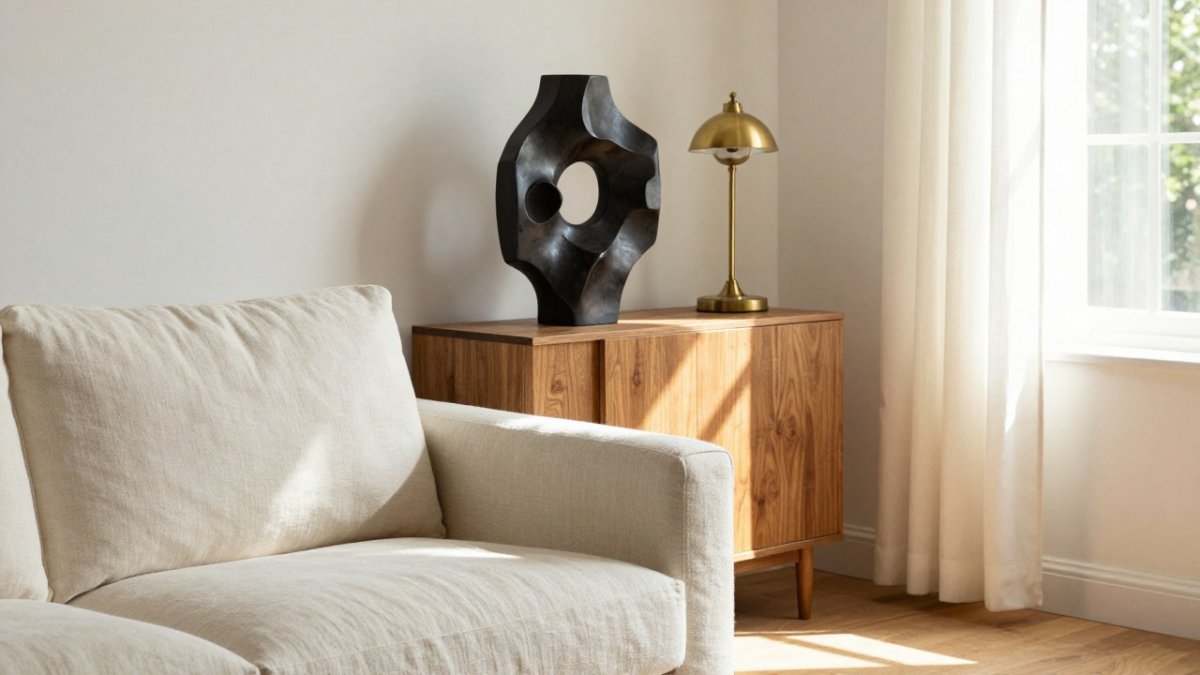
Start with the largest surface you have, like a console or a sideboard. Place the sculpture slightly off center. Then add the vintage piece beside it, not in front of it.
A few rules we follow:
- Keep the sculpture taller or wider than the vintage accessory, not both
- Leave at least a hand's width of empty space around each object
- Group in odd numbers when you use more than one item
For a deeper walkthrough, our guide on styling abstract sculptures in your living room walks through full room setups.
Placement Rules for Sculptural Forms
Placement comes down to sightlines. A sculptural form should sit where you naturally look when you enter or sit down. That might be a console across from the sofa, a shelf at eye level, or a side table beside your reading chair.
Avoid the two most common mistakes. First, do not line objects up like soldiers along a shelf. Second, do not push a sculpture into a corner where only half of it shows.
Sizing matters too. A sculpture on a console table should feel like it belongs there, not like it is about to tip. If you are unsure, our guide on sizing abstract sculpture for a console table breaks down the proportions.
Pedestals and Plinths: The Missing Layer
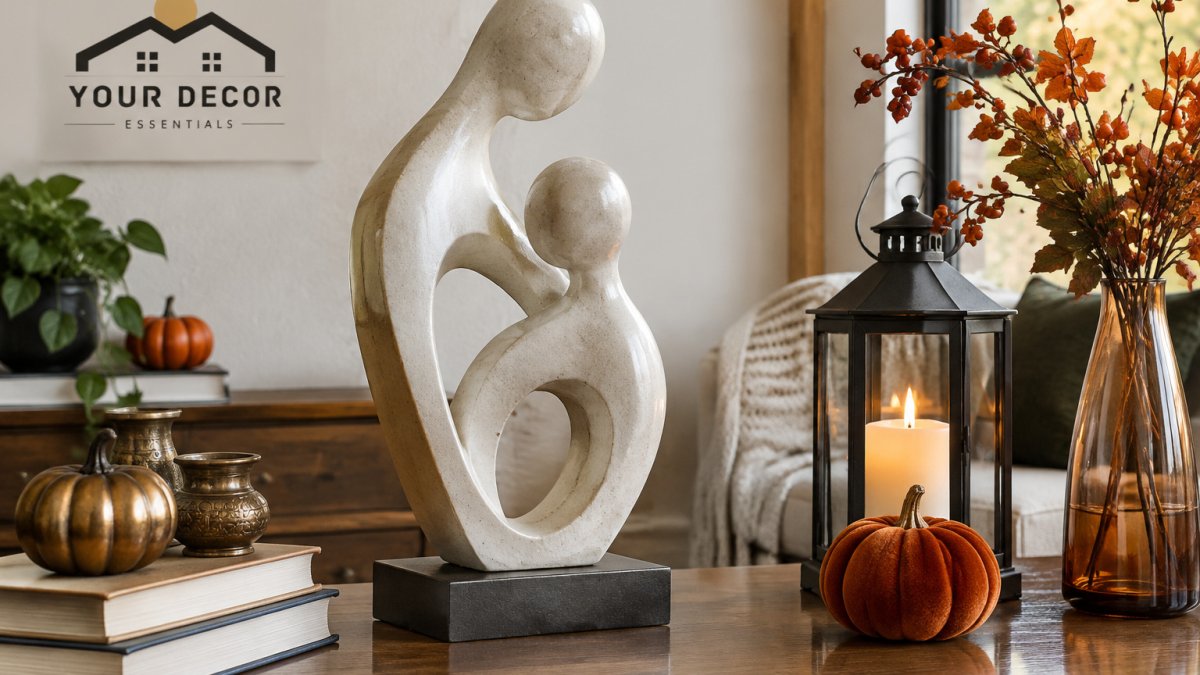
Most styling advice stops at the tabletop. A pedestal or plinth is what turns a sculpture from an accessory into a focal point, and it is the layer competitors skip. A plinth raises the piece to eye level, isolates it from surrounding clutter, and gives a small abstract form the presence of a gallery object.
Use these guidelines:
- Height: the top of the plinth should bring the center of the sculpture to roughly eye level when seated, or slightly above when standing. A plinth that is too low makes the piece read as a doorstop.
- Footprint: the plinth base should be wider than the sculpture's base by at least a few inches on each side so the piece does not look precarious.
- Material: a painted MDF or plaster plinth reads clean and modern against vintage wood; a raw wood plinth ties back to antique furniture but can look heavy in a small room.
- Pairing: place one vintage accessory at the foot of the plinth, not on top of it. The plinth is for the sculpture alone.
Watch out: a tall plinth in a walkway becomes a hazard. Keep plinths out of traffic paths and away from the swing of doors.
Shelf Styling for Abstract Forms
Shelves are where abstract sculptures most often get lost. The fix is to treat each shelf as its own composition rather than filling every inch.
- Put the sculpture on a shelf at or near eye level, not the top or bottom shelf
- Leave the shelf beside it partly empty so the form has negative space to read against
- Mix one vintage book stack or bowl per shelf, not three
- Vary shelf heights across the unit so the eye moves diagonally rather than in a straight line
A common pattern is to alternate a sculpture-heavy shelf with a book-and-vintage-object shelf, which keeps the unit from looking like a store display.
Focal Point and Layering
A living room reads best with one clear focal point. If the fireplace or a large window already holds that role, the sculpture should support it rather than compete. Place the sculpture where it can be seen from the main seating area, and layer a vintage textile or a low bowl in front of it only if the sculpture is tall enough to rise above the layer.
For more on displaying smaller accents without crowding, see our tips on displaying resin accents.
Mixing Vintage and Modern Decor: A Framework for Balance
Mixing vintage and modern decor works when you decide the ratio before you shop. Pick which style leads and which one supports. In most homes, vintage leads and modern accents support, or the reverse. Either way, one side sets the tone and the other adds contrast.
We use a simple split. Aim for roughly two-thirds of one style and one-third of the other in any single room. That keeps the space from looking like a showroom or a flea market.
Then check the color palette. A neutral groundwork, like cream, warm white, or soft gray, lets both styles sit together. Bold vintage colors and bright modern finishes compete. Neutrals let them talk.
The 3-5-7 Rule and Visual Weight
The 3-5-7 rule is a styling guideline for grouping objects in odd numbers, usually three, five, or seven pieces, at varying heights. Odd numbers feel more natural to the eye than even ones.
Here is how it works with a mixed group:
| Group Size | What to Use | Example |
|---|---|---|
| 3 items | 1 sculpture, 2 vintage pieces | Resin form, brass candlestick, old book |
| 5 items | 2 sculptures, 3 vintage pieces | Two small forms, a bowl, a frame, a vase |
| 7 items | 3 sculptures, 4 vintage pieces | A fuller shelf or mantel display |
Vary the heights within each group. Tall, medium, short, then repeat. This keeps the eye moving and stops the display from looking flat.
Mixing Abstract Sculptures With Vintage Home Accessories DIY
You can build this look yourself without a designer. The DIY approach is to shop your own home first, then fill the gaps with one or two new pieces. Most people already own vintage items they have stopped noticing.
Try this process:
- Pull every vintage accessory you own into one room
- Pick the three pieces you like most
- Choose one abstract sculpture to anchor them
- Test the group on a table before you commit
- Photograph it, live with it a week, then adjust
The photo step matters. A phone picture shows balance problems your eye misses in person.
A common mistake is buying too much at once. Start with one sculpture and one vintage pairing. Add more only after you see how the first group sits in the room.
How to Avoid Clutter When Mixing Vintage and Modern Decor
Clutter comes from too many objects, not from mixing styles. The fix is editing. Keep the pieces that earn their space and store the rest.
Our rule: if an object does not add contrast, height, or color, it goes. That clears room for the pieces that matter.
Try these habits:
- Cap yourself at one display group per surface
- Rotate accessories seasonally instead of displaying everything
- Keep at least one empty surface in each room
- Store extras in a bin, not on a shelf
Negative space is not wasted space. It is what lets a sculpture and a vintage piece stand out. For more on displaying smaller accents without crowding, see our tips on displaying resin accents.
Material Compatibility: Pairing Resin and Stone With Antique Wood
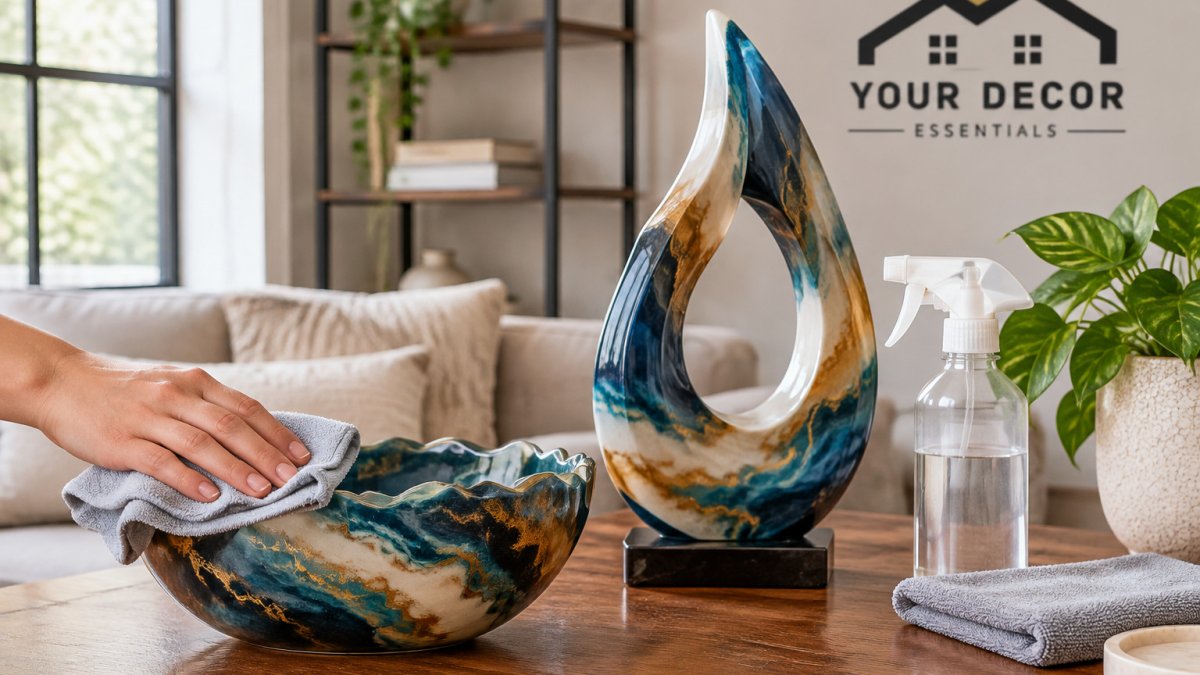
Resin and stone pair well with antique wood because the contrast in texture and sheen makes both materials look better. Smooth resin beside rough, aged wood creates material contrast. Stone adds weight and a matte finish that grounds a lighter modern piece. But the pairing works best when you account for how the materials actually behave next to each other, hardness, porosity, weight, and finish, not just how they look in a photograph.
Hardness and Surface Risk
Every material has a hardness that determines whether it will scratch, dent, or dull the surface it sits on. Resin is relatively soft and can mar if dragged across a gritty antique surface. Stone is harder than most wood finishes and can leave pressure marks or hairline scratches on soft pine or veneered tops. A common pattern is to place a felt or cork pad under any stone piece that sits directly on antique wood, and to lift, never slide, a resin sculpture when repositioning it.
Watch out: a heavy stone base set directly on a thin veneer can telegraph a ring or dent over time, especially in a warm room where the veneer softens.
Porosity and Moisture
Antique wood is porous and responds to humidity; resin and stone do not. That mismatch matters near windows, radiators, and bathrooms. A resin sculpture placed on a raw or oiled antique wood surface can trap moisture against the wood and leave a darker patch. Sealed or lacquered wood is more forgiving. If the wood is unsealed, keep a small gap or a protective coaster between the two.
Weight Distribution
A tall abstract resin form is light but top-heavy; a stone piece is heavy but stable. On an antique sideboard with slender legs, a heavy stone sculpture placed off-center can stress a joint. Distribute weight toward the center of the surface and keep the heaviest piece on the most structurally sound furniture. If the antique piece is wobbly, fix the wobble before you style it, a sculpture will amplify any instability.
Sheen and Finish Matching
Finish is where most pairings succeed or fail. A high-gloss resin on polished mahogany can look too slick because both surfaces reflect light the same way. A matte resin or a stone form sits better with older, oiled wood because the contrast in reflectivity gives the eye something to read. The general rule: match the level of shine, not the color. Two matte surfaces feel calm; one glossy against one matte feels intentional; two high-gloss surfaces compete.
A few pairings that work:
- Matte resin + oak or walnut: warm and calm, low reflectivity on both sides
- Stone + painted vintage wood: crisp contrast, stone's weight anchors the lighter paint
- Glossy resin + raw or distressed wood: bold, high contrast, best in small doses
- Sealed stone + lacquered wood: the most forgiving combination for high-traffic surfaces
Metal and Glass Interactions
Bronze and brass develop patina that can transfer to nearby porous surfaces, so keep unsealed metal away from raw wood and light-colored stone. Glass shelves are non-porous and easy to protect, but they show every scratch and dust line, a matte sculpture reads better on glass than a glossy one because it does not double the reflection.
If you are deciding between materials, our guide on abstract sculpture materials for modern homes compares resin and stone in detail.
Lighting and Framing Techniques for a Timeless Look
Lighting decides whether a sculpture reads as art or as clutter. A piece in shadow disappears. A piece under harsh light looks flat. Aim for soft, angled light that brings out texture and form.
Use a lamp with a warm bulb placed to the side of the sculpture, not directly above it. Side light casts shadows that show the shape of an abstract form. Overhead light washes it out.
For vintage pieces, framing matters. An ornate frame can hold its own next to a modern sculpture, but keep the frame's color quiet. A heavy gold frame plus a bright sculpture is too much. Let one piece be the focal point.
Our guide on lighting abstract art sculptures at home covers bulb types and placement in more depth.
Budget-Friendly Sourcing for Curated Decor
A curated look does not require a big budget. It requires patience and a good eye. Mix price points instead of buying everything from one store.
Where we would look:
- Estate sales and thrift stores for vintage accessories
- Local makers and small shops for abstract pieces
- Online curated collections for one statement sculpture
- Facebook Marketplace and consignment shops for vintage wood
Buy the sculpture new and the vintage pieces secondhand. That split usually saves money and gives you a more personal mix. Check condition carefully on vintage wood, especially joints and veneer.
Prices vary by piece and material, so check our site for current pricing on sculptures and lighting.
Choosing Your First Abstract Sculpture and Vintage Pairing
Start with one sculpture and one vintage piece that clearly contrast. Pick a sculpture whose color works with your room's neutral groundwork. Then choose a vintage accessory in a different texture, like aged brass or worn wood.
Hold both pieces side by side before you buy. If they feel like they belong to different rooms, they probably do. If they feel like they are in conversation, you have your pairing.
A good first pick is a mid-size matte resin sculpture and a vintage brass or wood accent. It is forgiving, easy to place, and works in most living rooms.
The hardest part is not the shopping. It is trusting that two very different pieces can share a room. They can, as long as you give each one space and let contrast do the work.
At Your Decor Essentials, we curate abstract sculptures and resin accents designed to sit alongside the vintage pieces you already love. Our collection focuses on distinctive, non-mass-produced decor, plus functional lighting that helps each piece read clearly. Browse the collection to find a sculpture that fits your space, then pair it with the vintage accessory you have been waiting to use.
Frequently Asked Questions
Can you mix abstract sculptures with vintage home accessories?
Yes. The contrast between clean-lined abstract sculptures and ornate vintage pieces creates visual interest and a curated aesthetic. The key is balance: let the sculpture act as a modern anchor while vintage accessories add warmth and history. Use a neutral groundwork, vary textures, and keep the arrangement intentional so the room feels collected rather than cluttered. Pairing resin or stone forms with antique wood or brass often yields the strongest design harmony.
How do you style an abstract sculpture in a living room without it looking out of place?
Start by choosing a focal point, such as a console or coffee table, and place the sculpture there with negative space around it. Mix in one or two vintage accessories of different heights and textures, like a brass candlestick or a small antique bowl. Keep the color palette cohesive by repeating one tone from the sculpture in the vintage pieces. This creates spatial balance and prevents the sculpture from feeling like an afterthought.
What is the 3-5-7 rule in interior design, and does it help with mixing vintage and modern decor?
The 3-5-7 rule suggests grouping objects in odd numbers, such as three, five, or seven items, to create a pleasing composition. When mixing vintage and modern decor, use this rule to combine abstract sculptures with vintage accessories. For example, group one sculpture with two vintage pieces for a total of three, or three sculptures with four vintage items for seven. Odd numbers encourage the eye to move naturally and help avoid a rigid, symmetrical look.
How can I avoid clutter when mixing vintage and modern decor?
Edit aggressively. Choose one statement abstract sculpture per surface and pair it with no more than two vintage accessories. Use negative space as a design element, and keep at least one-third of any shelf or tabletop empty. Store or rotate extra pieces rather than displaying everything at once. A curated aesthetic relies on restraint, so let each object breathe and maintain a clear focal point in every vignette.